Murata Electronics Corporation 2 6/2/2021
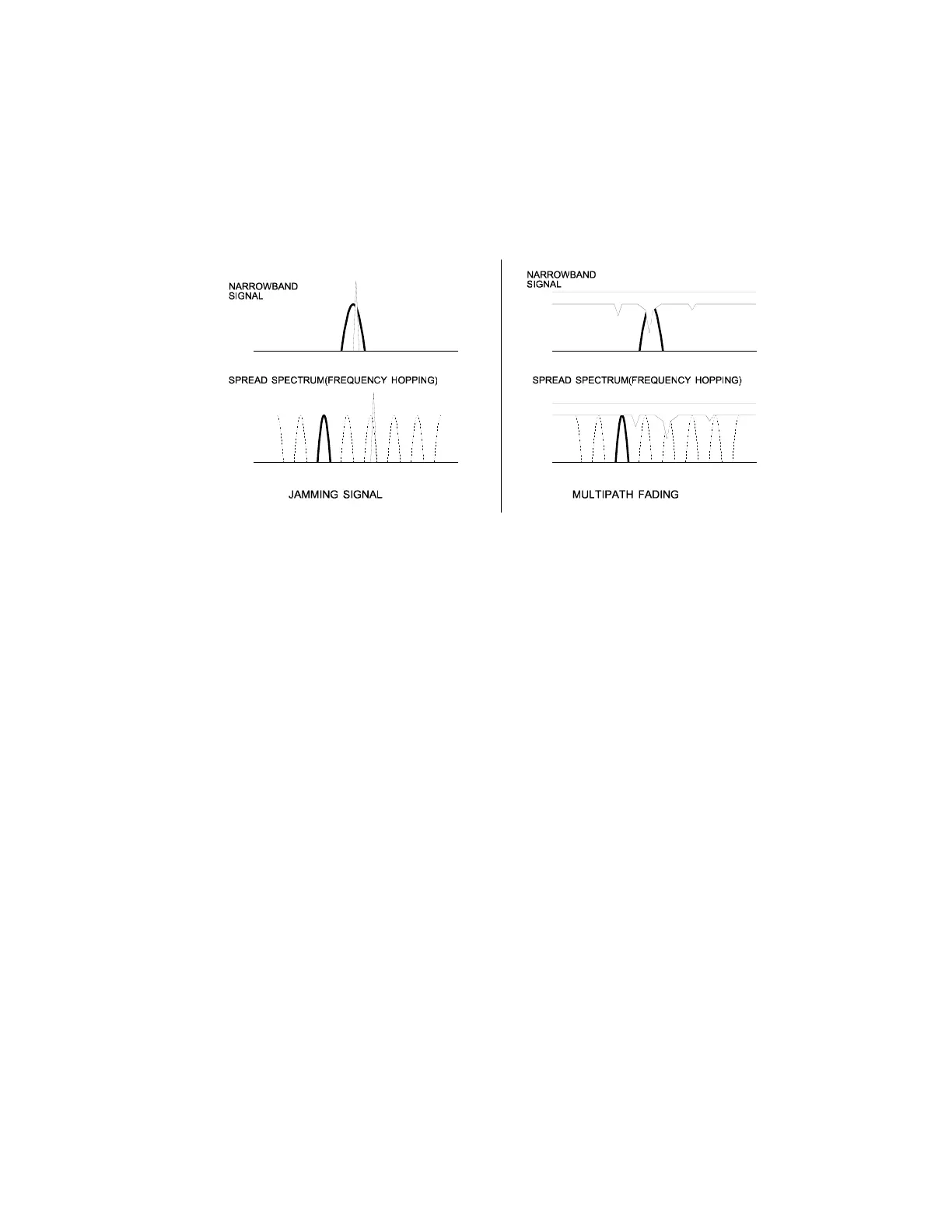
Spread spectrum reduces the vulnerability of a radio system to both interference from
jammers and multipath fading by distributing the transmitted signal over a larger region
of the frequency band than would otherwise be necessary to send the information. This
allows the signal to be reconstructed even though part of it may be lost or corrupted in
transit.
Figure 1
Narrowband vs. spread spectrum in the presence of interference
1.2 Frequency Hopping vs. Direct Sequence
The two primary approaches to spread spectrum are direct sequence (DS) and frequency
hopping (FH), either of which can generally be adapted to a given application. Direct
sequence spread spectrum is produced by multiplying the transmitted data stream by a
much faster, noise-like repeating pattern. The ratio by which this modulating pattern
exceeds the bit rate of the baseband data is called the processing gain, and is equal to the
amount of rejection the system affords against narrowband interference from multipath
and jammers. Transmitting the data signal as usual, but varying the carrier frequency
rapidly according to a pseudo-random pattern over a broad range of channels produces a
frequency hopping spectrum system.


 To Next Page