Murata Electronics Corporation 3 6/2/2021
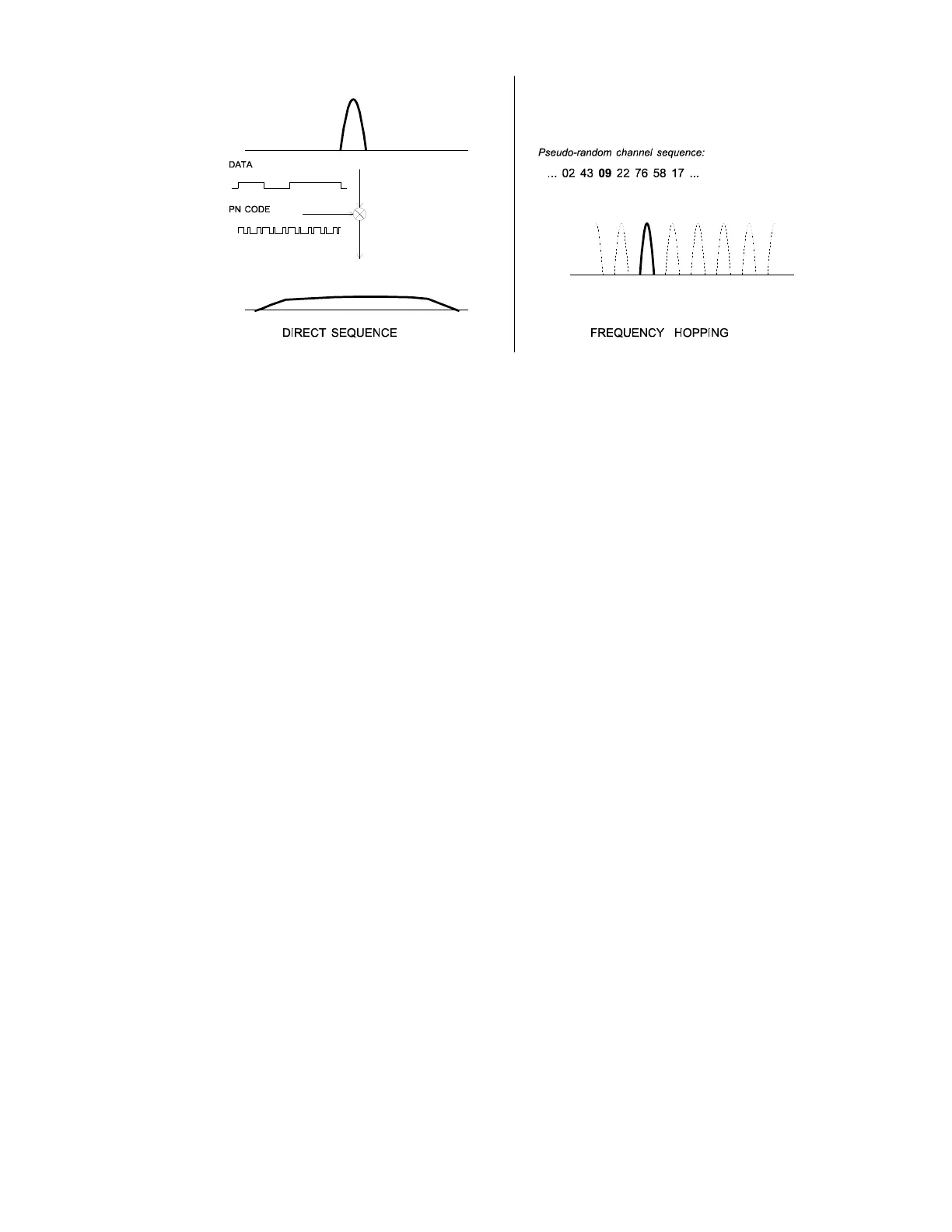
Figure 2
Forms of spread spectrum
One disadvantage of direct sequence systems is that due to spectrum constraints and the
design difficulties of broadband receivers, they generally employ only a minimal amount
of spreading (typically no more than the minimum required by the regulating agencies).
For this reason, the ability of DS systems to overcome fading and in-band jammers is
relatively weak. By contrast, FH systems are capable of probing the entire band if
necessary to find a channel free of interference. Essentially, this means that a FH
system will degrade gracefully as the channel gets noisier while a DS system may
exhibit uneven coverage or work well until a certain point and then give out completely.
Because it offers greater immunity to interfering signals, FH is often the preferred
choice for co-located systems. Since direct sequence signals are very wide, they tend to
offer few non-overlapping channels, whereas multiple hoppers may interleave with less
interference. Frequency hopping does carry some disadvantage in that as the transmitter
cycles through the hopping pattern it is nearly certain to visit a few blocked channels
where no data can be sent. If these channels are the same from trip to trip, they can be
memorized and avoided; unfortunately, this is generally not the case, as it may take
several seconds to completely cover the hop sequence during which time the multipath
delay profile may have changed substantially. To ensure seamless operation throughout
these outages, a hopping radio must be capable of buffering its data until a clear channel
can be found. A second consideration of frequency hopping systems is that they require
an initial acquisition period during which the receiver must lock on to the moving carrier
of the transmitter before any data can be sent, which typically takes several seconds. In
summary, frequency hopping systems generally feature greater coverage and channel
utilization than comparable direct sequence systems. Of course, other implementation
factors such as size, cost, power consumption and ease of implementation must also be
considered before a final radio design choice can be made.
As an additional benefit, RF spectrum has been set aside at 2.4 GHz in most countries
(including the U.S.) for the purpose of allowing compliant spread spectrum systems to
operate freely without the requirement of a site license. This regulatory convenience
alone has been a large motivation for the industry-wide move toward spread spectrum.


 To Next Page