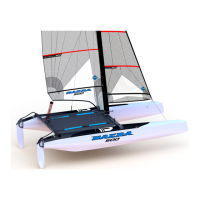
Lay the mast lengthwise on the boat so that the mast rests on the beams with the base forward, and
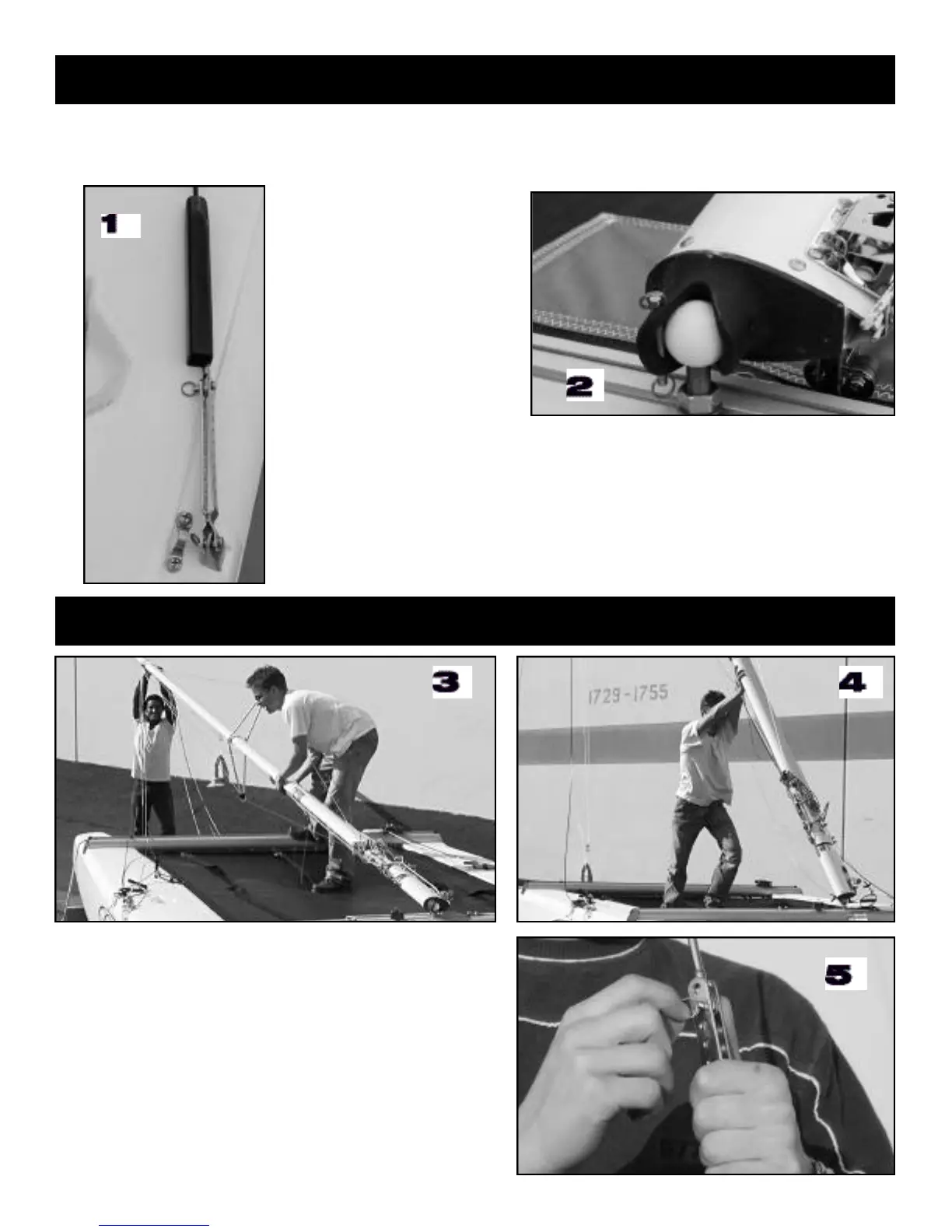
the sail slot pointing down. Slide the shroud covers over the shroud wires, and pin the shrouds in the
top hole of the shroud adjusters (1).
Walk the mast back-
wards until the base is
even with the mast ball.
Rotate the mast 90
d e gr e e s, and pin the
mast base onto the mast
b a l l . You must keep the
mast turned 90 degr e e s
until it is ve rtical to
avoid damage (2).
M a ke sure the rigging is clear of the rudders and other
o b s t ru c t i o n s, and the fo r e s t a y is not tangled in the shrouds
b e fore you begin to step the mast.
One person stands on the tramp near the rear beam, while a second per-
son raises the mast up to the person on the tramp (3). Raise the mast to
your shoulders and walk forward on the tramp while extending your arms
over your head until the mast is upright, being held by the shrouds (4).
Keep forward pressure on the mast as the second per-
son pins the forestay to the stay adjuster that is
attached to the bridle wires (5). Tighten the rig by put-
ting weight on the trapeze wires and adjusting the pins
in the appropriate shroud chain plate holes. Adjust so
the mast is raked slightly aft, or straight up. Rake
adjustment can be set according to boat handling or
wind conditions.
Remove the mast step pin to allow the mast to rotate
freely while sailing.
CAUTION: Check for overhead wires before raising or lowering the mast. A mast which comes in
contact with electrical power lines can cause serious injury or death.
CAUTION: Check for overhead wires before raising or lowering the mast. A mast which comes in
contact with electrical power lines can cause serious injury or death.



 To Next Page