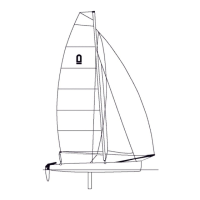
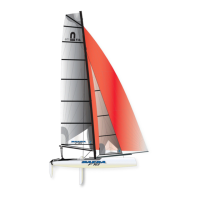
This document is the assembly manual for the Nacra 500 MK2 catamaran, providing instructions for setup, rigging, and maintenance, along with a glossary and parts list.
Function Description:
The Nacra 500 MK2 is a high-performance catamaran designed for sailing. It is intended for empowering sailors to achieve their best performance on the water. The manual guides users through the entire process of assembling the boat from its components, rigging the sails, and preparing it for sailing, as well as providing instructions for post-sailing procedures and maintenance.
Important Technical Specifications:
While detailed technical specifications are not explicitly listed in a consolidated section, various parts and assembly steps imply certain specifications:
- Dimensions: The manual mentions spacing hulls approximately 2.5m apart during beam assembly, and a front crossbar pre-bend measurement of 15mm.
- Fasteners and Tools: Specific tools and fastener sizes are frequently mentioned, such as a torque wrench for bolts (not to exceed 30 Nm), 5/16 or 8 mm hex sockets, 22mm or 7/8 inch wrenches, 19mm or 1/2 inch wrenches, 17mm wrench for diamond wire tension, 3mm and 4mm hex keys, T20 torx bits, flat head and Phillips head screwdrivers, long nose pliers, and adjustable spanners.
- Rope and Wire Sizes: Various rope and wire diameters are specified for different systems:
- Main halyard: 5mm
- Mainsheet: 8mm
- Jib sheet: 8mm
- Tramp lace rear: 3mm
- Main Downhaul: 5mm
- Righting line: 8mm
- Trapeze line: 6mm
- Trapeze shock cord: 5mm
- Righting line shock cord: 5mm
- Spinnaker sheet: 8mm
- Halyard shock cord (spinnaker): 3mm
- Spin tackline: 5mm
- Spin halyard: 5mm
- Snufferring tension line: 3mm
- Spin bale line: 3mm
- Spin bale up line: 4mm
- Spinsheet shockcord: 4mm
- Diamond wires: 2x
- Shroud: 2x
- Trapeze wires steel: 2x (6mm 1/4 shackle)
- Tension Settings: The manual refers to a "Trimsheet" for determining diamond tension settings (e.g., 170kg, 190kg, 220kg, 250kg for different wind strengths and sea states) and forestay tension (100kg). Mast rake is also a key setting, measured by angle difference between transom and mast, with specific values (e.g., 5.2°, 5.6°) for different conditions.
- Blocks and Shackles: Various block sizes (e.g., 32mm for jib sheet, 16mm double blocks for Cunningham, 29mm T2 block for spinnaker halyard, 40mm carbo pivoting lead block for spinnaker halyard cleat, 57mm carbo ratchmatic single spinnaker blocks) and shackle sizes (e.g., 8mm 5/16, 6mm 1/4, D 5mm hex) are listed.
Usage Features:
- Empowering Sailors: The core philosophy of Nacra is to empower sailors by providing high-quality equipment that allows them to push boundaries and reach new heights.
- Comprehensive Manual: The manual is designed to familiarize users with the operation and maintenance of their new Nacra, providing important safety information and detailed assembly instructions.
- Dealer Network Support: An extensive global dealer network is available to provide service, support, and genuine spare parts to ensure optimal performance.
- Sailing Experience Guidance: For first-time sailboat owners or those unfamiliar with catamarans, the manual recommends obtaining handling and operating experience from Nacra Sailing experience centers, National Sailing Federations, or yacht clubs.
- Trimsheet for Performance: A detailed trimsheet is provided to guide users on optimal mast rake, diamond tension, forestay tension, and jib block position based on wind strength and sea state (flat, medium, large).
- Adjustable Systems: The boat features adjustable systems such as kick-up rudders with sensitivity adjustment (by changing rubber size), adjustable trapeze wires (optional), and Cunningham systems for fine-tuning sail performance.
- Spinnaker System Options: The manual covers both snuffer and furling spinnaker systems, offering flexibility in how the spinnaker is deployed and retrieved.
- Divisible Bowsprit: The bowsprit is divisible, likely for easier transport and storage.
Maintenance Features:
- Regular Cleaning: Rinse the entire boat with fresh water after each use, flushing all blocks and fittings thoroughly.
- Sail and Trampoline Inspection: Regularly check sails and trampoline for rips, tears, or loose stitching, and repair immediately to prevent further damage. Keep trampoline lacing tight.
- Fastener Security: Tape all split rings and cotter pins to prevent loss. Periodically check all shackles, clevis pins, and fasteners for loosening or wear and replace as needed.
- Batten Care: Check for broken or delaminated battens. Never sail with damaged battens. Release batten tension when storing sails.
- Sail Storage: Rinse sails with fresh water, ensure they are dry, and store them away from UV light and moisture.
- Beam Bolt Torque: Always check beam bolts to ensure proper torque.
- Hull Inspection: Check hulls for excessive wear from beaching/dragging and for leaks at all hull fittings. Repair fiberglass damage and seal fittings with silicone sealant if leaks are detected.
- Water in Hull: Check for and remove any water in the hull using a sponge.
- Mast Inspection: Regularly inspect mast ball for wear, and mast for water tightness and diamond wire wear. Seal fittings with silicone. Check diamond wire attachment points, turnbuckles, and seizing wire.
- Rigging Tension: Avoid storing the Nacra with rigging tensioned to race settings for long periods.
- Line and Wire Inspection: Periodically check for and replace frayed, worn, or kinked wires, shock cord, and lines.
- Traveler Car Maintenance: Periodically check bearings in the traveler car and replace if necessary. Rinse thoroughly with fresh water to free any stuck bearings.
- Trampoline Re-tightening: The trampoline will need re-tightening after the first weeks or uses as the material sets.
- Kick-up Rudder Spring Replacement: Replace the kick-up rudder spring if it can no longer be tensioned sufficiently to keep rudders against the rake rubber blocks during sailing, as a weak spring can lead to heavy steering.

 Need help?

 To Next Page
 General