EasyManua.ls Logo

NAD 4130 - Alignment Method; Necessary Instrumentation for Alignment; Important Notes Before Alignment; Tuning Voltage Oscillator Adjustment

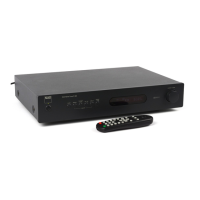
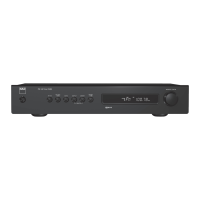
NAD 4130
18 pages
Print Icon
To Next Page IconTo Next Page
To Previous Page IconTo Previous Page
Loading...
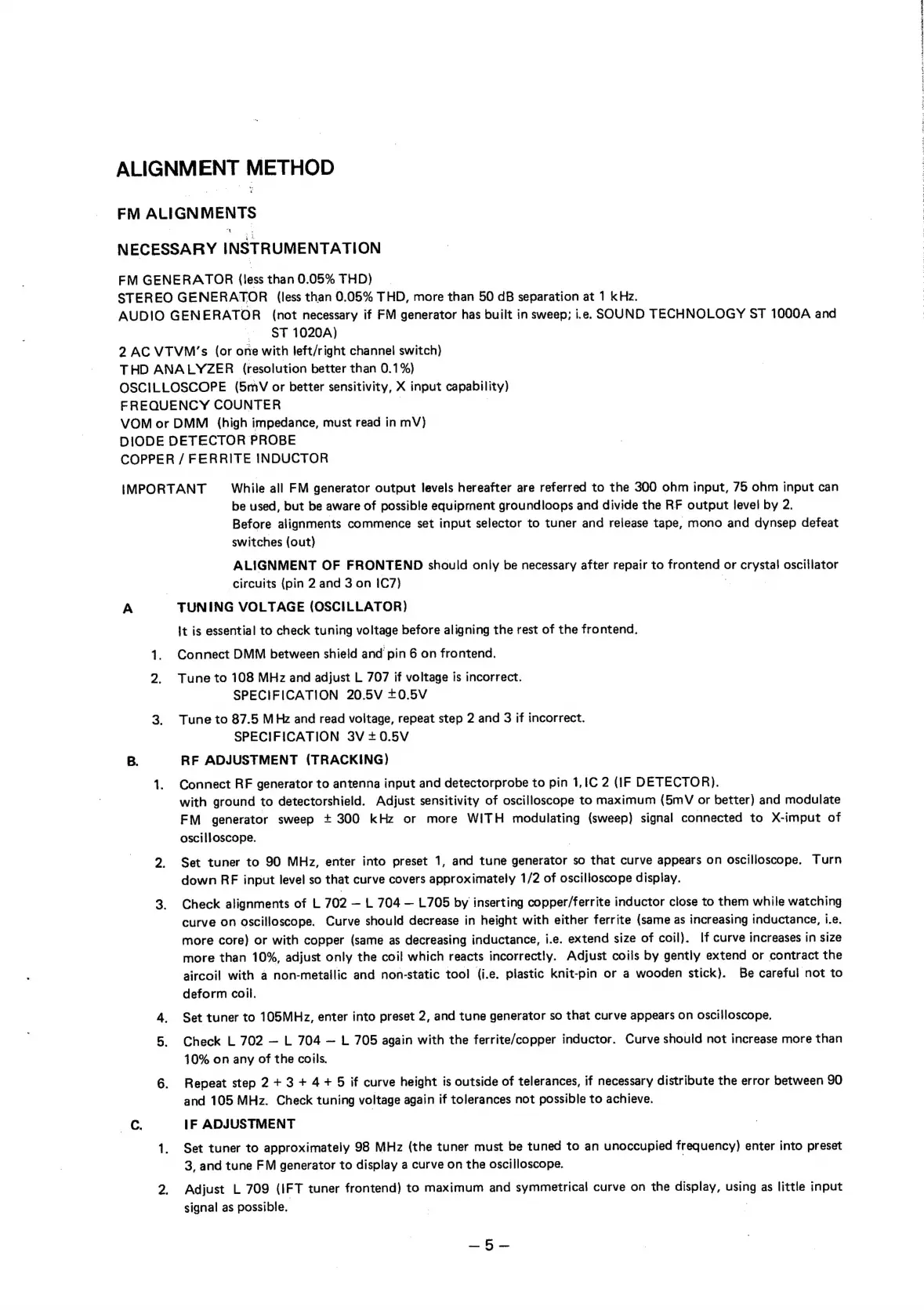
ALIGNMENT
METHOD
FM
ALIGNMENTS
NECESSARY
INSTRUMENTATION
FM
GENERATOR
(less
than
0.05%
THD)
STEREO
GENERATOR
(less
than
0.05%
THD,
more
than
50
dB
separation
at
1
kHz.
AUDIO
GENERATOR
(not
necessary
if
FM
generator
has
built
in
sweep;
i.e.
SOUND
TECHNOLOGY
ST
1000A
and
$T
1020A)
2
AC
VTVM’s
(or
one
with
left/right
channel
switch)
THD
ANALYZER
(resolution
better
than
0.1%)
OSCILLOSCOPE
(5mV
or
better
sensitivity,
X
input
capability)
FREQUENCY
COUNTER
| |
VOM
or
DMM
(high
impedance,
must
read
in
mV)
DIODE
DETECTOR
PROBE
COPPER
/
FERRITE
INDUCTOR
IMPORTANT
While
all
FM
generator
output
levels
hereafter
are
referred
to
the
300
ohm
input,
75
ohm
input
can
be
used,
but
be
aware
of
possible
equiprnent
groundloops
and
divide
the
RF
output
levei
by
2.
Before
alignments
commence
set
input
selector
to
tuner
and
release
tape,
mono
and
dynsep
defeat
switches
(out)
ALIGNMENT
OF
FRONTEND
should
only
be
necessary
after
repair
to
frontend
or
crysta!
oscillator
circuits
(pin
2
and
3
on
IC7)
A
TUNING
VOLTAGE
(OSCILLATOR)
It
is
essential
to
check
tuning
voltage
before
aligning
the
rest
of
the
frontend.
Connect
DMM
between
shield
and
pin
6
on
frontend.
2.
Tune
to
108
MHz
and
adjust
L
707
if
voltage
is
incorrect.
SPECIFICATION
20.5V
+0.5V
3.
Tune
to
87.5
M#z
and
read
voltage,
repeat
step
2
and
3
if
incorrect.
SPECIFICATION
3V+0.5V
B.
RF
ADJUSTMENT
(TRACKING)
1.
Connect
RF
generator
to
antenna
input
and
detectorprobe
to
pin
1,1C
2
(IF
DETECTOR).
with
ground
to
detectorshield.
Adjust
sensitivity
of
oscilloscope
to
maximum
(5mV
or
better)
and
modulate
FM
generator
sweep
+
300
kHz
or
more
WITH
modulating
(sweep)
signal
connected
to
X-imput
of
oscilloscope.
2.
Set
tuner
to
90
MHz,
enter
into
preset
1,
and
tune
generator
so
that
curve
appears
on
oscilloscope.
Turn
down
RF
input
level
so
that
curve
covers
approximately
1/2
of
oscilloscope
display.
3.
Check
alignments
of
L
702
L
704
L705
by
inserting
copper/ferrite
inductor
close
to
them
while
watching
curve
on
oscilloscope.
Curve
should
decrease
in
height
with
either
ferrite
(same
as
increasing
inductance,
i.e,
more
core)
or
with
copper
(same
as
decreasing
inductance,
i.e.
extend
size
of
coil).
If
curve
increases
in
size
more
than
10%,
adjust
only
the
coil
which
reacts
incorrectly.
Adjust
coils
by
gently
extend
or
contract
the
aircoil
with
a
non-metallic
and
non-static
tool
(i.e.
plastic
knit-pin
or
a
wooden
stick).
Be
careful
not
to
deform
coil.
Set
tuner
to
105MHz,
enter
into
preset
2,
and
tune
generator
so
that
curve
appears
on
oscilloscope,
5.
Check
L
702
L
704
L
705
again
with
the
ferrite/copper
inductor.
Curve
should
not
increase
more
than
10%
on
any
of
the
coils.
6.
Repeat
step
2+ 3+
4+
5
if
curve
height
is
outside
of
telerances,
if
necessary
distribute
the
error
between
90
and
105
MHz.
Check
tuning
voltage
again
if
tolerances
not
possible
to
achieve.
es
IF
ADJUSTMENT
1.
Set
tuner
to
approximately
98
MHz
(the
tuner
must
be
tuned
to
an
unoccupied
frequency)
enter
into
preset
3,
and
tune
FM
generator
to
display
a
curve
on
the
oscilloscope.
2.
Adjust
L
709
(IFT
tuner
frontend)
to
maximum
and
symmetrical
curve
on
the
display,
using
as
little
input
signal
as
possible.
—~5-—
Dra
Date
Habe
nar
A
Mant
al

Related product manuals