Need help?
Do you have a question about the NAD T751 and is the answer not in the manual?
Focus on audio performance and essential features over superficial ones, prioritizing music reproduction.
Automatically recognizes and adjusts to loudspeaker impedance for optimal power delivery and performance.
Details the various video, audio, and digital inputs for comprehensive source connectivity.
Highlights user-friendly aspects like remote control functionality and RDS tuning features.
Details power output, distortion, damping factor, and frequency response for the amplifier.
Lists sensitivity, frequency response, and separation for the FM/AM tuner.
Provides dimensions, net weight, and shipping weight of the receiver.
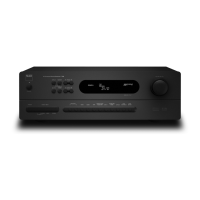
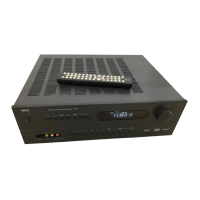
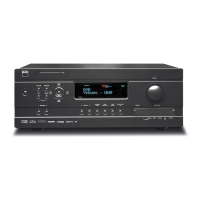
The NAD T751 Surround Sound Receiver is an audio-visual (AV) receiver designed with a primary focus on audio performance, distinguishing itself from other AV receivers that often prioritize features and impressive specifications. NAD's "music first" tradition is evident in the T751, making it an ideal choice for users who desire a system that excels in both surround sound and music reproduction. It aims to faithfully reproduce music, whether in stereo or multi-channel, with or without accompanying video.
The design philosophy of the T751 centers on concentrating on the truly important parts of an AV receiver, eschewing many costly and superfluous features. Given that modern Digital Surround Sound formats allow for wide bandwidth and large dynamic range across all channels, the T751 ensures that all five channels are capable of delivering an equal amount of power. Consistent with NAD's approach, the T751 employs discrete output stages for all channels, including the surround channels. This design choice has been proven over time in numerous acclaimed NAD amplifiers and receivers to offer superior performance compared to integrated output modules often favored by other designs. While integrated modules may deliver decent power under laboratory conditions with an 8-ohm resistor, they can struggle significantly when driving moderately difficult speakers. To address this, the T751 incorporates NAD's patented Impedance Sensing Circuitry (ISC), designed by Bjørn Erik Edvardsen, which is also utilized in a range of other NAD products.
The Impedance Sensing Circuitry (ISC) is a key feature that allows the T751 to achieve maximum performance regardless of the loudspeakers it is driving. This circuitry automatically detects the impedance characteristics of the connected loudspeakers and adjusts its power supply settings to optimally handle that specific load. NAD takes a stance against the "brochure power" approach, which often provides an unrealistic indication of an amplifier's true capabilities. Instead, the ISC topology offers a practical solution, enabling the amplifier to effectively manage dynamics and difficult loads. This approach makes the T751's dynamic capabilities, such as its ability to deliver up to 200 Watts into 2 ohms and up to 40 amps of peak current, more meaningful indicators of its real-world performance.
For digital-to-analog (DAC), analog-to-digital (ADC) converters, and Digital Signal Processors (DSP), the engineers selected the best available components within the budget. The T751 uses Crystal Sigma-Delta DACs and ADCs, each offering 24-bit resolution. The DSP chip, responsible for handling Dolby Digital, DTS, Dolby Pro Logic, and EARS Modes, is also sourced from the renowned manufacturer CrystalM. This combination of components ensures that the integrity of the original signal, whether it's music or an action movie, is maintained with full resolution and dynamics.
The T751 offers significant flexibility, a hallmark of NAD components. It includes five video inputs, with one conveniently located on the front panel for easy connection of devices like game consoles or camcorders, and two audio inputs, allowing users to connect all their sources with ease. Three of the video inputs are compatible with both S-Video and Composite signals. Beyond these standard inputs, the T751 features an external 5.1-channel decoder input, providing an easy upgrade path for future surround sound formats. Three digital inputs are provided—two coaxial and one TOS Link—to accommodate sources with optical outputs. Additionally, pre-amplifier outputs for all channels (Left, Centre, Right, Left Surround, Right Surround, and Subwoofer) allow for easy upgrading of output power. To ensure long-term contact reliability, all speaker terminals are robust binding posts, rather than the common spring clips, and all other audio sockets are gold-plated.
Ease of use is another critical aspect of NAD products, and the Model T751 is no exception. It includes a built-in noise generator, accessible via remote control, which facilitates accurate calibration of the Front, Centre, and Surround speakers. The remote control handset supplied with the Model T751 is also designed to control other NAD components, such as CD players.
For radio enthusiasts, the T751 offers 30 presets that can be programmed randomly, with ten for AM stations and twenty for FM stations. It also features an RDS tuner with RDS PS (Program Service) and RT (Radio Text) capabilities. When tuning into an RDS radio station, the T751 automatically displays the station's name, eliminating the need to remember frequencies. With the touch of a button, RDS RT (Radio Text) will display additional information broadcast by the radio station, such as the presenter or the music currently playing.
Instead of offering numerous different surround sound modes (e.g., Church, Jazz, Stadium), which often clutter and over-complicate many receivers, NAD engineers focused on perfecting the Dolby Digital and Pro Logic decoding and steering. For music listening, the Enhanced Ambience Recovery System (EARS) mode can be engaged to add a natural level of ambience, relying solely on the original information in the signal. This approach aligns with NAD's tradition of providing performance, ease of use, and flexibility that is hard to match. The T751 is equally at home in a system for discerning music lovers as it is for those enjoying videos, CDs, Dolby Digital, or DTS DVDs.
For maintenance, the robust binding post speaker terminals and gold-plated audio sockets are designed for long-term contact reliability, reducing the need for frequent intervention. The system remote control simplifies operation and calibration, making it user-friendly. The focus on quality components and a streamlined design also implies less complexity and potentially greater reliability over time.
 General
| Channels | 5.1 |
|---|---|
| Frequency Response | 20 Hz - 20 kHz |
| Total Harmonic Distortion | 0.08 % |
| Input Sensitivity | 200 mV |
| Tuner Bands | AM/FM |
| Surround System Class | Dolby Digital, DTS |
| Digital Sound Processor (DSP) | Yes |
| DSP Preset Qty | 5 |
| Bass Control | Yes |
| Treble Control | Yes |
| Damping Factor | > 100 |
| Speaker Impedance | 4 - 8 ohms |
| Inputs | digital audio (coaxial) x 2 |
| Outputs | headphones x 1 |
| Input Impedance | 47 kOhm |

 To Next Page