EasyManua.ls Logo

NAD T752 - User Manual

NAD T752
29 pages
Print Icon
To Next Page IconTo Next Page
Loading...
ENGLISH
Owner’s Manual

Table of Contents

Question and Answer IconNeed help?

Do you have a question about the NAD T752 and is the answer not in the manual?

Summary

Safety Information and Symbols

Graphical Symbols and Precautions

Explains graphical symbols and general safety precautions for the unit.

Electric Power and Service Information

Electric Power Handling

Covers power sources, polarization, AC cords, and extension cords.

Service and Maintenance Requirements

Details conditions requiring service and owner's record keeping.

Getting the Most from Your NAD T 752

Unpacking and Setup Guide

Unpacking and Location Selection

Lists box contents, advises saving packaging, and guides on choosing a location.

About the NAD T 752 Receiver

Key Features and Technologies

Highlights E.A.R.S., Matrix, Digital Surround, ease of use, and integration options.

Upgradability and Remote Control

Discusses system growth options and the HTR 2 remote control.

Quickstart Guide

Playing a DVD Movie

Provides immediate steps for connecting and playing a DVD movie.

Front Panel Controls Overview

Primary Controls and Displays

Details the functions of POWER, STANDBY, AM/FM, DISPLAY, MEMORY, FM MUTE/MODE, PRESET, SEARCH, VFL DISPLAY, and VOLUME.

Front Panel Input and Mode Selection

Input and Listening Mode Controls

Explains controls for selecting inputs, surround modes, levels, and tone.

Rear Panel Connections: Antenna, Power, and Basic I;O

Antenna and Power Connections

Details FM/AM antenna and AC power inlet connections.

Basic Input;Output Jacks

Covers MONITOR OUT, CD, and DISC audio input connections.

Rear Panel: Advanced Connectivity and Speaker Setup

Advanced Audio;Video and Digital Connectivity

Covers MAIN IN/PRE-OUT, IR, COMPONENT VIDEO, DIGITAL IN/OUT, and TAPE connections.

Speaker and Trigger Outputs

Explains connections for speakers and 12V TRIGGER IN/OUT.

Primary Source Input Jacks

Details the primary input connections for DVD, SAT, VCR, VIDEO 4-6, and 7.1 CH. INPUT.

Setting Up Your NAD T 752

Initial Setup and Noise Prevention

Guides on initial setup and troubleshooting hum and noise issues.

On-Screen Displays (OSD) and Input Setup

OSD Navigation and Input Configuration

Guides on displaying, navigating OSD menus, and setting up inputs.

Speaker Settings and Audio Calibration

Speaker Configuration and Level Adjustments

Covers speaker settings, listening modes, channel balance, and SPL meter usage.

Speaker Distance and Preset Management

Fine-Tuning Your System with Presets

Details setting speaker distance and managing system presets.

Using the NAD T 752 Receiver

Source Selection and Volume Control

Explains how to select sources, adjust volume, and mute sound.

Listening to Radio Broadcasts

Information about using the internal AM/FM tuner.

Radio Operation and Features

Antenna, Tuning, and RDS Functionality

Covers antenna setup, tuning, presets, FM mute, RDS, and text viewing.

Understanding Listening Modes

Detailed Listening Mode Descriptions

Details available listening modes like Stereo, PLII, DTS Neo:6, EARS, Matrix 7.1, and Enhanced Stereo.

Digital Surround Formats and Mode Selection

Dolby and DTS Decoding, Signal Mode Display

Explains Dolby Digital, DTS formats and how to select listening modes.

Advanced Mode and Level Adjustments

Fine-Tuning Listening Modes and Channel Levels

Covers adjusting listening modes and channel levels on the fly.

Using the HTR 2 Remote Control

Remote Specifications and Basic Operation

Lists remote specs and how to control the T 752 and learn codes.

HTR 2 Remote Advanced Functions

Macros and Command Copying

Details punch-through, copying commands, and macro recording/execution.

HTR 2 Remote Maintenance and Configuration

Customization and Reset Options

Covers illumination timeout, factory reset, delete mode, and loading code-libraries.

HTR 2 Remote Search and Trigger Setup

Advanced Features and System Integration

Explains search mode, code libraries, and trigger output assignment.

Troubleshooting Common Issues

Resolving Audio, Remote, and Control Problems

Addresses problems like no sound, digital format issues, and remote/panel response.

Technical Specifications

Summary

Safety Information and Symbols

Graphical Symbols and Precautions

Explains graphical symbols and general safety precautions for the unit.

Electric Power and Service Information

Electric Power Handling

Covers power sources, polarization, AC cords, and extension cords.

Service and Maintenance Requirements

Details conditions requiring service and owner's record keeping.

Getting the Most from Your NAD T 752

Unpacking and Setup Guide

Unpacking and Location Selection

Lists box contents, advises saving packaging, and guides on choosing a location.

About the NAD T 752 Receiver

Key Features and Technologies

Highlights E.A.R.S., Matrix, Digital Surround, ease of use, and integration options.

Upgradability and Remote Control

Discusses system growth options and the HTR 2 remote control.

Quickstart Guide

Playing a DVD Movie

Provides immediate steps for connecting and playing a DVD movie.

Front Panel Controls Overview

Primary Controls and Displays

Details the functions of POWER, STANDBY, AM/FM, DISPLAY, MEMORY, FM MUTE/MODE, PRESET, SEARCH, VFL DISPLAY, and VOLUME.

Front Panel Input and Mode Selection

Input and Listening Mode Controls

Explains controls for selecting inputs, surround modes, levels, and tone.

Rear Panel Connections: Antenna, Power, and Basic I;O

Antenna and Power Connections

Details FM/AM antenna and AC power inlet connections.

Basic Input;Output Jacks

Covers MONITOR OUT, CD, and DISC audio input connections.

Rear Panel: Advanced Connectivity and Speaker Setup

Advanced Audio;Video and Digital Connectivity

Covers MAIN IN/PRE-OUT, IR, COMPONENT VIDEO, DIGITAL IN/OUT, and TAPE connections.

Speaker and Trigger Outputs

Explains connections for speakers and 12V TRIGGER IN/OUT.

Primary Source Input Jacks

Details the primary input connections for DVD, SAT, VCR, VIDEO 4-6, and 7.1 CH. INPUT.

Setting Up Your NAD T 752

Initial Setup and Noise Prevention

Guides on initial setup and troubleshooting hum and noise issues.

On-Screen Displays (OSD) and Input Setup

OSD Navigation and Input Configuration

Guides on displaying, navigating OSD menus, and setting up inputs.

Speaker Settings and Audio Calibration

Speaker Configuration and Level Adjustments

Covers speaker settings, listening modes, channel balance, and SPL meter usage.

Speaker Distance and Preset Management

Fine-Tuning Your System with Presets

Details setting speaker distance and managing system presets.

Using the NAD T 752 Receiver

Source Selection and Volume Control

Explains how to select sources, adjust volume, and mute sound.

Listening to Radio Broadcasts

Information about using the internal AM/FM tuner.

Radio Operation and Features

Antenna, Tuning, and RDS Functionality

Covers antenna setup, tuning, presets, FM mute, RDS, and text viewing.

Understanding Listening Modes

Detailed Listening Mode Descriptions

Details available listening modes like Stereo, PLII, DTS Neo:6, EARS, Matrix 7.1, and Enhanced Stereo.

Digital Surround Formats and Mode Selection

Dolby and DTS Decoding, Signal Mode Display

Explains Dolby Digital, DTS formats and how to select listening modes.

Advanced Mode and Level Adjustments

Fine-Tuning Listening Modes and Channel Levels

Covers adjusting listening modes and channel levels on the fly.

Using the HTR 2 Remote Control

Remote Specifications and Basic Operation

Lists remote specs and how to control the T 752 and learn codes.

HTR 2 Remote Advanced Functions

Macros and Command Copying

Details punch-through, copying commands, and macro recording/execution.

HTR 2 Remote Maintenance and Configuration

Customization and Reset Options

Covers illumination timeout, factory reset, delete mode, and loading code-libraries.

HTR 2 Remote Search and Trigger Setup

Advanced Features and System Integration

Explains search mode, code libraries, and trigger output assignment.

Troubleshooting Common Issues

Resolving Audio, Remote, and Control Problems

Addresses problems like no sound, digital format issues, and remote/panel response.

Technical Specifications

Overview

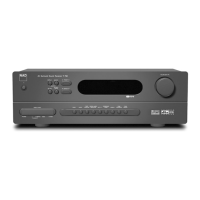
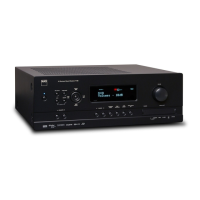
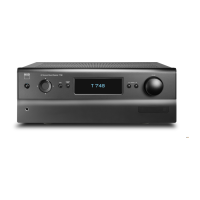
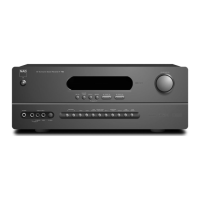
The NAD T752 is an A/V Surround Sound Receiver designed to deliver high-quality audio and home-theater performance. It incorporates NAD's "Music First" design philosophy, aiming for musical transparency and spatial accuracy in both stereo and multichannel modes.

Function Description:

The T752 functions as a central hub for an audio/video system, processing digital and analog signals for surround sound and stereo listening. It includes a built-in AM/FM tuner for radio broadcasts. The receiver features proprietary Power Drive™ amplifier technology for all channels, ensuring accurate and linear reproduction across various loudspeaker impedances. Its digital signal processing (DSP) capabilities handle advanced surround decoding from Dolby Digital and DTS sources, as well as proprietary NAD listening modes like Enhanced Ambience Recovery System (EARS) and Matrix 7.1. The EARS system is designed to extract natural ambience from recordings without artificial generation, enhancing spatial presentation for music. Matrix 7.1 creates a full 6.1/7.1-channel environment from stereo and surround-encoded recordings. The receiver also supports Dolby ProLogic II Music and DTS Neo:6 Music modes for enjoyable experiences from 2-channel sources.

The T752 offers flexible system integration with configurable DC trigger outputs and input, as well as standard-protocol IR communications links. It provides pre-out and main-in jacks for the front channels, allowing for the use of external amplifiers for expansion. The Surround Back channel outputs enable system growth from 5.1 to 6.1 or 7.1 channels by adding external amplification.

Important Technical Specifications:

Amplifier Section:

  • Power output Stereo Mode (8 ohms within rated distortion): 2 x 100W
  • IHF dynamic power (8 ohms): 2 x 150W
  • IHF dynamic power (4 ohms): 2 x 200W
  • Power output Surround Mode: 5 x 80W
  • Total harmonic distortion at rated power: 0.08%
  • IM distortion at rated power: 0.08%
  • Damping factor (8 ohms): 60
  • Input sensitivity and impedance: 200mV / 50k ohms
  • Frequency response: 5 to 20,000 Hz ±0.8dB
  • Signal/noise ratio (ref rated power / 8 ohms (A-WTD)): >90dB
  • Signal/noise ratio (ref 1W / 8 ohms (A-WTD)): >80dB
  • Remote Control: Yes

Tuner Section:

  • Input sensitivity Mono: 16.1dBf
  • 50dB Stereo: 36.1dBf
  • Harmonic Distortion (FM Mono): 0.25%
  • Harmonic Distortion (FM Stereo): 0.5%
  • Signal / noise (Mono): 60dB
  • Signal / noise (Stereo): 55dB
  • Stereo separation at 1kHz: 40dB
  • Frequency Response (± 1.5dB): 30Hz - 15kHz

Physical Specifications:

  • Dimensions (W x H x D): 17 1/8 x 5 3/16 x 13 3/4" (435 x 132 x 350mm)
  • Net Weight: 36 lbs (16.3kg)
  • Shipping Weight: 38 lbs (17.1kg)

Usage Features:

The T752 emphasizes ease of use with a simple, self-explanatory system of on-screen display (OSD) menus, accessible via the connected video monitor/TV. The HTR 2 universal remote control is designed for intuitive operation, allowing control of the T752 and other NAD or third-party components.

  • Input Setup: The receiver has eight configurable inputs (six audio-video, two audio-only). Users can assign analog and digital audio inputs to video inputs, with digital signals taking precedence.
  • Speaker Setup: Users can configure speaker settings (Small, Large, None) and subwoofer presence (On/Off) to optimize bass management. These settings are global but can be saved as presets.
  • Channel Balance (Test) Setup: The receiver provides a test signal for adjusting the relative balance of loudspeakers using an SPL meter or by ear, ensuring accurate surround sound and subwoofer integration.
  • Speaker Distance: Precise speaker distance settings optimize imaging, intelligibility, and surround-sound ambience by applying correct delays.
  • Listening Modes: Nine distinct listening modes are available, including Stereo, Downmix, Dolby Pro Logic, Dolby Pro Logic II (PLII Movies/Music), DTS Neo:6 (Movies/Music), EARS, Matrix 7.1, Enhanced-Stereo 1 (ST1), and Enhanced-Stereo 2 (ST2). These modes are tailored for different types of recordings and can be adjusted with various parameters like Dimension, Center Width, and Panorama for PLII, and Dynamic Range for Dolby Digital.
  • Presets: The T752's "Presets" system allows users to customize and store virtually every operational parameter (input settings, level settings, delay settings, speaker settings, listening mode selections, and tone control settings) for recall with a single keypress.
  • Volume Control: Master volume can be adjusted via the HTR 2 remote or front-panel knob, with settings displayed on the VFL and OSD.
  • Muting: A dedicated mute function silences all channels, persisting through standby or power cycles.
  • Radio Functions: The internal AM/FM tuner allows tuning stations, setting up to 40 radio presets (30 FM, 10 AM), and choosing FM Mute/Mode for strong signal reception or distant/noisy stations.
  • RDS (Radio Data System): Supports display of station-name (PS mode) and radio-text (RT mode) from compatible FM broadcasts.
  • HTR 2 Remote Control: This universal remote can control up to 8 devices, learn up to 352 commands, record up to 44 macros (64 commands each), and features configurable punch-through and key illumination. It includes pre-programmed NAD codes and allows loading of different code-libraries for other NAD components.

Maintenance Features:

  • Self-Service: The manual explicitly states "DO NOT ATTEMPT TO SERVICE THE UNIT YOURSELF" and advises referring servicing to qualified service personnel.
  • Cleaning: The unit should be cleaned only as recommended in the Operating Instructions.
  • Troubleshooting: A dedicated section provides common conditions, possible causes, and solutions for issues like no sound from channels, no Dolby Digital/DTS, or remote control unresponsiveness.
  • Memory Backup: The T752's memory back-up system stores channel level, tuner preset, and other settings for several weeks even when completely switched off or unplugged.
  • Soft Clipping: NAD's proprietary Soft Clipping circuitry can be enabled to gently limit output and minimize audible distortion, even when the receiver is over-driven. This can be left on at all times or defeated for critical listening to preserve optimum dynamics.

NAD T752 Specifications

General IconGeneral
BrandNAD
ModelT752
CategoryStereo Receiver
LanguageEnglish

Related product manuals