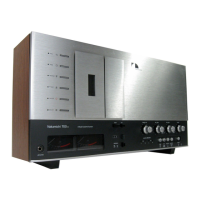
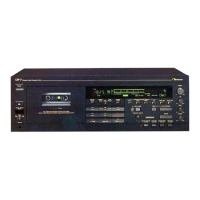
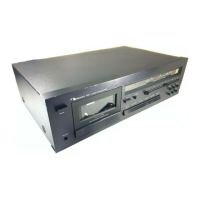
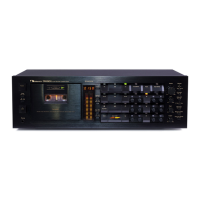
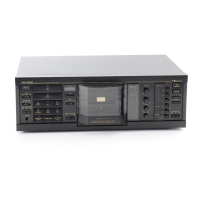
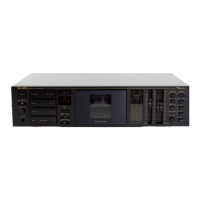
The Nakamichi 700ZXE is an advanced auto-tuning cassette deck designed for high-fidelity recording and playback. It continues the design philosophy of the earlier 700 and 700 II models but features a completely new, superior tape machine with a refined front panel.
Function Description:
The 700ZXE incorporates state-of-the-art electronic technology to enable several useful functions. Key among these is the automatic calibration of azimuth, bias, and level (sensitivity), ensuring optimal performance with any tape type. It also features the Random Access Music Memory (RAMM) system for automatic program selection during playback. The deck boasts Nakamichi's long-standing expertise in cassette deck design, resulting in a head and tape transport design that is unsurpassed, similar to that found in the 1000ZXL and 700ZXL models. This includes a discrete 3-head configuration, a diffused-resonance double-capstan transport, and a non-resonant chassis, all contributing to its "beauty and performance" motto.
Important Technical Specifications:
- Power Source: 100, 120, 120/220-240, 220 or 240 V AC; 50/60 Hz (country dependent).
- Power Consumption: Max. 50 W.
- Tape Speed: 4.8 cm/sec.
- Wow and Flutter: Less than 0.04% Wrms, less than 0.08% peak.
- Frequency Response (with auto calibration):
- 20-20,000 Hz ±2 dB (Nakamichi EX, EX II, SX, ZX tapes).
- 18-23,000 Hz ±3 dB (recording level -20 dB).
- Signal-to-Noise Ratio: Better than 66 dB (3% THD), better than 60 dB (0 dB) (IHF-A, Wrms, 400 Hz, with Dolby NR, ZX tape, 70 µsec).
- Total Harmonic Distortion: Less than 0.3% (ZX tape), less than 1.0% (SX, EX II tapes) (400 Hz, 0 dB).
- Erasure: Better than 60 dB (100 Hz).
- Channel Separation: Better than 37 dB (1 kHz, 0 dB).
- Crosstalk: Better than 60 dB (1 kHz, 0 dB).
- Bias Frequency: 105 kHz.
- Inputs:
- Line: 50 mV, 50 kΩ.
- Microphone: 0.2 mV, 10 kΩ.
- External Noise Reduction: 100 mV, 50 kΩ.
- Outputs:
- Line: 1 V (400 Hz, 0 dB, output level control at max.).
- Headphones: 45 mW (400 Hz, 0 dB, output level control at max.).
- External Noise Reduction: 100 mV, 2.2 kΩ.
- Dimensions: 500 (W) × 252 (H) × 250 (D) mm.
- Weight: Approx. 14 kg.
Usage Features:
- Cassette Insertion and Removal: The cassette compartment opens by pushing the eject lever. Cassettes are inserted from the top, ensuring the exposed tape faces down and the desired side's label faces the user.
- Power Switch: Activates the unit.
- Pause Button: Provides noise-free, short-term interruption of tape transport and activates the cueing feature.
- Headphone Jack: Accepts standard stereophone plugs.
- Record Button: Used for recording and activating the Rec Mute feature.
- Rewind/Fast-Forward Buttons: For rapid tape winding.
- RAMM Control Buttons: Activates RAMM functions for automatic program selection.
- Auto Calibration Button: Automatically adjusts azimuth, bias, and level (sensitivity) for optimal tape performance. This should be performed before every new recording for perfect results.
- Stop Button: Halts all tape motion.
- Counter Reset Button: Resets the tape counter to "0000".
- Play Button: Initiates tape motion for recording or playback.
- Tape Selector Switch: Selects EX (normal), SX (chrome), or ZX (metal) tape types, with the selected position displayed on the indicator panel.
- Monitor Switch: Allows monitoring of either the incoming source signal ("Source") or the recorded sound on the tape ("Tape") during recording.
- Output Level Control: Adjusts the deck's output level and headphone listening level.
- Pitch Control: Controls tape speed during playback over a range of approximately ±6%, useful for music lessons.
- Timer Switch: Enables unattended recording or playback in conjunction with an external timer.
- Memory Switch: Stops the tape at "0000" during fast-forward/rewind ("Stop") or automatically resumes playback at "0000" ("Play").
- Equalizer Switch: Selects 70 µsec or 120 µsec equalization based on the tape in use.
- Noise Reduction Switch: Activates built-in Dolby B-Type noise reduction or an external system like High-Com II.
- Test Tone Switch: Activates a 400 Hz, 0 dB test tone for exact level calibration with other audio components.
- Line Input Level Control: Adjusts recording levels for left and right channels separately, mixable with other level controls.
- Filter Switch: Selects MPX filter for 19 kHz carrier signal removal or subsonic filter for low-frequency noise.
- Microphone Level Controls (L, R) & Blend: Adjusts individual microphone levels and a monaural center microphone level, respectively.
- Level Meters: High-accuracy LED indicators for recording and playback levels.
- Tape Counter: Digital counter with a range from "9999" to "-999", linked to the memory switch.
- Indicator Panels: Dedicated panels for Noise Reduction, Equalizer, Tape Selector, Auto Calibration, and RAMM display selected settings and functions.
- Sealed Panel Cover: Slides upward to reveal additional controls.
- Memory-Backup Batteries: Two SUM-3 batteries are required to retain auto-calibration data (bias and level) when the unit is powered off. These batteries should be replaced when the tape selector indicator panel starts flashing.
- Tape Slack Prevention: A special circuit takes up any loose tape inside the cassette upon insertion, preventing snarls.
- Cueing: Allows listening to the tape in high-speed motion during fast-forward or rewind, with reduced speed, to locate blank spots or specific selections.
- Rec Mute: Mutes the recording signal during recording when the record button is pressed again, useful for cutting unwanted portions from broadcasts.
Maintenance Features:
To maintain superior performance and prolong the life of the heads and pressure rollers, all tape-contacting parts should be cleaned frequently.
- Cleaning Frequency: Minimum of once every ten hours of use, or after each playing for inferior tapes.
- Cleaning Kit: A kit with cotton-tipped sticks and alcohol is supplied. Isopropyl alcohol (preferably undiluted) can be used when the supplied alcohol runs out.
- Cleaning Procedure:
- Turn off power, open the cassette compartment, and carefully remove the see-through cover.
- Clean the record, playback, and erase heads with short, firm back-and-forth strokes along the tape path.
- Clean the tape guides, especially the far-left one.
- Press the play button and carefully apply the cleaning stick to the pressure rollers as they turn, using light pressure and an up-and-down stroke. Ensure cotton strands are removed from cleaned parts.
- Demagnetizing: All metal parts in contact with the tape should be demagnetized every 50 hours of use to prevent residual magnetism, which can cause hiss and high-frequency loss.
- Remove all tape from the deck and turn off the power.
- Turn on the demagnetizer at least two feet away from the deck.
- Slowly bring the tip close to the playback head, then the record head, moving in a random pattern for at least 10 seconds.
- Repeat for each capstan.
- Slowly withdraw the demagnetizer at least two feet from the deck before turning it off.
- Avoid contact with heads unless the demagnetizer tip is covered to prevent scratching.
The Nakamichi 700ZXE is a sophisticated and user-friendly cassette deck, designed for enthusiasts who demand the highest quality in audio recording and playback, with features that simplify operation and ensure long-term performance.

 Need help?
 General

 To Next Page