The Narda 5G FR2 Antenna is a specialized device designed to extend the measurement capabilities of the SRM-3006 field strength meter into the 5G millimeter wave band. Two models are available: a directional antenna (3591/01) for high sensitivity measurements and an omnidirectional antenna (3591/02) for environmental measurements.
Function Description:
Both LNB antenna models integrate a downconverter that translates the 24.25 GHz to 29.5 GHz millimeter wave band into the SRM-3006's receive band (up to 6 GHz). This conversion significantly reduces cable loss compared to using a 20 GHz cable. The integrated downconverter allows the antennas to be used with all SRM-3006 devices without hardware modifications, requiring only a firmware update. The antennas feature an independent, integrated rechargeable lithium-ion battery, ensuring that the SRM-3006's operating time is not affected. The battery can be charged via a USB-C socket, and for extended measurements, a USB power bank can be connected. Narda generally recommends connecting the antennas to the SRM-3006 via an RF cable to minimize the risk of damage to the basic unit's connector due to the antenna's weight and to facilitate sweeping the measurement volume.
Important Technical Specifications:
- Frequency Range: Extends SRM-3006 to cover 24.25 GHz to 29.5 GHz.
- Antenna Types:
- 3591/01 (Directional): High gain, high directivity, suitable for detecting weak signals and geographically separated base stations. Polarization is indicated on the antenna.
- 3591/02 (Omnidirectional): Offers an omnidirectional characteristic resembling a donut shape, providing the closest approximation to isotropic measurements in the FR2 band. Ideal for X-Y spatial plane measurements; requires movement to cover all three spatial axes for isotropic measurements.
- Power Supply: Integrated rechargeable lithium-ion battery, independent of the basic unit.
- Charging: Via USB-C socket.
- Connectivity: RF cable connection to SRM-3006, antenna control connector.
- Firmware: User-updatable via a flash tool (executable .exe file) from the Narda website, requiring Microsoft .NET Framework 3.5 or higher.
- Compliance: Directives 2014/30/EU, EN 61326-1:2013, 2014/35/EU, EN 61010-1:2010, and 2011/65/EU.
Usage Features:
- Measurement Modes: Supported by SRM-3006 when using the LNB antenna include Spectrum, Level Recorder, Scope, and Safety Evaluation.
- FR2 Band Switching: The dual-band design allows switching between FR2 bands in the "Frequency" submenu across most operating modes. This can also be done manually in the "Antenna" menu.
- Attenuator Control: The attenuator can be switched on/off in the "Meas Range" submenu in each mode, with its status displayed in the status bar.
- Antenna Information: Selected frequency band and antenna details (Long Name, P/N, S/N, Band, Attenuator, Run Mode, Temperature, Charger State, Battery Level, Firmware Version) can be viewed in the "Antenna" menu.
- Battery Level Indication: Warnings are displayed when the battery level drops below 20%, with additional warnings for every 5% drop. At 1%, measurements stop, and the antenna can no longer be operated.
- Tripod Mounting: Special devices are required for mounting the Narda antennas on a tripod, ensuring stability and resistance to external influences. For most applications, the LNB antenna needs to be moved/swept during measurement to cover all spatial axes.
Maintenance Features:
- Calibration: The LNB antenna is designed for low maintenance, but regular calibration is necessary to ensure accurate measurements. Calibration should only be performed by suitable (accredited) laboratories.
- Cleaning: Avoid liquids penetrating the antenna and do not use solvents to clean its surfaces.
- Repairs and Modifications: Only approved Narda Service Centers should perform repairs. Unauthorized modifications are not permitted and void warranty claims. The LNB antenna can only be adjusted by Narda in conjunction with a calibration.
- Battery Care: The rechargeable battery has a limited lifespan, which degrades over time. Charging should occur between 0 °C and 30 °C. For long-term storage, the battery should be sufficiently charged and fully recharged at least every 6 months.
- Disposal: Used equipment and permanently installed Li-Ion batteries must be disposed of separately from household waste according to national regulations and the European WEEE Directive 2012/19/EU. Non-destructive battery removal is only possible by Narda or qualified personnel.

 Need help?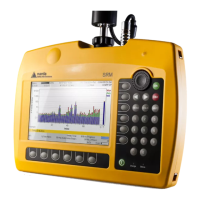

 To Next Page
 General