
 Need help?
Do you have a question about the National Instruments PXIe-1088 and is the answer not in the manual?
Procedures for inspecting the shipping container and chassis for damage during unpacking.
Lists the items included in the PXIe-1088 chassis kit and required accessories.
Details bandwidth, slot connectivity, cooling, and clock specifications for high performance.
Lists features contributing to high reliability, such as temperature range and monitoring.
Details optional rack-mount kits, filler panels, slot blockers, installation services, and handle/feet kits.
Lists optional EMC filler panels, slot blockers, handle/feet kit, rack mount kits, and fan kits.
Discusses compatibility with various CompactPCI and PXI Express devices.
Details the system controller slot and its role in system configuration.
Describes the eight hybrid peripheral slots and their capabilities.
Crucial safety warnings regarding electrical hazards, grounding, live circuits, explosive atmospheres, and part replacement.
Instructions on maintaining sufficient clearance for proper airflow and cooling.
Step-by-step instructions for connecting the chassis to an earth safety ground.
Procedure for testing power functionality using the Power Inhibit switch.
Detailed steps for installing a PXI Express system controller into the chassis.
General instructions for installing peripheral modules into the chassis slots.
Details the chassis inhibit modes and their selection via DIP switch for power control.
Explains fan modes (Auto, High) and cooling profiles (38W, 58W) for thermal management.
Guidance on cleaning frequency based on operating environment.
Precautions for qualified personnel performing maintenance, including ESD.
Procedures for cleaning the chassis exterior, interior, and fan filters.
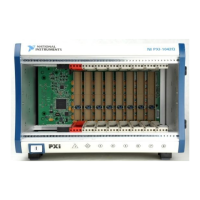
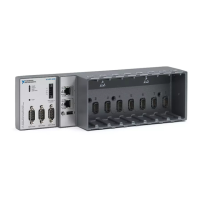
The PXIe-1088 is a high-performance 9-slot PXI Express chassis designed for a wide range of instrumentation applications. It integrates a robust backplane and power supply within a structurally optimized design, fully complying with the PXI-5 PXI Express Hardware Specification. This chassis offers significant flexibility, supporting various PXI Express, CompactPCI Express, and modified PXI/CompactPCI peripheral devices within a single unit.
The PXIe-1088 chassis serves as a foundational platform for PXI Express systems, providing the necessary infrastructure for system controllers and peripheral modules. Its backplane facilitates high-speed data transfer and synchronization between modules. The chassis includes a dedicated system controller slot (slot 1) configured for 4-Link CompactPCI Express and PXI Express system controllers, with three expansion slots for wider controller modules. This design prevents system controllers from occupying valuable peripheral slots.
The backplane intelligently routes PCI Express links from the system slot to the peripheral slots. Specifically, three peripheral slots (4, 6, and 8) receive x4 links, while five other peripheral slots connect via x1 links through a PCI Express switch, which itself links to the system slot via an x4 connection. This architecture ensures high dedicated bandwidth for each PXI Express slot, supporting up to 500 MB/s or 2 GB/s (single direction) per slot for Gen-2 PCI Express.
The chassis also features eight hybrid peripheral slots (slots 2 through 9), which are versatile enough to accept PXI Express peripherals with x8, x4, or x1 PCI Express links, CompactPCI Express Type-2 peripherals, and hybrid-compatible PXI or CompactPCI 32-bit peripherals. These hybrid slots offer full PXI Express and 32-bit PXI functionality, with specific connectivity to PXI Local Bus 6.
For synchronization, the PXIe-1088 provides a low-jitter internal 10 MHz reference clock for PXI/PXI Express slots and a 100 MHz reference clock for PXI Express slots, both with high stability. It also supplies PXIe_SYNC100 to each peripheral slot, with independent drivers for all reference clock signals to ensure minimal skew.
The PXI Trigger Bus, comprising eight trigger lines per bus segment, enables synchronized operation of multiple PXI peripheral modules. Trigger lines can be routed across trigger bridges in either direction, allowing for system-wide trigger signal distribution. Static and dynamic trigger routing can be configured through software, preventing double-driving of trigger lines.
The PXIe-1088 is designed for ease of use and high reliability in various operating conditions. It supports a wide operating temperature range and incorporates features for power supply, temperature, and fan monitoring to ensure stable operation.
The chassis offers two main fan operating modes: Auto and High. In Auto mode, fan speeds adjust based on chassis intake air temperature, optimizing acoustic performance. In High mode, fans operate at maximum speed for superior cooling, regardless of temperature. These modes are available for both 38 W and 58 W cooling profiles, accommodating different module power dissipations. Fan mode selection can be managed via a DIP switch on the backplane or through the Measurement & Automation Explorer (MAX) software.
The PXIe-1088 also supports two inhibit modes: Default and Manual. In Default mode, the power inhibit button functions normally, allowing users to power on/off the chassis, even without a system controller installed. In Manual mode, the chassis powers up automatically when AC power is applied and shuts down when AC power is removed. This mode is selected via a DIP switch.
Installation of system controllers and peripheral modules is straightforward, involving sliding the module into card guides and securing it with mounting screws. The chassis includes an LED indicator on the front panel to display its status: steady green for normal operation and steady red for out-of-range temperature or internal fault.
For optimal thermal performance, the chassis requires adequate clearance around its intake and exhaust vents. Filler panels are provided for unused slots to maintain proper cooling, and optional slot blockers can further enhance thermal management. Rack mounting is supported with optional kits, and the chassis feet are removable for this purpose.
The PXI Platform Services software, included with the chassis, automatically identifies system components and generates configuration files. MAX provides a comprehensive interface for configuring the PXI system, monitoring chassis information such as voltages, temperatures, fan speeds, and performing self-tests and firmware updates. It also allows for detailed trigger configuration, including static reservation and dynamic routing, to prevent conflicts and potential damage to devices.
The PXIe-1088 is designed with maintenance in mind to ensure long-term reliability. Key maintenance aspects include:
 General
| Number of Slots | 18 |
|---|---|
| PXI Express Slots | 8 |
| System Timing Slot | 1 |
| Power Supply | AC |
| Ethernet Ports | 1 |
| USB Ports | 2 |
| Storage Temperature | -40 to 70 °C |
| Form Factor | PXI Express |
| Chassis Size | 3U |
| Slot Types | PXI Express |
| Cooling | Forced air |
| Backplane | PXI Express |
| Operating Temperature | 0 °C to 55 °C |
| Relative Humidity Range | 10 to 90% (noncondensing) |



 To Next Page