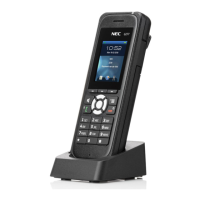
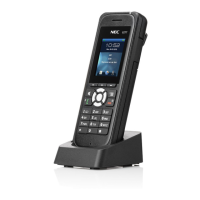
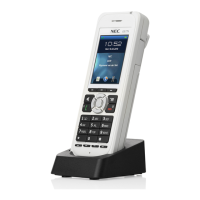
This document serves as a basic user guide for NEC DECT G566 and i766 handsets, specifically designed for use with NEC iSIP systems. It outlines the functionalities and operational procedures for various call handling and system features.
Device Function Description
The NEC DECT G566 and i766 handsets are designed to integrate with NEC Telecommunication servers, offering a range of communication features. The iSIP integration allows these handsets to utilize four line keys (function keys), mirroring the functionality of line keys found on NEC keyphones. This integration is crucial for advanced call management within the NEC system.
Important Usage Features
Line Keys and "Park-Orbit" Functionality:
A key recommendation for these handsets is to program the first line key as a "Park-Orbit" key. This is achieved by dialing *04 followed by a unique Park orbit number. This feature is vital for retrieving transferred calls where the target extension does not answer, preventing lost calls.
Mute Function:
During an active call, the G566 handset uses its SOS button as a "Mute" key, while the i766 handset uses its Keyboard Lock Key for the same purpose.
Call Handling:
- Answering a Call: When the handset rings, the display shows "CALL FROM" along with the caller's name/number. Pressing the green button answers the call, and the display changes to "TALKING TO" with the caller's details. Calls are ended by pressing the red button.
- Initiating an Internal Call: Internal calls connect to other extensions within the NEC Telephone System without using external trunk lines. The system supports two methods:
- Signaling: The target extension rings until lifted.
- Voice Call: A short tone is heard at the target, allowing direct hands-free reply.
To initiate, press the green button, dial the internal extension number, and the display shows "CALLING" with the target's name/number.
- External Outgoing Calls: Multiple methods are available for external calls:
- Dialing the common trunk access code (
9).
- Dialing a specific code (
805 + Line port number) for a specific line.
- Dialing a specific code (
804 + Line group number) for a specific line group.
- Pressing a pre-programmed Line key (2, 3, or 4).
- Automatic trunk access by pressing the green button (if configured).
After dialing, the display shows the line name and dialed digits, and an external dial tone is heard.
- Last Number Dial (LND): The system stores the last dialed number centrally.
- Redial: Press the green button, dial service code
816, and the last dialed number is shown and redialed.
- Delete LND Memory: Press the green button, dial service code
876, and the display shows "CLEAR REDIAL" with a confirmation tone.
- Hold/Enquiry Call: This feature allows placing an existing call on hold to make another call (enquiry) to an internal extension or external number.
- Internal Enquiry: During a call, press the Park key (which blinks), dial the internal extension number, conduct the enquiry, and then press the Park key again to resume the original call.
- External Enquiry: During a call, press the Park key (which blinks), dial
9 (trunk access) plus the external number, conduct the enquiry, and then press the Park key again to resume the original call. The external party can be disconnected by pressing the red button.
- Transfer: Calls can be transferred with or without announcement.
- Screened Transfer: During a call, press the Park key (which blinks), dial the target extension, wait for an answer, announce the transfer, and then press the "Transfer" softkey.
- Unscreened Transfer: During a call, press the Park key (which blinks), dial the target extension, and then press the "Transfer" softkey. If the target doesn't answer, a ringback is received.
- DSS-Key (Direct Station Selection): DSS-Keys provide Busy Lamp Field (BLF) functionality and one-button access to extensions. An LED indicates the extension's status (off for idle, steady on for busy, blinking for features like Call Forward or DND). DSS-Keys can also be programmed for external numbers or service codes, though without status indication.
- Call to Extension via DSS Key: Press the green button, then the DSS Function-Key.
- Transfer via DSS Key: During a call, press the Park key (which blinks), then the DSS Function-Key, and then the "Transfer" softkey.
- Speed Dial: Allows quick access to frequently called numbers (up to 24 digits).
- Via Servicecode: Press the green button, dial service code
813, then the bin number.
- With Fixed Target (Function-Key): Press the green button, then the Speed Dial Key.
- With Flexible Target (Function-Key): Press the green button, then the Speed Dial Key, then enter the bin number.
- Station Speed Dial: Each extension has 10 personal Speed Dial bins (0-9) for internal or external numbers.
- Dialing: Press the green button, dial service code
761, then the bin number.
- Storing: Press the green button, dial service code
855, then the bin number, enter the number to be stored (prefix 9 for external numbers), and optionally assign a name using the "Hold" softkey.
- Call Pickup: Intercepts calls ringing at other extensions. Extensions can be assigned to different Pickup Groups.
- From Own Pickup-Group (Service Code): If an extension in your group is ringing, press the green button, dial service code
867.
- From Own Pickup-Group (Function-Key): If an extension in your group is ringing, press the green button, then the Pickup Key (own Pickup Group).
- From Any Other Pickup-Group (Service Code): If an extension in another group is ringing, press the green button, dial service code
869 (*#).
- From Any Other Pickup-Group (Function-Key): If an extension in another group is ringing, press the green button, then the Pickup Key (any other Pickup Group).
- From Specific Pickup-Group (Service Code): If an extension in a specific group is ringing, press the green button, dial service code
868, then the Pickup Group number.
- From Specific Pickup-Group (Function-Key): If an extension in a specific group is ringing, press the green button, then the Pickup Key (specific Pickup Group).
- From Specific Extension (Service Code): If a specific extension is ringing, press the green button, dial service code
715, then the ringing extension number.
- Call Forwarding: Redirects calls to another extension or external number.
- Immediate to External Numbers (Service Code): Press the green button, dial service code
848 for direct CF, dial 1 to activate, then dial 9 (trunk access) plus the external number. A name can be assigned using the "Hold" softkey.
- Cancel Immediate to External Numbers (Service Code): Press the green button, dial service code
848 for direct CFW, then dial 0 to cancel.
- To Internal Numbers (Service Code): Press the green button, dial
84, then the next digit (2: both ring, 3: when busy, 4: busy & unanswered, 5: unanswered, 8: immediate), then the internal target number.
- To Internal Numbers (Function-Key): Press the green button, then the Call Forward Key, dial
1 to activate, then the internal target number.
- Cancel (Internal/External) (Service Code): Press the green button, dial
84, then the next digit (2: both ring, 3: when busy, 4: busy & unanswered, 5: unanswered, 8: immediate), then dial 0 to cancel.
- Cancel (Internal/External) (Function-Key): Press the green button, then the Call Forward Key, then dial
0 to cancel.
- Follow Me: Allows calls to ring at a co-worker's extension.
- Activate: While at the co-worker's desk, press the green button, dial service code
846 for Follow Me, dial 1 to activate, then dial the number of the extension where calls should follow.
- Cancel: Press the green button, dial service code
846 for Follow Me, then dial 0 (All) or a specific extension to cancel.
- DND (Do Not Disturb): Blocks incoming calls and paging announcements. Four types can be activated.
- Activate/Cancel (Service Code): Press the green button, dial service code
847 for DND, then dial 0 (cancel), 1 (external only), 2 (internal only), 3 (all), or 4 (call forward to this extension).
- Activate/Cancel (Function-Key): Press the green button, then the DND Function-Key (which will be red if DND is active), then dial
0, 1, 2, 3, or 4.
- Callback / Camp On: Allows leaving a callback request for a busy or unanswered extension.
- Camp On (Service Code): When calling a busy extension, dial service code
850 for Camp On. The system will connect when the target becomes idle.
- Camp On (Function-Key): When calling a busy extension, press the Camp On Key (which turns red).
- Callback (Service Code): When calling an unanswered extension, dial service code
850 for Callback. The system will ring your phone when the target becomes idle.
- Callback (Function-Key): When calling an unanswered extension, press the Camp On Key.
- Conference: Adds multiple parties (up to 31 internal/external, plus the originator for a total of 32) to a conversation.
- Via DSS Function-Key: During a call, press the Conference Key, dial the next internal or external number, and wait for an answer. To add more parties, press the Conference Key again. To quit, hang up.
- Voicemail (InMail): Accesses the system's voicemail. A flashing LED or voicemail-envelope symbol indicates new messages.
- Via Service Code: Press the green button, dial service code
717.
- Via Function-Key: Press the green button, then the (flashing) Mailbox-Access Function-Key.
- Mailbox Operations: Common digits for mailbox operation include
5 (listen/skip), 3 (erase), 22 (listen from beginning), 0 (main menu), 9 (exit).
Technical Specifications
The document does not explicitly list technical specifications such as battery life, screen resolution, or physical dimensions. However, it implies that the handsets are DECT (Digital Enhanced Cordless Telecommunications) devices, suggesting standard cordless phone technology for range and audio quality. The iSIP integration indicates compatibility with NEC's IP-based communication systems.
Maintenance Features
The manual does not detail specific maintenance features for the handsets themselves (e.g., cleaning, battery replacement). However, it does provide information on system-level maintenance and configuration:
- System Programming: The document highlights that the system's flexible programming allows for deviations from the manual, especially regarding service codes. Users are advised to contact their installer or system administrator for customized handling and operation.
- Error Disclaimer: It states that errors cannot be completely excluded and that no claims or rights can be derived from the instructions, illustrations, and descriptions.
- End-of-Life Disposal: The manual includes a symbol indicating that electrical and electronic products should not be disposed of as municipal waste. They should be taken to designated facilities for proper treatment, recovery, and recycling to reuse valuable materials and prevent environmental contamination. A fine may be imposed for illegal disposal.
Supported Function-Keys
The document provides an extensive list of supported Function-Keys (00-99, and special codes like #04, *00, etc.) that can be assigned to the handset's four line keys. Each function has a description and indicates whether it is supported by iSIP DECT.
Examples of Supported Function-Keys:
01: DSS/One-Touch (OK)03: Do Not Disturb (DND) Key (OK)06: Transfer (OK)07: Conference (OK)09: Night Mode Switching (OK)10: Call Forward - Immediate (OK)24: Call Pickup for Own Group (OK)27: Speed Dial - Common/Private (OK)34: Barge - In (OK)37: Do Not Disturb/Call Forward Override (OK)46: Department Group Logout (OK)62: Flash Key (OK)77: InMail Voice Mail access (OK)#04: Change Restriction Class (OK)*04: Park Key (OK)
Examples of Not Supported Function-Keys (or not explicitly supported by iSIP DECT):
02: Microphone05: Headset08: Incoming Caller ID List16: --- Not Used ---18: Text Message Setup23: Meet-Me Answer to Internal Paging29: Redial31: Memo Dial32: Meet - Me Conference39: Room Monitoring
The document emphasizes that for full details on programmable function key usage, users should refer to the NEC Telephone Systems Features and Specifications manual. To clear a programmed key, 000 should be pressed.
Overall, this user guide provides comprehensive instructions for operating NEC DECT G566 and i766 handsets within an NEC iSIP environment, focusing on call management and system feature utilization.

 Need help?
 General

 To Next Page