Need help?
Do you have a question about the NI 9207 and is the answer not in the manual?
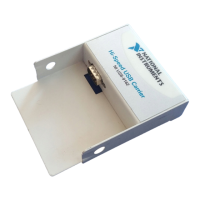
Recommends using a backshell kit for protecting NI 9207 connections in high-vibration applications.
Explains that the NI 9207 provides overvoltage protection for each analog input channel.
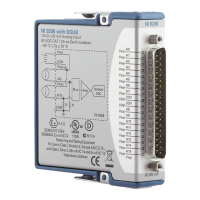
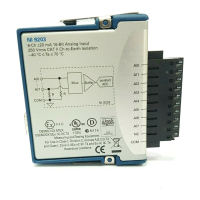
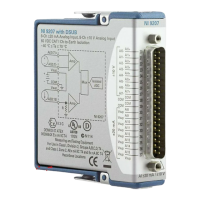
The NI 9207 is a versatile data acquisition module designed for a wide range of industrial and laboratory applications, offering 16 analog input channels capable of measuring both current (±20 mA) and voltage (±10 V) with 24-bit resolution and an aggregate sampling rate of 500 S/s. This module is part of the National Instruments C Series, making it compatible with CompactRIO and CompactDAQ systems, which are known for their ruggedness and flexibility in various environments. The NI 9207 is available in two main connection types: spring terminal and DSUB, providing options for different wiring preferences and application requirements.
The primary function of the NI 9207 is to accurately acquire analog signals from a variety of sensors and transducers. With its 16 analog input channels, it can simultaneously monitor multiple points in a system, making it suitable for complex measurement setups. The module's ability to handle both current and voltage inputs eliminates the need for separate modules for different sensor types, simplifying system design and reducing costs. The 24-bit resolution ensures high precision in measurements, capturing subtle changes in signals, which is crucial for applications requiring fine detail and accuracy. The 500 S/s aggregate sampling rate allows for the capture of relatively slow-changing signals, common in process control, structural health monitoring, and environmental monitoring applications.
The NI 9207 supports various connection configurations, including floating differential, grounded, and single-ended connections, offering flexibility to adapt to different sensor types and noise environments. For current measurements, the module can interface with both loop-powered and three-wire current transducers, further expanding its applicability. An external power supply (0 to 30 V) is required to power the module and provide current for connected devices, ensuring stable operation and reliable measurements. The module's design incorporates overvoltage protection for each channel, safeguarding the device and connected equipment from unexpected voltage spikes.
The NI 9207 is designed for ease of integration and use within NI's ecosystem. Users are guided to complete software and hardware installation procedures as outlined in their chassis documentation before operating the module. This ensures proper setup and compatibility within the larger system. The module's guidelines emphasize operating it only as described in the documentation to prevent product misuse and potential hazards, which could compromise the built-in safety protection.
For spring terminal versions, users are advised to use 2-wire ferrules for secure connections when multiple wires are connected to a single terminal. Wires should be pushed into the terminal for solid wires or stranded wires with ferrules. For stranded wires without ferrules, the push button should be pressed to open the terminal. These detailed instructions ensure reliable and safe wiring, especially in industrial settings where connections can be subject to vibration or other environmental stresses. For high-vibration applications, the NI 9940 backshell kit is recommended to protect connections to the spring terminal version of the NI 9207, enhancing the system's robustness and longevity.
The module's safety guidelines are comprehensive, addressing various measurement categories and hazardous locations. For spring terminal connections, it specifies isolation limits for channel-to-channel and channel-to-earth ground, along with continuous and withstand voltage ratings. It explicitly warns against connecting to signals or using for measurements within Measurement Categories III or IV. Similarly, for DSUB connections, it provides isolation limits and withstand voltage ratings, cautioning against use in Measurement Categories II, III, or IV. These guidelines are critical for ensuring user safety and preventing damage to the device and surrounding equipment.
The NI 9207 is suitable for use in Class I, Division 2, Groups A, B, C, D, T4 hazardous locations, as well as Class I, Zone 2, AEx nA IIC T4 and Ex nA IIC T4 hazardous locations, and nonhazardous locations. Specific conditions for hazardous locations use in Europe and internationally are also provided, including requirements for installation in ATEX/IECEx-certified enclosures with a minimum ingress protection rating of IP54. These detailed instructions underscore the module's suitability for deployment in demanding and potentially dangerous environments, provided that all safety protocols are strictly followed.
Maintenance of the NI 9207 primarily revolves around ensuring its proper installation and adherence to operational guidelines to prevent damage and ensure longevity. The documentation stresses that if the product is damaged, it should be returned to NI for repair, indicating that user-level repairs are not recommended or supported. This approach ensures that any repairs are performed by qualified personnel using appropriate parts and procedures, maintaining the integrity and safety of the device.
For hazardous locations, specific maintenance-related cautions are provided, such as not removing modules unless power has been switched off or the area is known to be nonhazardous. This prevents accidental ignition or electrical shock. Additionally, substitution of components is cautioned against, as it may impair suitability for Class I, Division 2 environments. These warnings highlight the importance of maintaining the module's original configuration and operating conditions to preserve its safety certifications.
Electromagnetic Compatibility (EMC) guidelines are also provided, stating that the product complies with regulatory requirements and limits for EMC. To ensure specified EMC performance, particularly for the DSUB version, users are advised to operate the NI 9207 only with shielded cables and accessories. If unshielded cables or accessories are used, they must be installed in a shielded enclosure with properly designed and shielded input/output ports and connected to the product using a shielded cable. Failure to adhere to these guidelines can compromise EMC specifications, potentially leading to interference or degraded performance.
The documentation also outlines environmental specifications for operating the NI 9207, including temperature, humidity, pollution degree, and maximum altitude. Adhering to these environmental conditions is crucial for the module's reliable operation and long-term performance. Regular checks of the operating environment against these specifications can be considered a form of preventative maintenance, ensuring the device is not subjected to conditions that could lead to premature failure.
Finally, National Instruments provides extensive support resources, including online documentation, technical support, installation services, extended warranties, and product registration. These resources are invaluable for troubleshooting, obtaining calibration certificates, and staying informed about product updates, all of which contribute to the effective long-term maintenance and operation of the NI 9207.
 General
| Number of Analog Outputs | 0 |
|---|---|
| Sampling Rate | 500 kS/s (aggregate) |
| Connectivity | C Series |
| Isolation | 250 Vrms channel-to-earth ground |
| Input Range | ±10 V |

 To Next Page