Need help?
Do you have a question about the Nibe S2125 and is the answer not in the manual?
Details for recording product, serial number, installation date, and installer.
Explanation of symbols used in the manual and important notes.
Information specific to the United Kingdom, including regulations and warranty.
Details on NIBE guarantee, installation requirements, and Benchmark Checklist.
Performing routine checks on the heat pump's grilles, panels, and condensation pipe.
Recommendations for draining the system and disconnecting the non-return valve during power failures.
Using silent mode for noise reduction and fan de-icing for ice buildup.
Information on updating the heat pump's software via the installer manual.
Basic actions for troubleshooting operational interference not shown on the display.
Addressing ice build-up in the fan, grille, or fan cone using de-icing functions.
Resolving water below the unit by checking condensation drainage and fitting accessories.
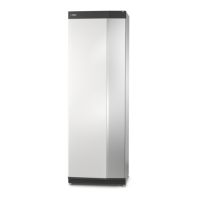
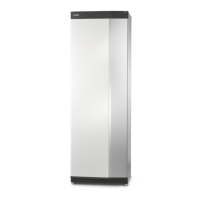
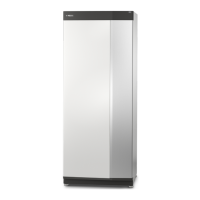
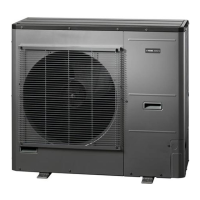
The NIBE S2125 is an air/water heat pump designed to provide heating for homes. It operates by extracting free heat energy from the outdoor air and converting it into residential heating through a three-circuit process.
The heat pump system involves three main circuits: the outdoor air circuit, the refrigerant circuit, and the heating medium circuit.
Outdoor Air Circuit: Outdoor air is drawn into the outdoor unit by a fan. This air then passes through the evaporator, where it releases thermal energy to the refrigerant. As a result, the air's temperature drops, and the colder air is then blown back out of the outdoor unit.
Refrigerant Circuit: This is a closed system within the outdoor unit where a refrigerant gas circulates. The refrigerant has a very low boiling point. In the evaporator, it collects heat energy from the outdoor air and begins to boil, turning into a gas. This gas is then routed into an electrically powered compressor, which increases its pressure and significantly raises its temperature (e.g., from 0 °C to approximately 80 °C). From the compressor, the hot, high-pressure gas is forced into a heat exchanger (condenser), where it releases its heat energy to the indoor module's heating medium. As it releases heat, the gas cools and condenses back into a liquid form. Still at high pressure, the refrigerant then passes through an expansion valve, which reduces its pressure, returning it to its original temperature. The refrigerant has now completed a full cycle and is routed back to the evaporator to repeat the process.
Heating Medium Circuit: The heat energy produced by the refrigerant in the condenser is transferred to the indoor unit's heating medium (water), which is heated to a suitable supply temperature (e.g., approximately 55 °C). This heated water then circulates in a closed system, transporting the heat energy to the house's radiators or heating coils. Additionally, the indoor module contains an integrated charge coil within its boiler section, which uses the heated water to warm up the surrounding domestic hot water.
The NIBE S2125 is controlled via an indoor module or a separate control module, depending on the specific system configuration. During installation, a qualified engineer adjusts the necessary settings to optimize the heat pump's performance within your home's heating system.
The heat pump includes a "Silent mode" feature, which can be activated to reduce the unit's noise level. This is particularly useful when the S2125 needs to be placed in noise-sensitive areas. However, it's important to note that using silent mode for extended periods might prevent the heat pump from reaching its full dimensioned power.
The system also offers "Fan de-icing" functionality. This can be activated if ice or snow accumulates on the fan, grille, or fan cone, which might cause abnormal fan noise from the outdoor unit. "Fan de-icing" works by heating the fan, grille, and fan cone using hot air from the evaporator. There is also an option for "Continuous fan de-icing," where every tenth defrosting cycle will include fan de-icing. While this helps prevent ice build-up, it can slightly increase annual energy consumption.
Regular maintenance is crucial for the optimal performance and longevity of the NIBE S2125, especially since it is an outdoor unit.
Checking Grilles and Bottom Panel: It is important to regularly check throughout the year that the grilles and the bottom panel are not clogged by leaves, snow, or other debris. Particular vigilance is required during windy conditions or snowfall, as blockages can occur. Ensure the back of the unit is free from dirt and leaves. Also, verify that the drain holes in the bottom panel are clear to allow proper condensation drainage. If unsure about condensation routing, consult your installer.
Keeping Free of Snow and Ice: Prevent snow from building up and covering the grilles and drain holes of the S2125.
Cleaning the Outer Casing: If necessary, the outer casing can be cleaned with a damp cloth. Care should be taken to avoid scratching the heat pump during cleaning. Do not spray water into the grilles or sides to prevent water from penetrating the unit. Avoid using alkaline cleaning agents on the S2125.
Actuating the Safety Valve (FL2): The safety valve should be actuated regularly to remove dirt and ensure it is not blocked. Remember to also check that the vent valve is working correctly.
In Event of Long Power Cuts: For prolonged power failures, it is recommended to drain the outdoor part of the heating system. Installing shut-off valves can facilitate this process. Additionally, disconnect the non-return valve (RM1.2) to prevent the condenser from freezing.
Troubleshooting Ice Build-up: If ice builds up in the fan, grille, or fan cone, activate the "Fan de-icing" function via the indoor or control module. If problems persist, contact your installer.
Troubleshooting Water Below S2125 (Larger Amount): If a significant amount of water is observed below the unit, ensure that the accessory KVR is fitted to divert condensation from the heat pump. Also, check that the water drainage via the condensation pipe (KVR) is functioning correctly.
Software Updates: Information regarding software updates can be found in the Installer Manual for your indoor module or control module.
 General
| Type | Air/Water Heat Pump |
|---|---|
| Refrigerant | R290 |
| Weight Outdoor Unit | 120 kg |
| EER Cooling | 4.0 |
| Sound Power Level Outdoor | 54 dB(A) |
| Control System | Nibe SMO 40 |
| Dimensions Outdoor Unit (HxWxD) | 900 x 400 mm |


 To Next Page