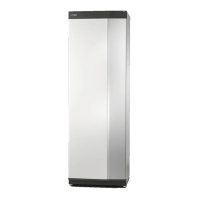
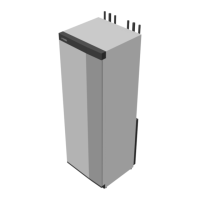
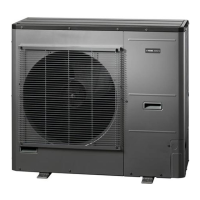
Outdoor air
The outdoor air is drawn into the outdoor unit.
A
The fan then routes the air to the outdoor unit’s evapor-
ator. Here, the air releases thermal energy to the refriger-
ant and the air’s temperature drops. The cold air is then
blown out of the outdoor unit.
B
Refrigerant circuit
In a closed system in the outdoor unit, a gas (a refriger-
ant) circulates, which also passes the evaporator. The
refrigerant has a very low boiling point. In the evaporator,
the refrigerant collects the heat energy from the outdoor
air and starts to boil.
C
The gas that is produced during boiling is routed into an
electrically powered compressor. When the gas is com-
pressed, the pressure increases and the gas's temperat-
ure increases considerably, from 0 °C to approx 80 °C.
D
From the compressor, gas is forced into a heat ex-
changer, condenser, where it releases heat energy to
the indoor module, whereupon the gas is cooled and
condenses to a liquid form again.
E
As the pressure is still high, the refrigerant can pass an
expansion valve, where the pressure drops so that the
refrigerant returns to its original temperature. The refri-
gerant has now completed a full cycle. It is routed to the
evaporator again and the process is repeated.
F
Heat medium circuit
The heat energy that the refrigerant produces in the
condenser is retrieved by the indoor unit’s heating medi-
um, water, which is heated to approx. 55 °C (supply
temperature).
G
The heating medium circulates in a closed system and
transports the heated water's heat energy to the house
radiators/heating coils.
H
The indoor module’s integrated charge coil is placed in
the boiler section. The water in the coil heats up the
surrounding domestic hot water.
I
7Chapter 2 | Installation functionNIBE S2125



 To Next Page