-PHOTOGRAPHIC
TECHNIQUES-continued------
:
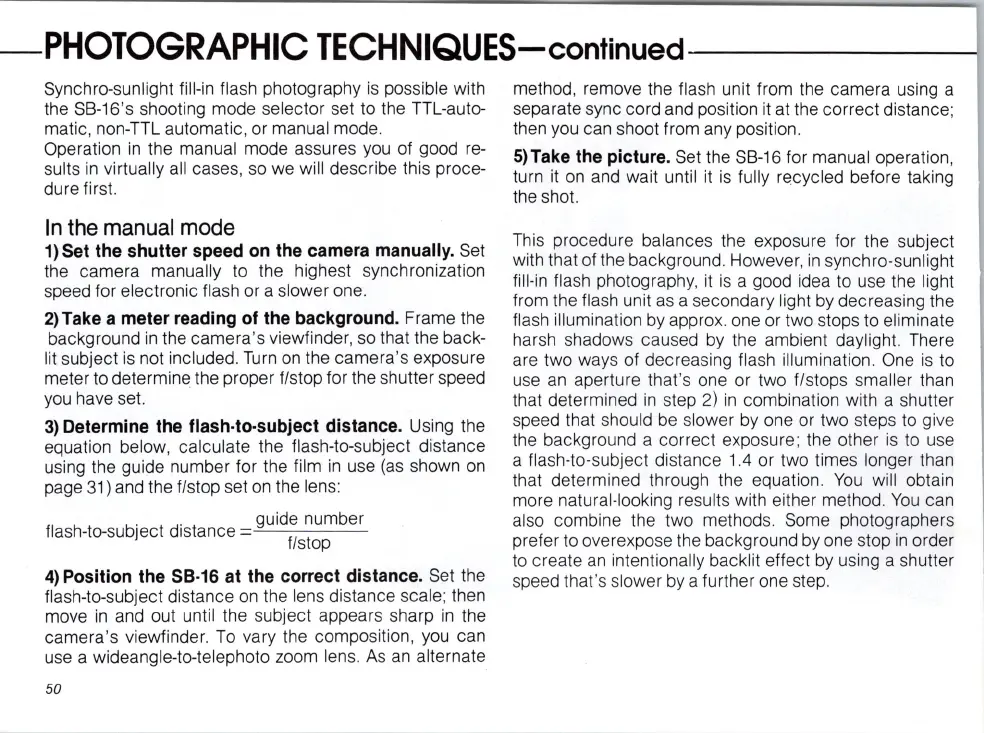
Synchro-sunlight fill-in flash photography
is
possible with
the S8-16's shooting mode selector set to the TTL-auto-
matic, non-
TT
L automatic, or manual mode.
Operation
in
the manual mode assures you of good
re
-
sults
in
virtually all cases, so we will describe this proce-
dure first.
In
the
manual
mode
1)
Set the shutter speed
on
the camera manually.
Set
the camera manually to the highest synchronization
speed for electronic flash or a slower one.
2)
Take a meter reading of the background. Frame the
background
in
the camera's viewfinder, so that the back-
lit subject
is
not included.
Turn
on
the camera's exposure
meter to determine the proper f/stop for the shutter speed
you
have set.
3)
Determine the flash·to·subject distance. Using the
equation below, calculate the flash-to-subject distance
using the guide number for the film
in
use
(as
shown
on
page
31)
and the f/stop set
on
the lens:
.
gu
ide number
flash-to-subject distance f/stop
4)
Position the
58·16
at the correct distance.
Set
the
flash-to-subject distance
on
the lens distance scale; then
move
in
and out until the subject appears sharp
in
the
camera's viewfinder.
To
vary the composition,
you
can
use a wideangle-to-telephoto zoom lens.
As
an
alternate
50
method, remove the flash unit from the camera using a
separate sync cord and position
it
at the correct distance;
then you can shoot from any position.
S)Take the picture. Set the S8-16 for manual operation,
turn
it
on
and wait until
it
is
fully recycled before taking
the shot.
Thi
s procedu
re
balances the exposure for the subject
with that of
th
e background. However,
in
synchro-sunl ight
fill-in flash photography,
it
is
a good idea
to
use the light
from the flash unit
as
a secondary light
by
decreasing the
flash illumination by approx. one or two stops to eliminate
harsh shadows caused
by
the ambient daylight. There
are two ways of decreasing flash illumination.
One
is
to
use
an
aperture that's one or two f/stops smaller than
that determined
in
step
2)
in
combination with a shutter
speed that should be slower by one or two steps
to
give
the background a correct exposure; the other
is
to
use
a flash-to-subject distance
1.4
or two times longer than
that determined through the equation.
You
will obtain
more natural-looking results with either method.
You
can
also combine the two methods. Some photographers
prefer to overexpose the background by one stop
in
order
to
create
an
intentionally backlit effect
by
using a shutter
speed that
's
slower by a further one step.


 To Next Page
 Loading...