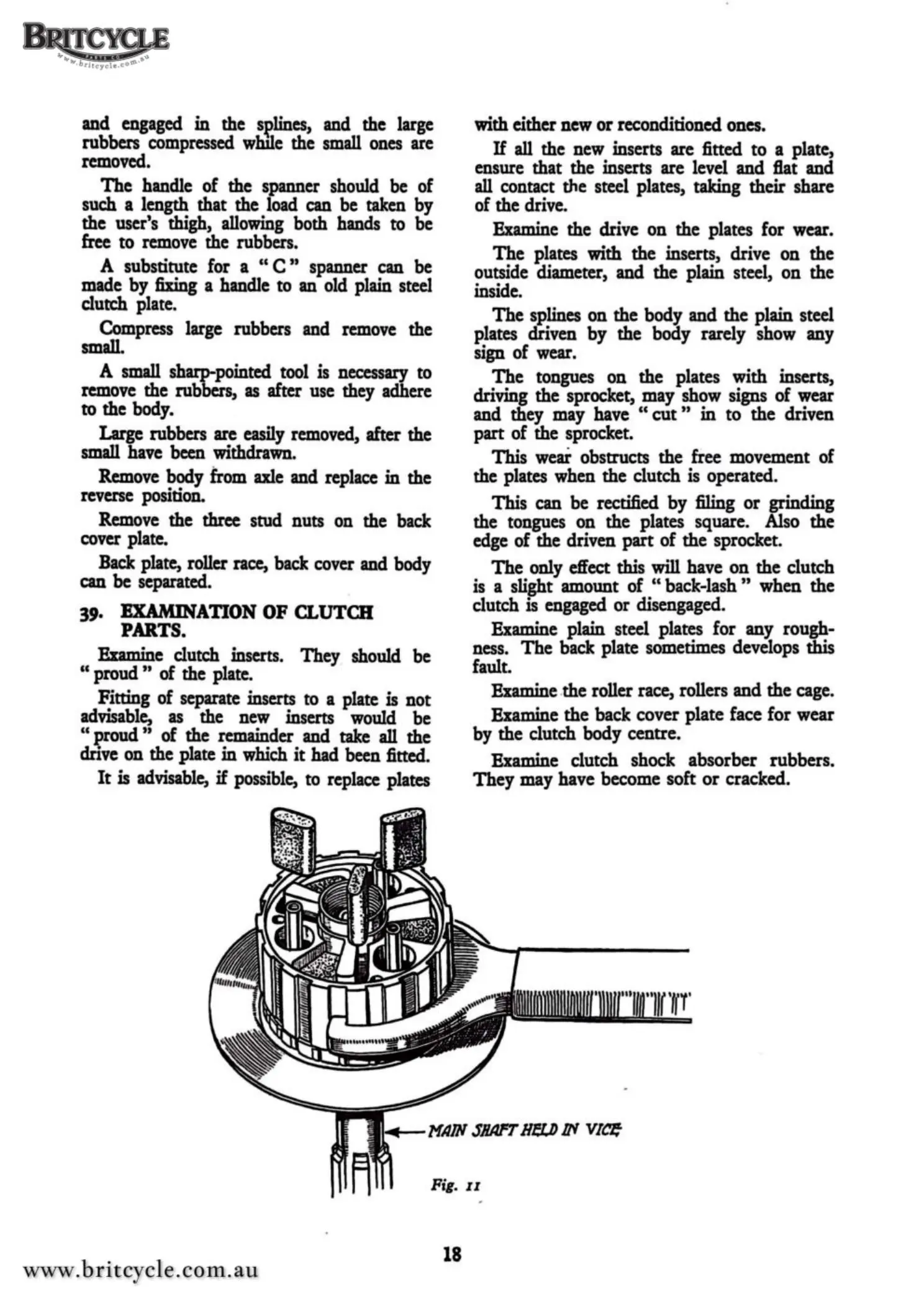
and engaged in the selines, and the large
rubbers compressed while the small ones are
removed.
The
handle of the spanner should be of
such a length that the load can be taken by
the user's thigh, allowing both hands
to
be
free
to remove the rubbers.
A substitute for a " C " spanner can be
made by
fixing
a handle to an old plain steel
clutch plate.
Compress large rubbers and remove the
small.
A small sharp-pointed tool is necessary to
remove the rubbers,
as
after use they adhere
to
the body.
Large
rubbers arc easily removed, after the
small have been withdrawn.
Remove body from
axle
and replace in the
reverse position.
Remove the three stud nuts on the back
cover plate.
Back plate, roller race, back cover and body
can be separated.
39.
EXAMINATION
OF
CLUTCH
PARTS.
Examine clutch inserts. They should be
" proud " of the plate.
Fitting of separate inserts to a plate is not
advisable, as the new inserts would be
" proud ,, of the remainder and take all the
drive on the plate in which
it
had been fitted.
It
is advisable, if possible, to replace plates
with either new or reconditioned
ones.
If all the new inserts are fitted to a plate,
ensure that the inserts are level and flat and
all contact the steel plates, taking their share
of the drive.
Examine the drive on the plates for
wear.
The
plates with the inserts, drive on the
outside diameter, and the plain steel, on the
inside.
The
splines on the body and the plain steel
plates driven
by
the body rarely show any
sign of wear.
The
tongues on the plates with inserts,
driving the sprocket, may show signs of wear
and they may have " cut " in to the driven
part of the sprocket.
This wear obstructs the free movement of
the plates when the clutch is operated.
This can be rectified
by
filing
or
grinding
the tongues on the plates square. Also the
edge of the driven part of the sprocket.
The
only
effect
this will have on the clutch
is a slight amount of " back-lash " when the
clutch is engaged or disengaged.
Examine plain steel plates for any rough-
ness.
The
back plate sometimes develops this
fault.
Examine .the roller race, rollers and the cage.
Examine the back cover plate face for wear
by the clutch body centre.
Examine clutch shock absorber rubbers.
They
may have become soft
or
cracked.
4---HAIN
SRAFT
HELD
IN
VI~
Fig.
11
18



 To Next Page