THE
ENGINE
1.
ENGINE,
LUBRICATION
SYSTEM.
This
is
of
the
dry
sump type.
The
oil
flows
from the oil tank to
the
pump by gravity,
assisted by suction from the feed side of the
oil pump, through the gears, and is forced
under pressure
to
various parts
of
the engine,
drains
to
the lowest
part
of
the
crankcase-
that
is the sludge
trap-and
by suction from
the return side
of
the pump is lifted back
to the oil tank.
2.
THE
FILTER
The
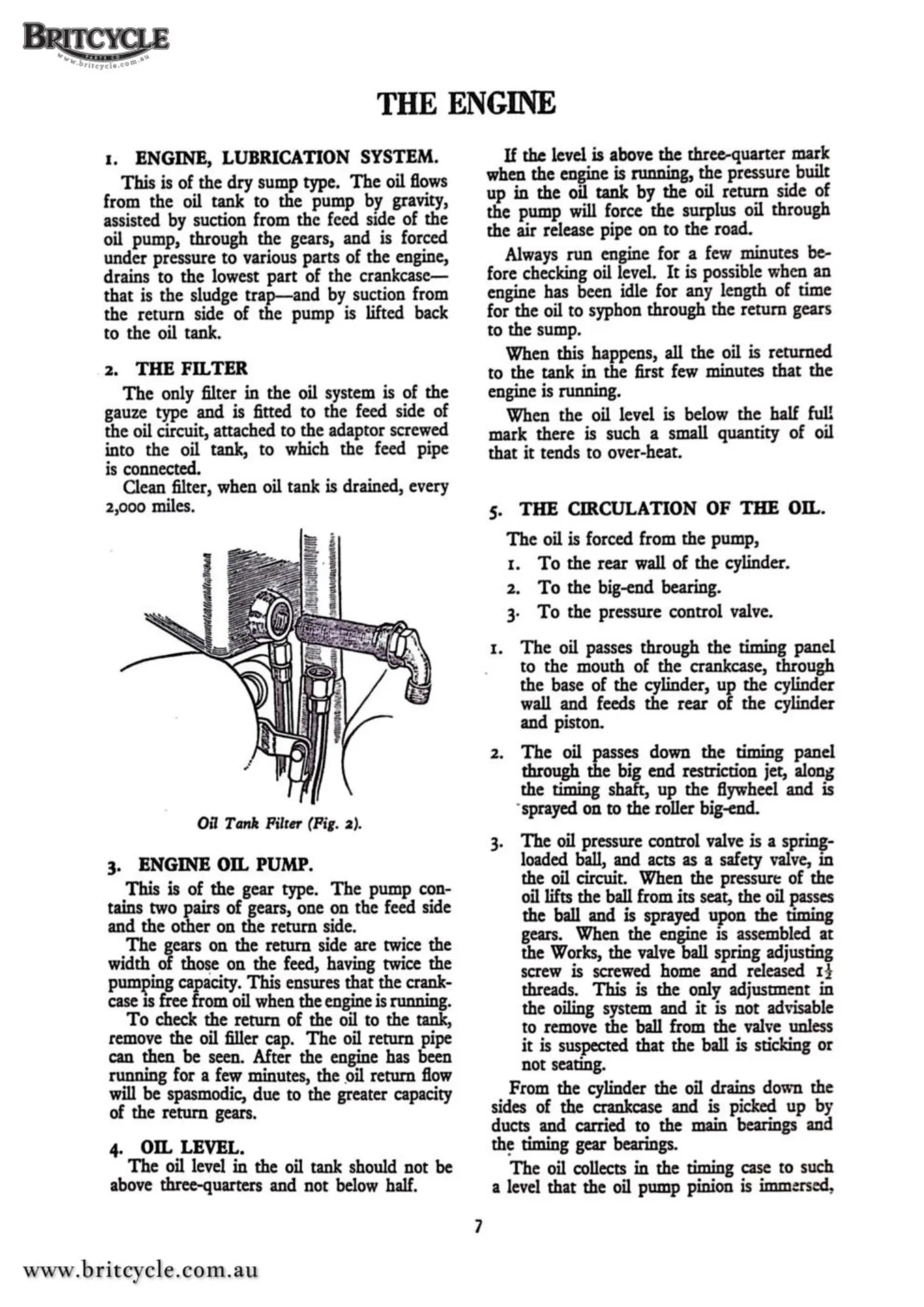
only filter in the oil system is of the
gauze type and is fitted
to
the feed side
of
the oil circuit, attached to the adaptor screwed
into the oil tank, to which the feed pipe
is connected.
Clean filter, when oil tank is drained, every
2,000
miles.
Oil Tank Pilta
(Pig.
2).
3.
ENGINE
OIL
PUMP.
This
is of
the
gear type.
The
pump con-
tains two pairs
of
gears, one
on
the feed side
and the other
on
the return side.
The
gears
on
the return side are twice the
width
of
tho~e
on
the feed, having twice the
pum~ing capacity. This ensures that the crank-
case
1s
free from oil when the engine is nmning.
To
check the return
of
the oil to the tank,
remove the oil filler cap.
The
oil return pipe
can then
be
seen. After the engine has been
running for a few minutes, the .oil return
flow
will be spasmodic, due to the greater capacity
of the return gears.
4.
OIL
LEVEL.
The
oil level
in
the oil tank should not be
above three-quarters and not below half.
7
If
the level is
above
the
three--quarter mark
when
the engine is nmoiog,
the
pressure built
up
in
the oil tank
by
the
oil return side
of
the pump will force
the
surplus oil through
the air release pipe
on
to
the
road.
Always run engine for a few minutes
be--
fore checking oil level.
It
is possible when an
engine has been idle for any length of time
for the oil to syphon through the return gears
to the sump.
When this happens, all the oil is returned
to the tank in the first few minutes that the
engine is running.
When the oil level is below the half full
mark there is such a small quantity
of
oil
that
it
tends to over-heat.
5.
THE
CIRCULATION
OF
THE
OIL.
The
oil is forced from the pump,
I.
To
the
rear
wall
of
the cylinder.
2.
To
the big-end bearing.
3·
To
the pressure control valve.
I.
The
oil passes through
the
timing panel
to the mouth
of
the crankcase, through
the base
of
the cylinder,
up
the
cylinder
wall and feeds the rear
of
the cylinder
and piston.
2.
The
oil passes down the timing panel
through the big end restriction jet, along
the timing shaft,
up
the flywheel and is
· sprayed
on
to the roller big-end.
3.
The
oil pressure control valve is a spring-
loaded ball, and acts as a safety valve,
in
the oil circuit. When the pressure:
of
the
oil lifts the ball from its seat, the oil passes
the ball and is sprayed upon the timing
gears. When the engine is assembled
at
the Works, the valve ball spring adjusting
screw is screwed home and released
I½
threads.
This
is the only adjusonent
in
the oiling system and
it
is not advisable
to remove the ball from the valve unless
it
is
suspected that the ball is sticking or
not seating.
From the cylinder the oil drains down the
sides of the crankcase
and
is picked
up
by
ducts and carried to the
main
bearings and
th~ timing gear bearings.
The
oil collects
in
the timing case to such
a level that the oil pump pinion
is
immersed,


 To Next Page
 Loading...