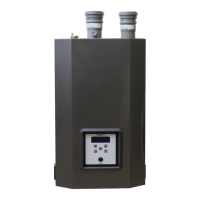
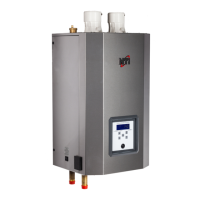
3
TRX Series II - Installation - Startup - Maintenance Instructions
Foreword
For the Installer
This boiler must be installed by qualified and licensed personnel.
The installer should be guided by the instructions furnished with the
boiler, and by local codes and utility company requirements. In the
absence of local codes, preference should be given to the National
Fuel Gas Code - ANSI Z223.1 in the United States and the Natural Gas
and Propane Installation Code - B149.1 in Canada (latest versions).
Installations Must Comply With:
Local, state, provincial, and national codes, laws, regulations, and
ordinances.
In the United States - The latest version of the National Fuel Gas Code,
ANSI Z223.1, from American Gas Association Laboratories, 8501 East
Pleasant Valley Road, Cleveland, OH 44131.
The latest version of the National Electrical Code, NFPA No. 70.
In Canada - The latest versions of the Natural Gas and Propane
Installation Code, CSA B149.1, and the Canadian Electrical Code, C22.1,
from CSA Group, 178 Rexdale Blvd, Toronto, Ontario, Canada M9W 1R3.
NOTE: The gas manifold and controls met safe lighting and other
performance criteria when undergoing tests specified in ANSI Z21.13 -
latest edition.
This manual is intended to be used in conjunction with other literature
provided with the boiler. This includes all related control information.
It is important that this manual, all other documents included in
this system, and additional publications including the National Fuel
Gas Code - ANSI Z223.1 in the United States and the Natural Gas and
Propane Installation Code - B149.1 in Canada (latest versions), be
reviewed in their entirety before beginning any work.
Installation should be made in accordance with the regulations of
the Authority Having Jurisdiction, local code authorities, and utility
companies which pertain to this type of water heating equipment.
Authority Having Jurisdiction (AHJ) – The AHJ may be a federal, state,
provincial, local government, or individual such as a fire chief, fire
marshal, chief of a fire prevention bureau, labor department or health
department, building official or electrical inspector, or others having
statutory authority. In some circumstances, the property owner or
his/her agent assumes the role, and at government installations, the
commanding officer or departmental official may be the AHJ.
NOTE: The manufacturer reserves the right to modify product
technical specifications and components without prior notice.
CAUTION
CAUTION
NOTICE
WARNING
The following defined terms are used throughout this
manual to bring attention to the presence of hazards of
various risk levels or to important product information.
DANGER indicates an imminently hazardous
situation which, if not avoided, will result in serious
personal injury or death.
WARNING indicates a potentially hazardous
situation which, if not avoided, could result in
personal injury or death.
CAUTION indicates a potentially hazardous situation
which, if not avoided, may result in moderate or
minor personal injury.
CAUTION used without the safety alert symbol
indicates a potentially hazardous situation which, if
not avoided, may result in property damage.
NOTICE is used to address practices not related to
personal injury.
SPECIAL ATTENTION BOXES
DANGER
CARBON MONOXIDE DETECTORS
The installer must verify that at least one carbon
monoxide alarm has been installed within a
residential living space or home following the
alarm manufacturer’s instructions and applicable
local codes before putting the appliance into
operation.
For each floor containing bedroom(s), a carbon
monoxide detector and alarm shall be placed in the
living area outside the bedrooms, as well as in the
room that houses the heater. Detectors and alarms
shall comply with NFPA 720 (latest edition). Failure
to comply with these requirements could result in
product damage, severe personal injury, or death.
WARNING


 To Next Page
 Loading...