27
CHECK WATER TEMPERATURE RISE
Always check water temperature rise through the HPWH
unit’s internal heat exchanger before checking the refrigerant
charge. See Start Up on page 19 for information on how to
measure the water temperature rise.
If the measured water temperature rise during start up was
within 8°F to 12°F (4°C to 7°C) checking the charge is not
necessary unless other conditions warrant testing.
If the measured temperature rise through the HPWH unit is
less than 8°F (4°C) checking the charge is not necessary
unless other conditions warrant testing. Short water piping
runs between the HPWH and the storage tank will produce
lower temperature rises and are not problematic.
If the measured temperature rise through the HPWH unit is more
than 12°F (7°C) check for restrictions in the inlet and outlet water
piping connected between the HPWH unit and the storage tank.
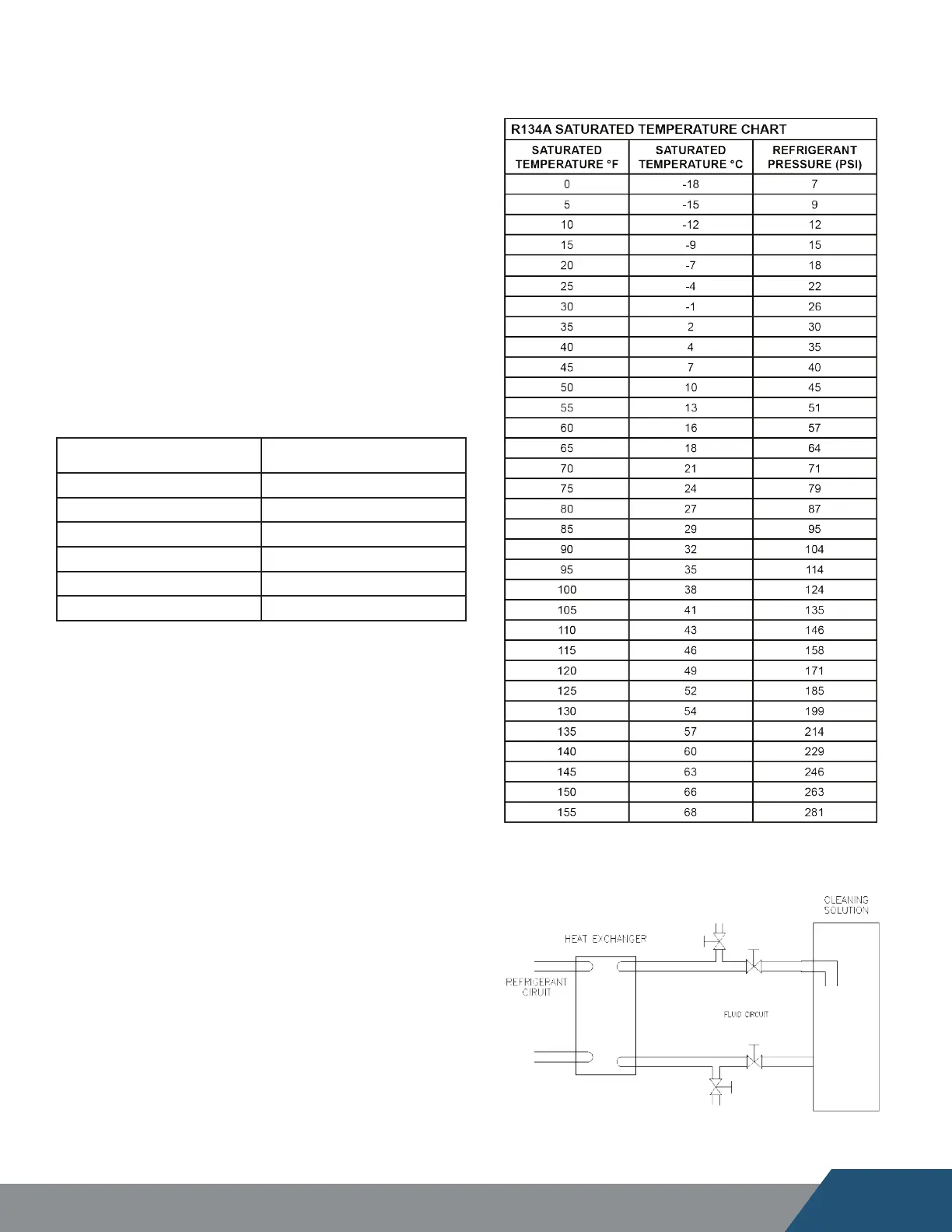
TABLE 9
SUPERHEAT CALCULATION
1. Measure and record the suction pressure at the
suction line pressure access port inside the unit.
2. Convert the recorded suction pressure to saturated
temperature.
3. Measure the suction line temperature near the suction
line pressure access port inside the unit.
4. Compare the suction line temperature to the saturated
temperature in Table 10.
5. The difference between saturated temperature and
suction line temperature is the superheat. Superheat
normal range should be 8°F to 12°F (4.4°C to 6.7°C)
BRAZE PLATE CLEANING INSTRUCTIONS
In some applications the heat exchanger may be subjected
to severe uid conditions, including high temperature hard
water conditions, causing accelerated scaling and corrosion
rates, and will diminish performance.
It is important to establish regular cleaning schedules, A 5%
solution of Phosphoric Acid or Oxalic Acid may be considered.
Other types of solutions can be obtained from your local
wholesaler. Make sure cleaning solution is applicable for stainless
steel and copper and all directions are followed.
Do not heat solution. Be sure to ush heat exchanger with
fresh water after cleaning. See Figure 12.
Model Factory Charge R134A
C25A 7 #
C60A 14 #
C90A 21 #
C125A 25 #
C185A 30 #
C250A 50 #
TABLE 10
FIGURE 12


 To Next Page