OFITE, 11302 Steeplecrest Dr., Houston, TX 77065 USA / Tel: 832-320-7300 / Fax: 713-880-9886 / www.ote.com 9
Lubricity Test
The Lubricity Test should only be performed when the unit has been
successfully calibrated with deionized water and gives a Coefcient of
Friction reading of 34 ± 2. See page 24.
1. Clean the lubricity test ring (#111-02-01 with a at outer surface) and the
lubricity test block (#111-08-01 with a concave groove on one side) with
acetone and rinse both thoroughly with deionized water. All parts of the
machine in the sample area (block holder and shaft) must be completely
clean before starting a test.
Do not touch the metal contact areas with bare hands.
Removing the ring from the main shaft can change the alignment of the
contact area with the block. We recommend removing the ring only to
replace it (along with the block) or to switch between lubricity and extreme
pressure tests.
The Coefcient of Friction for water is 34 ± 2 at 60 rpm and 150
inch-pounds. Since not all metallurgical structures are the same nor is
the contact area the same between the metal parts, a variance of ± 2 is
allowed. When calculating the Coefcient of Friction, a correction factor of
34 divided by the water reading is used. A test should never be performed
if the Coefcient of Friction for water is outside this range.
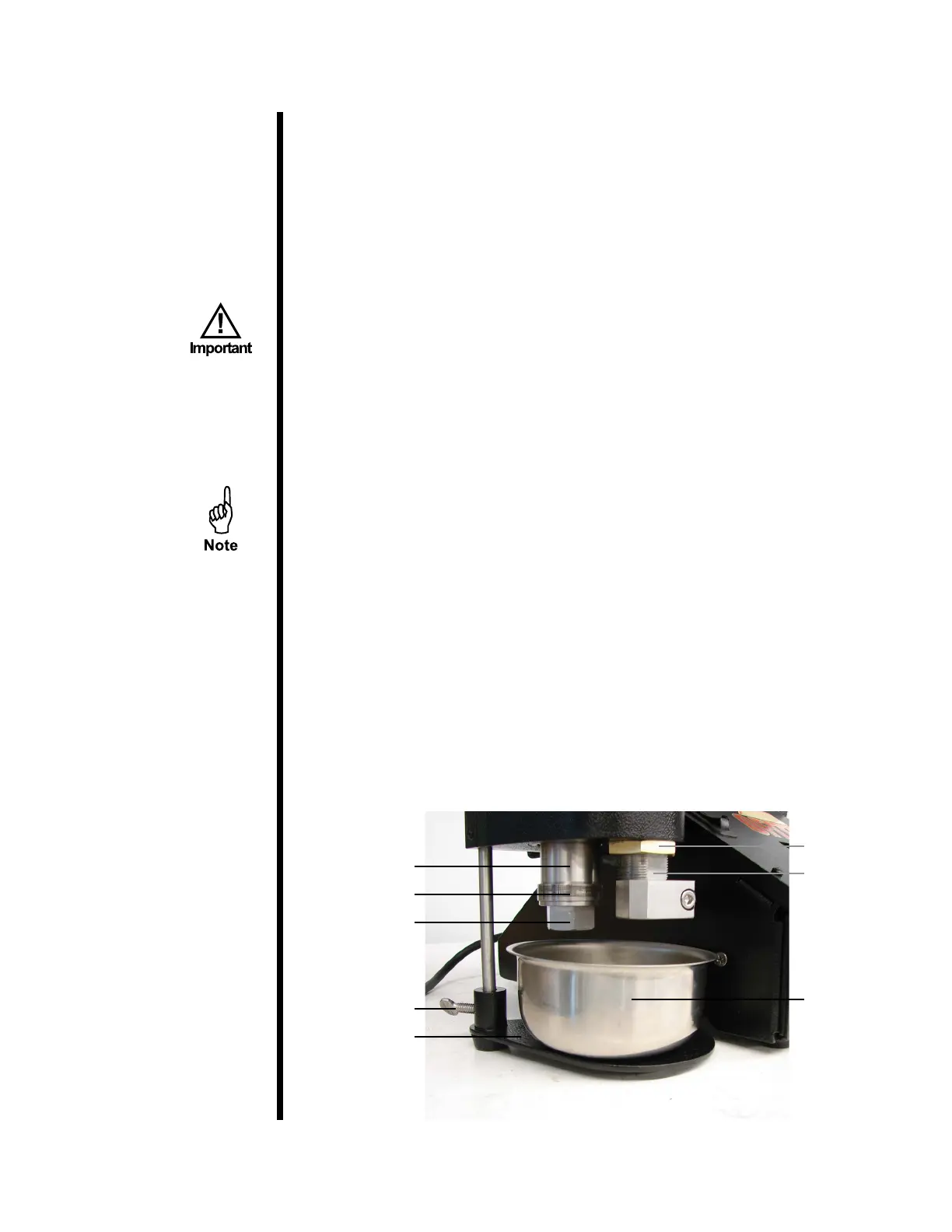
2. Place the lubricity test ring squarely onto the tapered portion of the main
shaft. Secure the test ring retainer nut with a " wrench. Make sure the
ring seats squarely on the taper of the shaft.
3. Turn on the power and let the machine run for approximately 15 minutes.
4. Place the lubricity test block in the block holder with the concave side
facing out away from the torque shaft. Do not let the ring and block
contact each other.
Torque Bushing
(#111-00-36)
Sample Cup
(#111-09)
Locking Nut
(#111-00-009)Main Shaft
(#111-00-34)
Test Ring
Retainer Nut
(#111-00-35)
Thumb Screw
(#141-18)
Cup Stand


 To Next Page