Need help?
Do you have a question about the OHAUS SD and is the answer not in the manual?
Instructions for installing three LR14 ("C") batteries into the indicator.
Verify local line voltage matches the AC adapter before connecting.
Options for mounting the indicator with or without brackets.
Describes the power-on sequence where display segments appear.
How to zero the scale and tare with added mass or containers.
Indicates "E" when load exceeds scale capacity.
Scale turns off after four minutes of inactivity when on batteries.
Procedure for performing dynamic weighing with averaging.
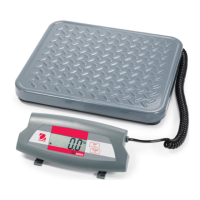
The Ohaus SD Shipping Scales are designed for accurate weighing in various environments, offering a blend of functionality, ease of use, and maintenance features.
The SD Shipping Scales are primarily used for determining the weight of items, particularly in shipping and logistics applications. They support multiple weighing modes and units, including pounds (lb) and kilograms (kg), making them versatile for different regional standards. A key feature is the "Dynamic Weighing" mode, which allows for the accurate measurement of unstable loads or items that might be moving slightly, by averaging the weight over a set period. The scale also includes a "Zero Function" to reset the display to zero, which is useful for taring containers or ensuring accurate measurements when adding multiple items. An "Overload" indicator protects the scale by displaying an error ("E") if the load exceeds its capacity, prompting the user to remove the excess weight to prevent damage. For battery-powered operation, an "Auto Shut-Off" feature conserves energy by turning off the scale after four minutes of inactivity.
The SD Shipping Scales are designed for straightforward operation with a user-friendly interface. The indicator, which displays the weight and other information, can be mounted in various ways, either with or without brackets, to suit different workspace configurations. This flexibility in mounting options, including flush, angled, or elevated positions, allows for optimal viewing and accessibility.
Powering the device can be done via three LR14 ("C") batteries (not included) for portable use, or through an AC adapter for continuous operation. The battery compartment is easily accessible on the bottom of the indicator. A battery charge symbol on the display provides a visual cue for battery status.
The control panel consists of two main buttons: "UNITS Cal" and "ON/ZERO Off".
The display includes several symbols to provide clear information to the user:
The "Power Up Test" ensures the scale is functioning correctly by displaying all segments and the software version upon startup. The "Zero Function" is particularly useful for taring, allowing users to place a container on the platform, press "ON/ZERO Off" to zero out its weight, and then add items to measure only the net weight. If both the sample and container are removed, a negative value will be displayed, which can be reset to zero by pressing "ON/ZERO Off" again.
Dynamic Weighing is a specialized feature for measuring unstable loads. To use this, the platform is first emptied, and "UNITS Cal" is pressed until a bullet symbol flashes. A mass is then placed on the platform, and the scale displays "-A-". If a container is used, it can be tared by pressing "ON/ZERO Off". A short press of "UNITS Cal" starts a 5-second countdown, after which the averaged weight appears, and the bullet symbol stops flashing. The display holds this averaged weight until a button is pressed. The process can be repeated with a mass or container on the platform, or exited by removing the mass and pressing "UNITS Cal".
The SD Shipping Scales are designed with maintenance in mind, focusing on user safety and product longevity. Proper placement is crucial for accurate operation; the scale should be placed on a firm, steady surface, away from excessive air currents, vibrations, heat sources, or rapid temperature changes. Leveling feet are provided to ensure the base is perfectly level, which is essential for precise measurements.
Safety precautions are clearly outlined to prevent damage to the device and ensure user safety. Before plugging in the indicator, users must verify that the local power supply matches the voltage printed on the AC adapter label, and only the provided adapter should be used. This prevents electrical damage. The indicator should be disconnected from the power supply when cleaning to avoid electrical hazards.
The device is not designed for operation in hazardous or unstable environments, and users are advised against dropping loads on the platform, as this can cause damage. The product should only be operated under ambient conditions specified in the Instruction Manual to ensure optimal performance and lifespan. Any service or repairs should be performed by authorized personnel only, guaranteeing that the device is handled by trained professionals and maintaining its integrity. These guidelines contribute to the overall durability and reliable operation of the SD Shipping Scales.
 General
| Capacity | 200 kg |
|---|---|
| Readability | 0.05 kg |
| Display | LCD |
| Power | AC Adapter (included) or 3 C Batteries (not included) |
| Units of Measurement | kg, lb |

 To Next Page