
 Need help?
Do you have a question about the Olivetti d-COLOR MF654 and is the answer not in the manual?
Describes basic procedures, functions, and troubleshooting for using the machine.
Contains detailed information on product functions and various setting options.
Company's efforts to reduce environmental impact and save resources.
Machine meets ENERGY STAR® Guidelines for energy efficiency.
How power management settings reduce electricity consumption.
Product's compatibility with recycled and lightweight paper for resource saving.
Function to print on both sides of paper automatically to save resources.
Explains symbols used to indicate warnings and precautions for safety.
Instructions and warnings for connecting the power cord and ensuring safe power supply.
Warnings and precautions regarding the use, handling, and connection of the power cord.
Precautions for safe installation, placement, and handling of the machine.
Warnings and precautions for safe operation and maintenance of the machine.
Safety precautions for handling toner cartridges, developing units, and toner.
Compliance statement for users in the European Union (EU).
Compliance and usage instructions for FCC Part 15 for USA users.
Compliance statement for Canadian users regarding radio frequency devices.
Warnings for Class A product causing interference in domestic environments.
Information regarding GS certification and display workplace placement.
Information on the machine being a Class 1 laser product.
Certification as a Class 1 Laser product under US regulations.
Describes the laser safety label attached to the machine.
Recommendation for well-ventilated rooms due to ozone generation.
Specifies the maximum sound pressure level according to EN ISO 7779.
Symbol explanation for waste disposal and compliance with RoHS Directive.
Instructions for connecting a telephone cable with a ferrite core.
Instructions for connecting USB devices to the USB host port.
Explains various graphical symbols used on the machine.
Illustrates and describes caution labels on the front of the machine.
Illustrates and describes caution labels on the front of the machine.
Approval statement for pan-European single terminal connection to PSTN.
Recommended clearances for machine operation and maintenance.
Recommended clearances for machine operation and maintenance.
Specifies voltage and frequency fluctuations for optimal performance.
Specifies temperature and humidity requirements for correct operation.
Recommendations for storing copies to prevent fading or damage.
Suggests deleting data on hard disks before disposal or transfer.
Lists items that must not be reproduced, like financial instruments and legal documents.
Describes the machine's design as an office system for print, copy, scan, and fax.
Lists conditions under which the system should not be operated.
Manufacturer's disclaimer for operation under impermissible conditions.
Explains the purpose and content of the Quick Guide.
Describes the content and access methods of the User's Guide CD/DVD.
Describes the layout and navigation of the user guide's top page.
Specifies supported operating systems and web browsers.
Explains symbols indicating preconditions, steps, and supplementary explanations.
Explains symbols for warnings, cautions, notices, tips, references, and settings.
Lists main units and basic optional components with their descriptions.
Lists additional optional components like i-Options, upgrade kits, and heaters.
Lists main units and basic optional components for MF364/MF304/MF254.
Lists i-Options, upgrade kits, heaters, and power supply boxes.
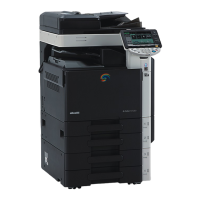
Identifies and describes parts on the front of the machine.
Identifies and describes parts on the side and rear of the machine.
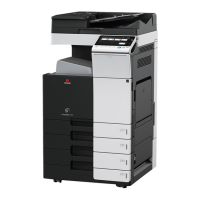
Identifies and describes parts on the front of the machine.
Identifies and describes parts on the side and rear of the machine.
Identifies parts of Finisher FS-537, Saddle Stitcher SD-512, etc.
Identifies parts of Z Folding Unit ZU-609.
Identifies the output tray of the Job Separator JS-602.
Identifies the trays and control panel of the Post Inserter PI-507.
Identifies punch kit, staple cartridge, output tray, and tray extension.
Identifies the output tray of the Job Separator JS-506.
Identifies output tray, staple cartridge, punch scrap box, and saddle stitcher.
Identifies Punch Kit and Folding Output Tray for finishers.
Illustrates the Large Capacity Units LU-302 and LU-207.
Instructions for powering the machine on and off using the main power switch.
How to use the power key to shift between power save modes.
How to configure power saving settings for reduced consumption.
Identifies and describes the main components of the control panel.
Identifies and describes parts of the optional keypad KP-101.
Describes the layout and functions of the main menu on the touch panel.
How to extend and customize the main menu screens.
Explains how to open and close the slide menu.
Explains tap, double-tap, and flick gestures for touch panel interaction.
Explains drag, pan, long-tap, and drag & drop gestures.
Explains pinch/rotate gestures and provides usage precautions.
Explains how to enter characters using the on-screen keyboard.
Describes the job screen for viewing and managing print jobs.
Explains the capability to register multiple jobs concurrently.
Instructions for loading paper into standard paper trays.
Instructions for loading paper into the Large Capacity Tray.
Instructions for loading paper into LU-302 and LU-207.
Instructions for loading paper into the bypass tray.
Lists applicable paper types and sizes for the bypass tray.
Lists paper types that should not be loaded in the bypass tray.
Step-by-step guide for loading paper into the bypass tray.
Instructions for loading postcards into the bypass tray.
Instructions for loading transparencies into the bypass tray.
Instructions for loading envelopes into the bypass tray.
Details on changing paper type and size settings for envelopes.
Instructions for loading label sheets into the bypass tray.
Instructions for loading index papers into the bypass tray.
Describes settings and operations for printing from Windows computers.
Steps to verify cable connection and network settings.
Step-by-step guide for installing the printer driver.
Instructions on how to send data to the printer.
Explains PCL, PS, and XPS printer driver types.
Describes settings and operations for printing from Mac computers.
Describes the flow for printing data from a Mac.
Verifies network settings and Bonjour name configuration.
Steps to change the Bonjour name for device identification.
Guide for installing and setting up the printer driver on macOS.
Instructions for sending print data from a Mac.
Overview of methods to send scanned data (computer, email, USB).
Details other methods like web service, user box, FTP, WebDAV.
Steps to prepare for sending scanned data to Windows via SMB.
Describes the process of sending scanned data via SMB.
Checklist for computer information and settings for SMB send.
Steps to create a folder and enable sharing settings.
How to register a shared computer folder as a destination.
Details on entering name, sort character, user ID, and password.
Entering host address and file path for SMB destination.
Steps to load original and select destination for SMB send.
How to check and adjust scan settings for SMB send.
Steps to prepare for sending scanned data to Mac via SMB.
Describes the process of sending scanned data to Mac via SMB.
Machine settings for SMB send with Mac (NTLM, Direct Hosting).
Checklist for computer information and settings for Mac SMB send.
Steps to create a folder and enable sharing settings on Mac.
How to register a shared Mac folder as a destination.
Details on entering name, sort character, user ID, and password for Mac SMB.
Entering host address and file path for Mac SMB destination.
Steps to load original and select destination for Mac SMB send.
How to check and adjust scan settings for Mac SMB send.
Steps to prepare for sending scanned data via email.
Describes the process of sending scanned data via email.
Verifies cable and network settings for email transmission.
Setting up the SMTP server and enabling E-mail TX function.
Registering administrator name and email address for sender info.
Steps to load original and select destination for email send.
Steps to enter destination email and check settings.
How to check and adjust scan settings for email transmission.
Settings and operations for sending and receiving faxes via phone line.
Verifies the connection of the modular cable to the LINE port.
Entering sender name and fax number for fax transmissions.
How to select PB or 10pps dialing method for fax.
Steps to load original and select destination for fax send.
Steps to enter fax number and check settings.
Steps for preparing and sending faxes from a PC.
Benefits of sending faxes directly from a computer.
Steps for preparing and sending faxes from a PC.
Verifies network settings for PC-FAX TX.
Guide for installing the fax driver on a computer.
Instructions for creating and sending data via PC-FAX TX.
Describes fundamental steps for making a copy, including login.
How to check and adjust copy settings like original type, color, paper, zoom.
Explains how user authentication works for copying.
Steps to register destinations in the address book via Utility.
Details on entering destination name and fax number.
Steps to register destinations directly from the address book menu.
Details on entering destination name and fax number.
Steps to register destinations in scan/fax mode.
Details on entering destination name and fax number in scan/fax mode.
Registering destinations directly using input.
Explains the use of index for narrowing down destinations.
Steps to prepare and register destinations using Web Connection.
Steps to find the machine's IP address for Web Connection.
Lists required items for registering E-Mail, User Box, Fax, PC (SMB), FTP, WebDAV.
Steps to create a new group for destinations.
How to select destinations using index or registration number.
How to find and select registered destinations.
Methods to narrow down destinations using index and address type.
Methods to specify a destination: Direct Input, Job History, Addr. Search.
Instructions for printing files stored on a USB memory device.
Steps to select files and check print settings from USB.
Instructions for saving scanned data to a USB memory device.
Settings to allow saving documents to USB memory.
How to enable saving documents and job settings for USB memory.
Steps to load original and save data to USB memory.
How to check and change file name and scan settings.
Final step to press the Start key to save data to USB.
Explains how to use the guidance function for operation help.
How to access guidance for the currently displayed screen.
Steps to narrow down information within the guidance function.
How to access guidance for specific functions or procedures.
Lists categories of help information available in the Help Menu.
How to directly access function settings from guidance.
Detailed descriptions of items in the Help Menu.
Steps to access and configure quick security settings.
Explains settings like Admin Password, USB, Password Rules, IP Filtering, Web Setting.
Introduces advanced functions and i-Option requirements.
Using My Panel/Address functions requires My Panel Manager.
Process for adding optional functions by registering licenses.
Steps for enabling i-Option functions.
Steps to enable i-Option by inputting token code.
Steps to get a request code from the machine for license registration.
Accessing the LMS website to register the machine serial and request code.
How to get and store license and function codes.
Steps to enable i-Option by inputting license and function codes.
Steps to enable i-Option using a USB drive with license code.
General instruction to configure settings for each advanced function.
Steps to prepare and use the web browser function.
Steps to enable the web browser function.
Steps for starting and using the web browser.
Steps to enable the web browser usage via settings.
Steps to register the machine's serial number on the LMS website.
How to get and store the license code for the web browser.
Steps to enable the web browser by inputting license and function codes.
Steps to enable the web browser by entering license codes.
Steps to enable the web browser using a USB drive with license code.
Installing the web browser license from a USB drive.
How to launch the web browser on the machine.
Steps for entering URLs and navigating web pages.
How to print displayed pages or linked files from the web browser.
Explains messages related to replacing consumables or cleaning.
How to clear persistent paper jams and error messages.
How to respond to error messages and contact service.
Explains the automatic image stabilization process for print quality.
Addresses issues when printing quality declines.
Step-by-step guide for cleaning the print head glass.
Continues the cleaning procedure for the print head glass.
Troubleshooting steps for a machine that won't turn on.
Troubleshooting steps if the touch panel is off or not responding.
Addresses messages about finisher staples and punch scrap box.
Explains messages for low toner and replacement prompts.
Explains messages for replacing drum units.
Explains messages prompting contact with service for developing unit.
Addresses messages about replacing the waste toner box.
Step-by-step guide for replacing toner cartridges.
Step-by-step guide for replacing toner cartridges.
Step-by-step guide for replacing the waste toner box.
Step-by-step guide for replacing the waste toner box.
Step-by-step guide for replacing drum units.
Step-by-step guide for replacing drum units.
 General
| Functions | Print, copy, scan, fax |
|---|---|
| Duplex Printing | Yes |
| Scan Resolution | 600 x 600 dpi |
| Copy Resolution | 600 x 600 dpi |
| Fax Transmission Speed | 33.6 Kbps |
| Type | All-in-One Printer |
| Print Technology | Laser |
| Maximum Print Resolution | 1200 x 1200 dpi |
| Connectivity | USB, Ethernet, Wi-Fi |
| Scanner Type | Flatbed, ADF |
| Operating System Compatibility | Windows, Mac, Linux |




 To Next Page