
 Need help?
Do you have a question about the Olivetti ECR 7700 and is the answer not in the manual?
Instructions for safe setup, use near water, and maintenance.
Plug in the cash register and insert batteries to save data.
Load the thermal paper roll into the printer.
Proceed with the initial programming sequence.
Execute fundamental sales operations.
Explore the cash register's features in depth.
Step-by-step guide for installing memory backup batteries.
Guide on how to load thermal paper into the printer.
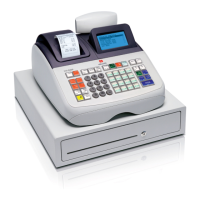
Description of the cash drawer with lock and its features.
Detailed explanation of each key's operation and purpose.
How to use the control lock for settings and reports.
Explanation of display readouts, symbols, and indicators.
List of error codes and procedures for clearing errors.
Resets the cash register's working memory only.
Clears working memory, totals, and counters.
Erases data except language captions.
Erases all data, memory, totals, and programming.
How to program, print, and clear the electronic journal.
Configure the cash register language.
Input the current date in DDMMYY format.
Input the current time in HH:MM format.
Program a specific VAT rate for calculations.
Assign sales type, tax status, and price to departments.
How to update initial programming settings like VAT rates or PLUs.
Using the keypad to program receipt headers and messages.
Instructions for entering alphanumeric characters and symbols.
How to change the default header and footer text.
Naming up to 14 departments with up to 12 characters each.
Naming PLUs up to 12 characters for identification.
Programming automatic discount or add-on rates.
Setting up to four foreign currency exchange rates.
Defining up to 10-character descriptors for currencies.
Configuring rounding for specific European currencies.
Choosing how to round figures for VAT calculations.
Setting up VAT details to print on customer receipts.
Accessing and using the built-in calculator feature.
Steps to activate the calculator mode.
Steps to return from calculator mode to normal register mode.
Setting a password for calculator mode access.
Enabling the security and monitoring feature for clerks.
Disabling the clerk system for unrestricted use.
Linking a three-digit secret code to a clerk.
How to log in as a clerk before operations.
Programming names or identifiers for up to 8 clerks.
Setting a password to protect Z mode access.
Removing the manager password for Z mode.
Accessing Z reports with a defined manager password.
Switching to and from training mode for practice.
Setting a password to secure training mode access.
Overview of programmable system options for cash register functions.
Adjusting cash register settings via machine condition numbers.
Changing the starting or current receipt number.
Configuring the Z1 counter value.
Configuring the Z2 counter value.
Understanding the purpose of X and Z reports.
Generating financial reports for mid-day and end-of-day.
Generating period-to-date and end-of-month financial reports.
Printing sales data per clerk.
Printing sales totals for each Price Look-Up item.
Reporting current stock levels for PLU items.
Printing department configuration details.
Printing details of programmed PLUs.
Printing all programmed cash register settings.
Printing X or Z reports for transactions in training mode.
Printing a full list of transactions from the electronic journal.
Viewing historical transaction data.
Viewing the most recent transaction data.
Viewing Z financial reports and prior receipts.
Examples of typical customer receipts issued by the register.
Switching between REG and JRNL modes for operations.
Displaying current date and time.
Checking available space in the electronic journal.
Switching the receipt printer on or off for transactions.
Performing sales for single items with change.
Performing sales for multiple items with exact cash tender.
Recording sales across different departments.
Processing payments using credit or debit cards.
Handling check payments with change calculation.
Applying discounts to the entire sales transaction.
Processing refunds for multiple items.
Recording payments received on account.
Reprinting the most recent sales receipt.
Detailed technical characteristics of the cash register model.
Table showing characters and how to input them using keypad keys.
Guidelines for proper disposal of electronic waste in EU countries.
Guidelines for proper disposal of electronic waste outside the EU.
 General
| Clerk lock | Yes |
|---|---|
| Buttons quantity | 37 |
| Types of payment | Cash |
| Number of clerks/departments | 8 |
| Number of programmable VAT rates | 4 |
| Number of Price Look-Up codes (PLUs) | 400 PLUs |
| Supported paper width | 57 mm |
| Display number of lines | 1 lines |
| Dimensions (WxDxH) | 340 x 360 x 230 mm |
 Weight and Dimensions
| Weight | 5100 g |
|---|



 To Next Page


