Need help?
Do you have a question about the Olympus OES ELITE and is the answer not in the manual?
Provides guidance on reading and using the product instructions, including system guide and HF equipment instructions.
Explains the meaning of signal words like WARNING, CAUTION, and NOTICE used throughout the document.
Details symbols used for safety alerts, helpful information, and explains numbering, bullet points, and dashes.
Lists trademarks associated with the product, indicating they belong to their respective owners.
Identifies the manufacturer of the product as Olympus Winter & Ibe GmbH in Hamburg, Germany.
Describes the intended applications of Olympus telescopes in Urology, Gynecology, and Otorhinolaryngology, specifying model types.
States that there are no known contraindications for the telescope itself, but users must observe equipment contraindications.
Specifies that medical use requires a trained physician, reprocessing requires hygiene personnel, and repair needs authorized personnel.
Defines the environment for medical use as hospitals/medical rooms and requires reprocessing to follow national/local standards.
Provides general warnings about risks to patient/user from insufficient understanding, damaged products, or electric shock.
Lists the items included in the delivery for different telescope models and the protective tube, advising to check for completeness.
Describes the telescope as a rigid endoscope with an image relay system and explains the function of PDD telescopes and their sensitivity to impacts.
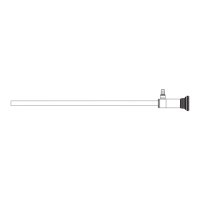
Illustrates the entire telescope and its main body components, detailing the insertion tube, connectors, and direction of view codes.
Illustrates the PDD telescope and its main body, detailing components, color codes for direction of view, and the PDD specific code.
Shows an illustration of the distal end of the telescope, labeling the objective cover glass and light emission surface.
Illustrates the eyepiece cup of the telescope, labeling the eyepiece cover glass.
Explains how the direction of view is indicated in degrees on the main body of the telescope, with visual examples.
Describes the protective tube as a rigid device made of polymer material that protects the telescope from mechanical stress.
Explains various symbols used on the product and packaging, including REF, SN, QTY, Date of manufacture, and CE markings.
States that warranty claims are forfeited if unauthorized repair or modification is attempted, and no warranty is provided for misuse.
Warns about risks of infection and product damage from improper reprocessing and emphasizes pre-use inspection.
Details the inspection process for reprocessing, including visual checks for cleanliness and debris.
Provides guidance on assembly and connection, including checking compatibility and removing the telescope from its protective tube.
Explains how to attach the telescope to the system component, ensuring the connector pin clicks into position.
Details the process of connecting the light-guide cable to the telescope, referring to compatible equipment and instructions.
Instructs on connecting video adapters and camera heads, referencing compatible equipment and their instructions for use.
Warns about electric shock risk from connecting equipment before patient insertion and thermal injury from hot connectors/distal end.
Provides guidance on using the PDD mode for diagnosis and white light imaging during treatment.
Details the steps for removal and disassembly after use, including cooling down the endoscope and disconnecting cables.
Illustrates and instructs on attaching the telescope back to its protective tube for storage or transport.
Instructs to bring the product to the reprocessing area immediately after use and reprocess according to document and system guide instructions.
Warns about infection risks from improper reprocessing and advises against using plastic trays for automated cleaning/disinfection.
Provides information on compatible reprocessing methods according to ISO 17664 and refers to the 'System Guide Endoscopy'.
Provides guidelines for selecting and using cleaning brushes for lumens and outer surfaces, emphasizing material compatibility and size.
Gives instructions on using detergents, including concentration, immersion time, and ensuring complete immersion and no air bubbles.
Advises referring to national and local guidelines regarding the approval of using alcohol for reprocessing.
Details the manual cleaning procedure for the telescope, including immersion, brushing, wiping, and rinsing steps with specific detergents.
Describes manual disinfection using Cidex OPA® Solution, including immersion times, rinsing, and drying.
Refers to the 'System Guide Endoscopy' for automated cleaning and thermal disinfection, and mentions using alkaline detergent.
Covers inspecting the telescope and protective tube after cleaning, checking for debris, dents, cracks, and markings.
States that sterilization has been validated with steam and STERRAD® sterilization, and refers to specific sections for details.
Details preparing the telescope for steam sterilization by attaching it to the protective tube or loading it into an instrument tray.
Warns about STERRAD® sterilization residues and allergic reactions, and describes preparing the product for low temperature plasma sterilization.
Explains STERRAD® systems and cycles (100S, NX™, 100NX™) applicable to the information provided in the document.
States that repair service is available for specific products and must be performed by authorized Olympus personnel.
Provides guidelines for shipping products for repair, emphasizing reprocessing, cleaning, and proper packaging to avoid damage and infection risk.
Instructs to follow all applicable national and local laws and guidelines when disposing of the product or its components.
Provides general dimensions for telescopes (working length, insertion width) and protective tubes (length, inner diameters).
Lists relevant dimensions for reprocessing the product and refers to the 'Reprocessing' chapter for detailed procedures.
Provides specifications for the direction of view for various telescope models.
Specifies operating conditions, including ambient temperature, relative humidity, and atmospheric pressure.
Defines the temperature and relative humidity ranges for storing the product.
Specifies the temperature and relative humidity ranges for transporting the product.


 To Next Page
 General