42
4.1 Warnings and cautions
TB-0545PC/IC/FC, TB-0535PC/IC/FC, TB-0520IC, TB-0510IC
INSTRUCTION MANUAL
Ch.4
• Do not pinch or contact the transducer cord with sharp object. Otherwise the cord
may break and malfunction, which could cause burns due to a possible leakage of
RF Bipolar current.
• Before activating the output, be sure that neither the grasping section nor the probe
tip comes into contact with the surrounding tissue. Do not use the THUNDERBEAT
if you do not have a sufficient view to confirm the above or if the grasping section
and probe tip are penetrating into the tissues. Otherwise, perforation, bleeding or
burns may result. Do not use the THUNDERBEAT if you do not have a sufficient
view of the grasping section and probe tip to ensure that only the intended tissue is
in contact with the grasping section.
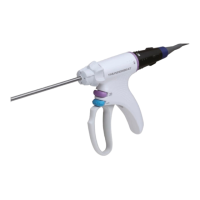
• The probe tip of the THUNDERBEAT instrument is sharp. Do not activate the
THUNDERBEAT instrument if you do not have a sufficient view to confirm the
probe tip. Such condition could cause unintended tissue damage.
• Incomplete or partial cutting tends to occur with thin membranous tissues. Even if a
tissue or vessel (especially thin membranous tissue) cannot be cut completely, do
not continue output for a longer period. Otherwise, this may cause patient injury
and/or deterioration of the equipment. In addition, if the distal end of the shaft is
stuck to desiccated tissue, bleeding may also result if you attempt to withdraw it by
force.
• If dessicated tissue or coagulum is present on the probe tip in the SEAL mode
output, activate the SEAL & CUT mode with the grasping section open. This will
assist in the cleaning of the probe tip via ultrasonic vibrations. While doing so, do
not touch tissue with the probe tip accidentally.
• Do not hold the transducer surface for an extended period of time. Otherwise, the
rise of the surface temperature may result in burns.
• When cutting, or vessel sealing is performed in SEAL & CUT mode, apply light
tension on the tissue so that users can confirm that they are transected. Also, stop
activation immediately after tissue is transected. Otherwise, the grasping section,
the PTFE pad, or the probe tip may break and fall off, and partial separating of the
PTFE pad may occur due to a local increase of temperature caused by the friction
between PTFE pad and the probe tip during activation.
• If an irregular noise is generated during output, the THUNDERBEAT instrument or
the transducer may be damaged. Continuing to use them may cause the probe tip
to break and fall off inside the body cavity. Replace the damaged THUNDERBEAT
instrument or transducer with a spare one.
• Take care not to drop the transducer or not to subject the transducer to strong
impacts. Even if the transducer appears undamaged, do not use it and replace it
with a new transducer. Its durability and capability may have been impaired.
• This system will only allow the activation of one instrument at a time. Confirm that
other instruments are not being activated before activating a selected instrument.




 To Next Page