39
12.7 Water Quality Guidelines
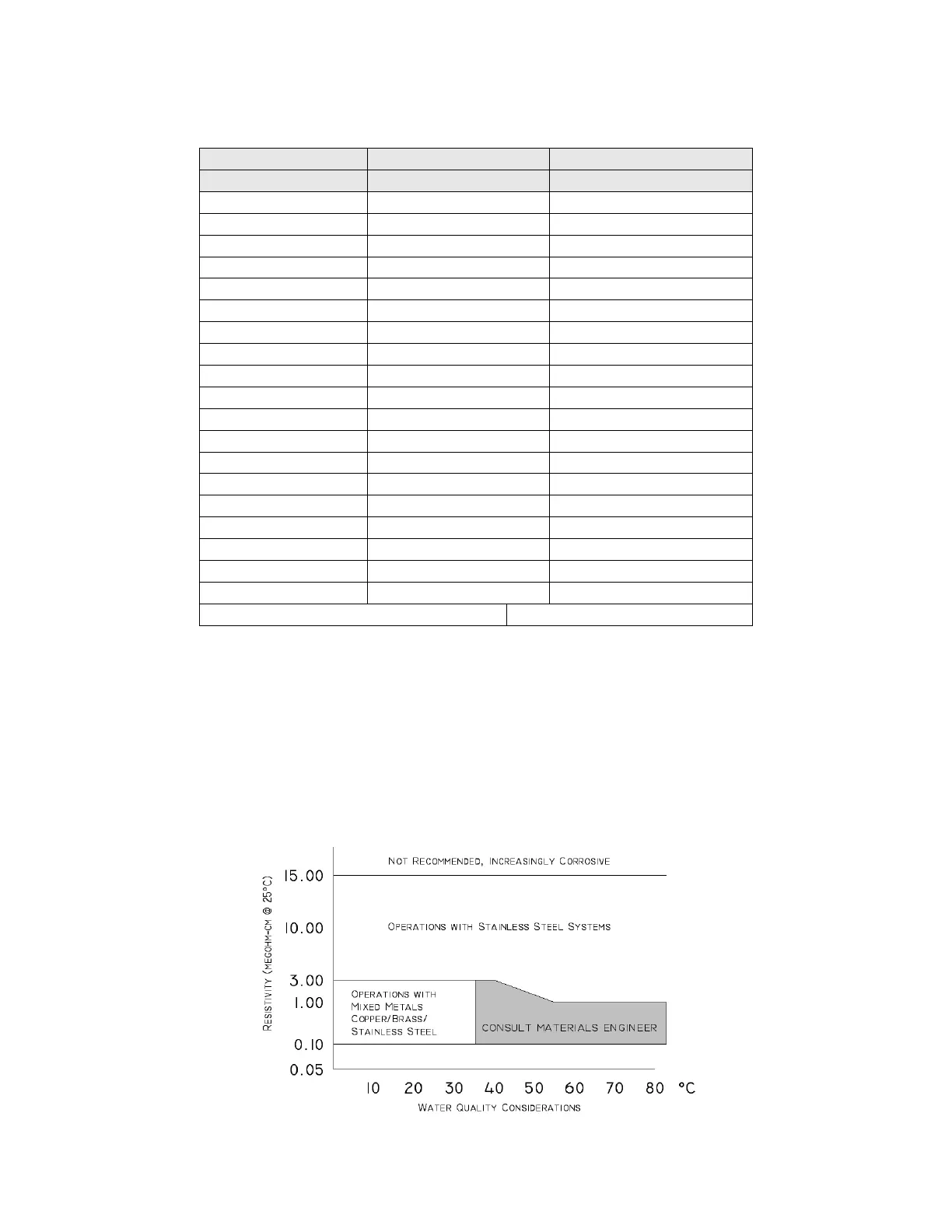
*Megohm-Cm (Compensated to 25°C)
Unfavorably high total ionized solids (TIS) can accelerate the rate of galvanic corrosion. These contaminants
can function as electrolytes which increase the potential for galvanic cell corrosion and lead to localized
corrosion such as pitting which can be observed at the studs and on the outside surface of cooling coils.
Eventually, the pitting will become so extensive that the coil will leak refrigerant into the water reservoir.
For example, raw water in the U.S. averages 171 ppm (of NaCl). The recommended level for use in a water
system is between 0.5 to 5.0 ppm (of NaCl).
Recommendation: Initially fill the tank with distilled/deionized water. Do not use untreated tap water as the total
ionized solids level may be too high.
Maintain this water quality at a resistivity of between 1 to 10 megohm-cm (compensated to 25°C) by using a
purification system. Although the initial fill may be as high as 10 megohm-cm (compensated to 25°C), the
desired level for long time usage 1 to 3 megohm-cm (compensated to 25°C).
The above two recommendations will reduce the electrolytic potential of the water and prevent or reduce the
galvanic corrosion observed.



 To Next Page