22
optibelt
TT 3
3.1 Measuring without
belt parameters
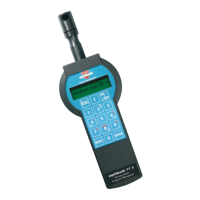
After it is switched on, the device
is immediately ready to measure
(display “A” for “active”). The
tensioned belt is brought into
vibration by touching with a nger or
an object. Then, you hold the sensor
head over the belt drive to measure
the frequency. To achieve the
ma ximum possible accuracy, the TT 3
attempts to carry out 4 consecutive
measurements. The number of
successfully performed measurement
cycles is shown on the right next to
the “A”. If there are less than
3 measurement cycles, the process
should be repeated. The completion
of a measurement cycle is conrmed
both by acoustic and by visual
signals. The frequency measured is
shown in the upper line of the display
(see diagram 1).
3
Carrying out of measurements
3.2 Measuring with belt
parameters
The Optibelt TT 3 FrequencyTension
Tester makes
possible a comparison of
the actual and the targeted static belt
tension.
This static belt tension is calculated
according to the following formula:
T = 4 x k x L
2
x f
2
with:
• T = static tension [N]
• K = meter weight [kg/m]
• L = length of span [m]
• F = frequency of the belt [Hz]
In order to evaluate the measurement
result qualitatively, the TT 3 must also
know the nominal static belt tension.
3.2.1 Measuring with
belt parameters
from the Optibelt
data bank
The product group and the prole
from the Optibelt data bank are
selected using key 4.
The following are stored:
• Optibelt V-belts
– Optibelt SK Wedge belts
– Optibelt VB Classical V-belts
– Optibelt S-TX Raw edge,
moulded cogged V-belts
• Optibelt Timing belts


 To Next Page