10
Fabric facing
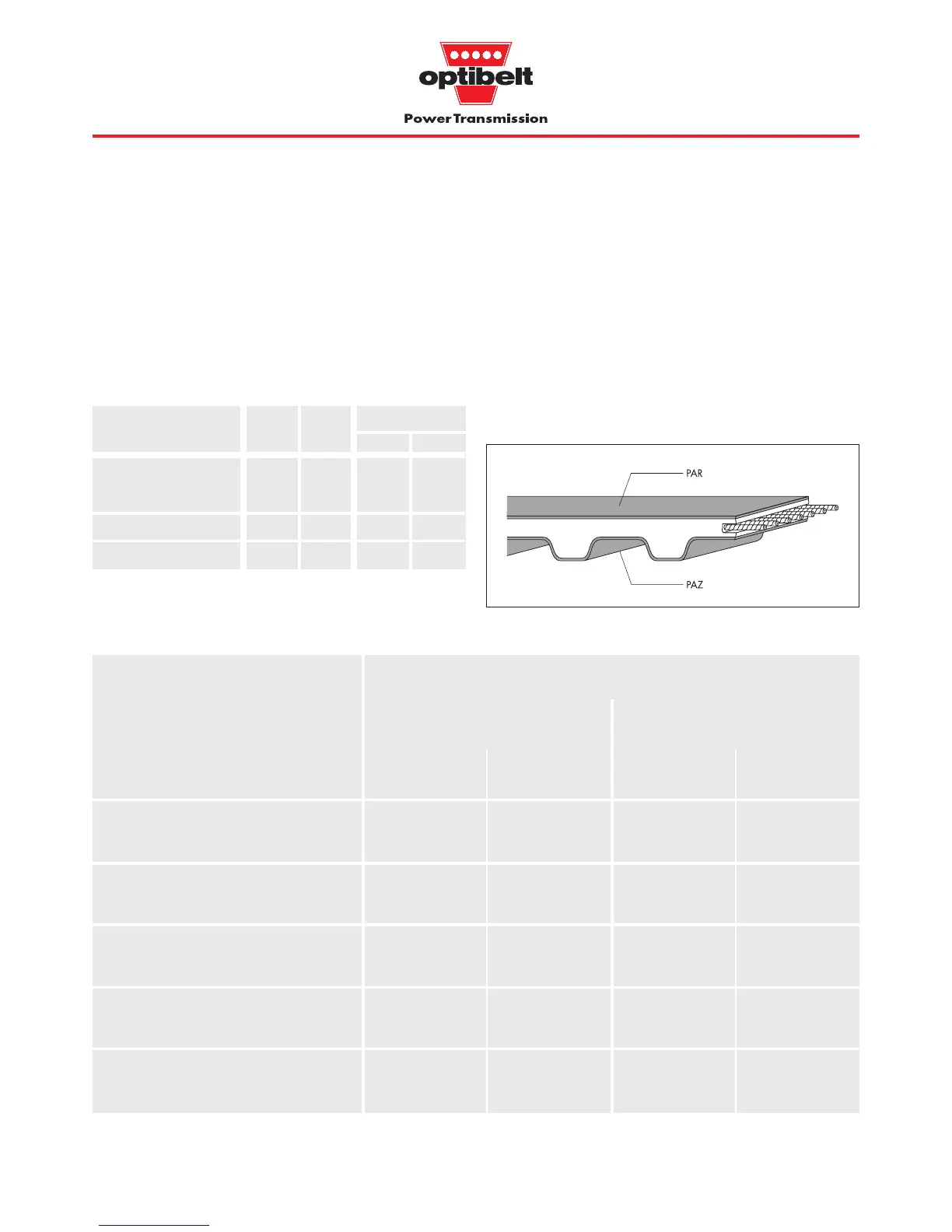
Optibelt timing belts can be supplied with polyamide fabric on
either the top face or the toothed face of the belt. This fabric offers
less friction resistance than polyurethane and is ideally suited for
facing on belts (PAR) used on ram conveyor applications. Fabric
covering on the toothed face (PAZ) is used to reduce static and
sliding friction on belts which need to be supported on this face by
plastic or metal rails. Support rails are used primarily on belt haul-
off and feeder sections where support idlers are widely spaced.
Fig. 1.6: Timing belt with fabric facing on both sides
1 Product Description
1.4 Special constructions
Optibelt timing belts can be adapted to the most varied of
applications in the conveying, control and handling fields, by the
appropriate choice of top surfaces, fabric facings and cleats.
The Optibelt ZRM/ZRP timing belts, intended for use for power
transmission can also be provided with an additional top surface.
Table 1.5: Special constructions
The special constructions shown in Table 1.5 can be combined with
one another.
Special ZRM ZRP ZRL
construction ZRL-M ZRL-V
Fabric facings
– top face (PAR) ●●
– toothed face (PAZ) ●●
Additional top surfaces ●●●●
Conveyor cleats ●●
* polyamide fabric is required where sliding friction is important
Which of the coefficients of friction is used depends upon whether
the conveyed components are static or sliding on the belt. The
coefficients of friction apply for dry conditions and can vary with
belt speed, heat dissipation rate and texture of the surface of the
materials in contact. The upper and lower limits of the coefficients
of sliding friction are based on a belt speed of 0.1 to 1.0 m/sec.
≥ 0.40 ≥ 0.25
≤ 0.70 ≤ 0.45
≥ 0.50 ≥ 0.20
≤ 0.90 ≤ 0.30
≥ 0.30 ≥ 0.20
≤ 0.50 ≤ 0.35
≥ 0.85* ≥ 0.30
≤ 1.00* ≤ 0.50
≥ 0.50 ≥ 0.20
≤ 0.85 ≤ 0.35
µ
0
µµ
0
µ
R
z
= 16 µm
R
z
= 6,3 µm
Table 1.6: Coefficients of friction
slairetamtcatnoC noitcirffostneiciffeoC
enahteruyloP
gnicafcirbafRAP/ZAPtuohtiw
enahteruyloP
gnicafcirbafRAP/ZAPhtiw
noitcirfcitatsnoitcirfgnidilsnoitcirfcitatsnoitcirfgnidils
,leetS
5554
,muinimulA
0553
enelyhteyloP
5252
,ssalG
htooms
0503
,dooW
niargehthtiw
5353.0


 To Next Page