11
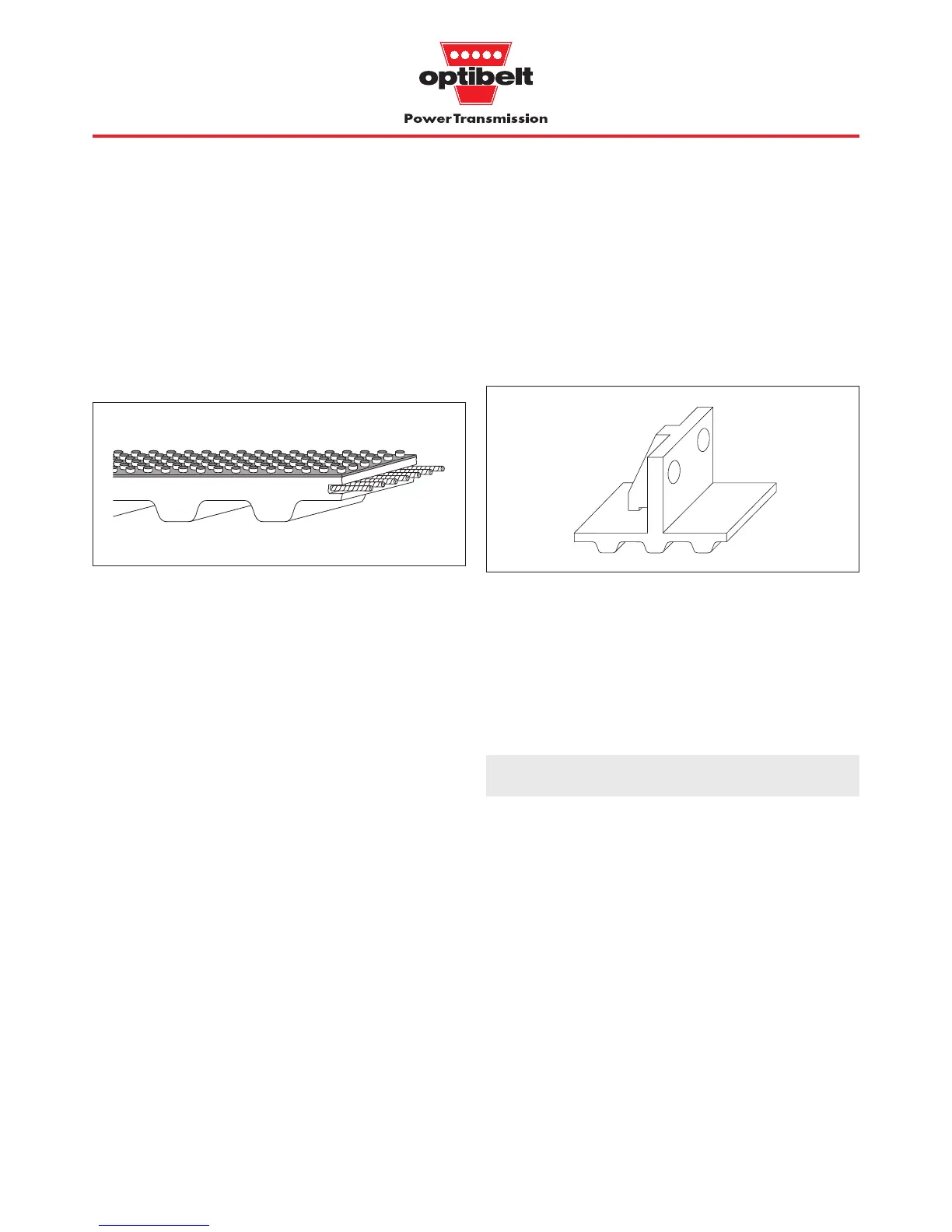
Additional top surfaces
The top surface materials listed in Table 1.4 on page 9 improve
conveying rates by increasing the coefficient of friction. They also
protect the top surface of the belt. They allow the belt to be used
on a small incline or on a haul-off arrangement in which the belt is
used to overcome level differences. Where stringent demands are
made on the uniformity of the surface or thickness, the top surface
can also be ground.
Fig.1.7: Additional top surfaces e.g. studs, white
Conveyor cleats
The belts in the Optibelt programme can be fitted with conveyor
cleats. Like the timing belt, they are made of polyurethane and are
welded to the back of the belt.
By making positive contact with the transported goods, the con-
veyor cleats extend the range of applications for ZRL timing belting
as follows:
● uniform feed e.g. for production and assembly lines
● conveying of bulky items using belts running in
parallel
● inclined and vertical conveying to bridge differences
in levels
● positioning and switching in handling and control
systems
1 Product Description
1.4 Special constructions
The shapes and sizes of the cleats are adapted to the function they
are required to carry out. They can, for example, be provided with
holes if fixtures are to be attached e.g. for vertical conveying.
Cleats with V-shaped grooves on their upper faces are suitable for
conveying in longitudinal and transverse directions.
Fig.1.8: Cleats with unwelded back supports for large loads and
with holes for fixtures
Cleats should be narrow in the area of the weld and are usually
arranged opposite a belt tooth. The original flexibility of the timing
belt is thus retained. In order to achieve this, the required cleat
spacing a
m
must coincide with the tooth pitch t, and the belt length
L
w
must be matched to the number n
m
of cleats required for the
length of the conveyor in question. With particularly long timing
belts, the length tolerance of the belt must be taken into considera-
tion (see Table 5.2, page 43).
L
w
= a
m
· n
m
a
m
= t · x x total number of teeth


 To Next Page