BWS350 System Installation, Operation & Maintenance 14
Introduction
The AMS-QT Reverse Osmosis membrane uses
pressure to allow pure water molecules to lter through
its semipermeable membrane separating pure water
from dissolved solids (salts) and other contaminants.
In essence the membrane splits feed water into two
separate streams. One stream is the water produced
for use (product or pure water), and the other
contains the salts and contaminants ltered out by
the membrane (reject) carried away to the drain. The
OptiPure BWS350 is designed to produce water at
a 30% recovery rate which means it uses water at a
ratio two gallons of reject water for each gallon of pure
water produced. This is a Product/Reject Ratio of
1:2.
The “pure water” produced by the membrane is
not always appropriate for use with food service
equipment. The BWS350 system also allows
blending ltered water with the pure water to produce
Optimized Water which can be adjusted to provide
the ideal characteristics for foodservice equipment
applications. Instructions for blending Optimized water
are on page 10.
Each system is adjusted at the factory for the
proper operating parameters.
In most cases the factory setting should not be
changed. However, due to certain conditions an
adjustment may produce better operating efciency
and membrane performance. Conditions that can
inuence the best Product/Reject Flow Rate Ratio
include feed water quality (TDS level, Turbidity and
specic contaminants such as iron and silica) along
with water temperature and water pressure. The
determination of whether to make a Product/Reject
Flow Rate adjustment is complex. An understanding
of your water chemistry and operating conditions in
necessary in order to safely deviate from the factory
setting. It is strongly recommended that you
contact your OptiPure dealer or the factory for
assistance before changing the factory setting.
Reject Flow Rate Adjustment
The parameter that can be adjusted is the Reject
Flow Rate. This is the amount of water used to carry
away the impurities rejected by the membrane. It
is critical that both the Product Flow Rate and the
Reject Flow Rate are measured to conrm the desired
Product/Reject Ration has been achieved. The higher
the ratio of product to reject ow rate, the shorter the
life of the membrane will be.
IMPORTANT: Never close the Reject Flow Control
Valve, and never adjust it such that the Reject ow
rate is less than the Permeate (Product) ow rate!
This will cause premature fouling and shorten
membrane life.
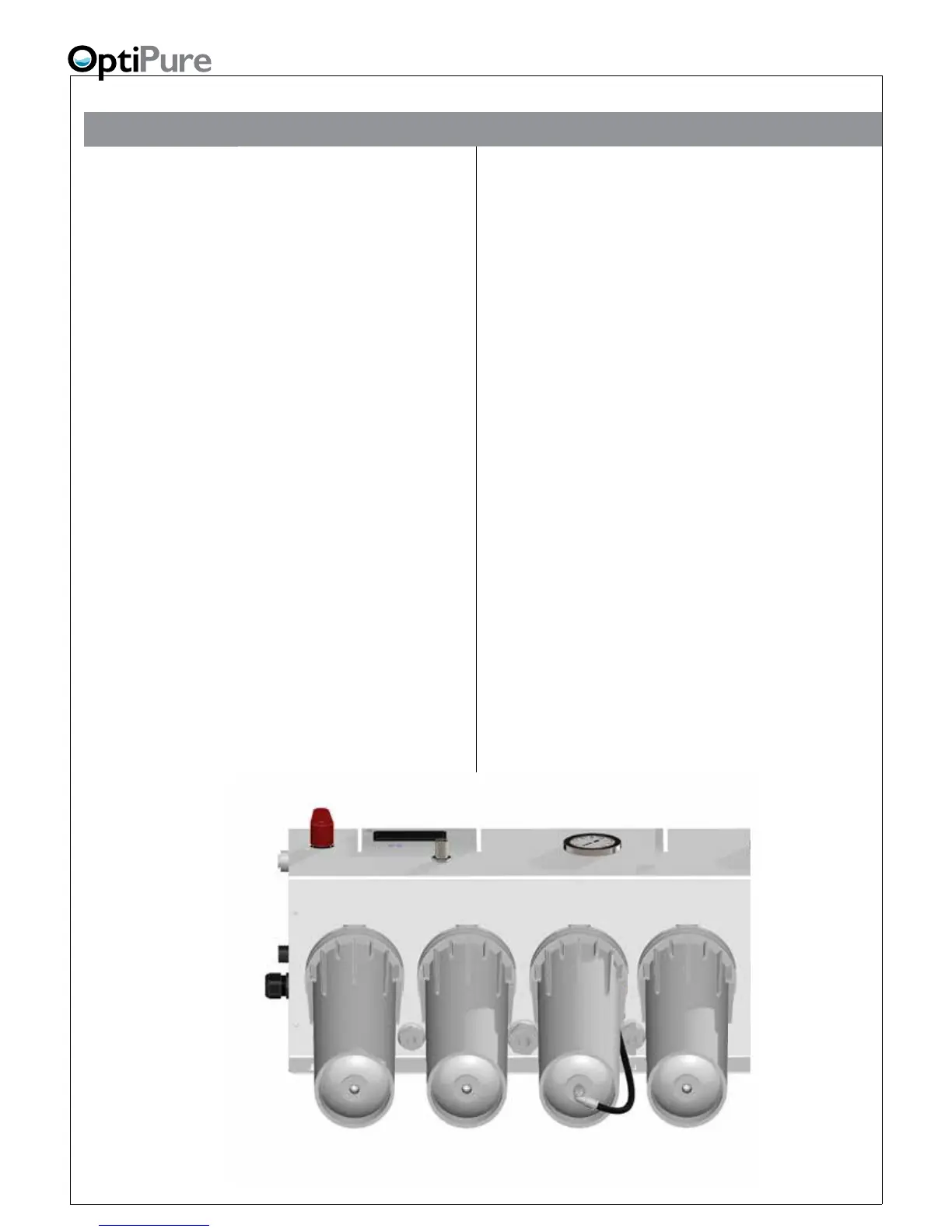
To adjust the reject ow rate, locate the reject ow
control valve. Loosen the lock-nut (at the base of the
valve stem) just slightly.
IMPORTANT: Before adjusting Reject Flow Rate
CLOSE the BLENDING VALVE.
To increase the reject ow rate, use a slot screw driver
to turn the valve stem counterclockwise. To reduce the
reject ow rate, turn it clockwise. A minor adjustment
makes a big difference in the ow rate so begin with
Product/Reject Flow Rate Adjustments
Reject Flow Control
Adjust with Blend Valve Closed


 To Next Page