
 Need help?
Do you have a question about the Orbit OceanTRx7 and is the answer not in the manual?
Lists the revision history for the document, detailing changes and modifications.
Explains text formatting, symbols, and notations used in the manual for clarity.
Details the meaning of symbols like 'Note', 'Hazard', and 'Adherence' used in the document.
States the document's objective is to provide instructions for replacing and configuring the ADMX.
Outlines the fundamental principles to be followed during the procedures described in the note.
Provides a table of torque values for tightening various screw types used in the ADMX replacement.
Explains the function and role of the ADMX module in the communication link.
Lists the parts included in the ADMX spare kit with their part numbers and quantities.
Lists necessary tools and customer-supplied parts for performing the procedures.
Detailed steps and images for safely disconnecting and removing the ADMX unit.
Step-by-step instructions and visuals for installing the new ADMX unit onto its mounting plate and pedestal.
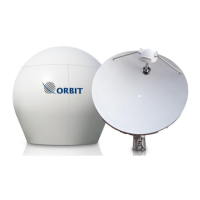
The Orbit OceanTRx7™ Maritime Stabilized VSAT System is a sophisticated communication solution designed for maritime environments, ensuring reliable and continuous satellite connectivity. At its core, the system leverages the OceanTRx7™ and OceanTRx™ technologies to provide robust and stable VSAT (Very Small Aperture Terminal) services on vessels. This system is engineered to maintain communication without boundaries, a testament to Orbit Communication Systems' commitment to high-performance maritime communication.
The OceanTRx7™ system facilitates high-speed, two-way satellite communication for maritime applications. It is specifically designed to provide broadband connectivity to ships, enabling a wide range of services such as internet access, voice communication, video conferencing, and data transfer, even in challenging sea conditions. The "Stabilized" aspect of the VSAT system is crucial for maritime use, as it ensures that the antenna remains pointed accurately at the satellite despite the vessel's motion (pitch, roll, and yaw). This stabilization is achieved through advanced gyroscopic and motion compensation technologies, which continuously adjust the antenna's position to maintain a stable link.
A key component of this system is the Above Deck Mux (ADMx), which plays a vital role in the communication link. The ADMx, mounted on the pedestal of the antenna, works in conjunction with the Below Deck Mux (BDMx), located inside the Below Deck Equipment (BDE) CCU (Control and Communication Unit). Together, these multiplexer modules form the communication link between the Above Deck Equipment (ADE) and the BDE. This design significantly minimizes the physical connection requirements, reducing it to a single coaxial cable (LMR-200, LMR-400, or LMR-600, depending on the required cable length). This simplification of cabling reduces installation complexity and potential points of failure, enhancing system reliability. Beyond its multiplexing function, the ADMx also provides integral amplification and attenuation of both the transmit (Tx) and receive (Rx) paths, optimizing signal quality and strength for efficient satellite communication.
The overall system is designed to be a comprehensive solution for maritime satellite communication, ensuring that vessels can maintain critical data and voice links for operational efficiency, crew welfare, and safety. Its robust design and advanced stabilization capabilities make it suitable for a variety of maritime vessels, from commercial ships to offshore platforms, requiring uninterrupted connectivity.
The OceanTRx7™ system is built for ease of operation and maintenance, with several features that enhance its usability in a maritime setting. The system's design focuses on minimizing the complexity of installation and ongoing management.
One of the primary usage features is its ability to provide continuous and stable communication regardless of sea conditions. This is paramount for maritime operations, where reliable connectivity is essential for navigation, weather updates, operational data transfer, and crew communication. The advanced stabilization technology ensures that users on board experience consistent broadband access, similar to terrestrial internet services.
The system's architecture, with the ADMx and BDMx, simplifies the cabling infrastructure. By consolidating multiple signals onto a single coaxial cable, the system reduces the number of cables running between the above-deck antenna and the below-deck control unit. This not only makes installation quicker and less intrusive but also reduces clutter and potential points of failure, which is a significant advantage in the confined and harsh environment of a ship.
The ADMx's integral amplification and attenuation capabilities mean that signal quality is actively managed within the above-deck unit. This ensures that signals are optimized before transmission to the satellite and upon reception, contributing to higher data rates and more reliable links. This active signal management reduces the need for external amplification or complex signal conditioning, streamlining the overall system.
The system is designed to be user-friendly, with clear instructions for operation and maintenance. The manual emphasizes the importance of understanding all information and procedures, ensuring that personnel can effectively manage the system. The use of standard text conventions, such as specific fonts for screen elements, hardware components, and GUI elements, aids in clarity and ease of understanding for operators.
Furthermore, the system is designed to be robust against environmental factors common in maritime settings, such as salt spray, extreme temperatures, and vibrations. This durability ensures long-term performance and reduces the frequency of repairs or replacements. The overall goal is to provide a "communication without boundaries" experience, enabling seamless connectivity for all maritime communication needs.
Maintenance of the Orbit OceanTRx7™ system, particularly the ADMx, is designed to be straightforward, with clear procedures outlined to ensure system longevity and reliability. The manual provides detailed instructions for tasks such as replacing the ADMx, emphasizing safety and precision.
A critical aspect of maintenance is the adherence to specific torque values for screws. The manual includes a comprehensive torque table for various screw types (M8, M6, M5, M4, M3), ensuring that components are fastened securely without being over-tightened or under-tightened. This precision prevents damage to delicate parts and ensures the structural integrity of the system, which is vital in a vibrating maritime environment.
The replacement procedure for the ADMx is broken down into clear, step-by-step instructions, complete with visual aids. This includes disconnecting RF cables, unlocking and removing network cables, unscrewing plugs, and removing mounting plates. The use of standard tools like open/ring wrenches and Allen keys simplifies the process, making it accessible to qualified personnel. The manual explicitly lists the required tools and spare kit contents, ensuring that technicians have everything they need before beginning a maintenance task.
Safety is a paramount concern in all maintenance procedures. The manual includes prominent warnings about handling delicate screws to prevent thread stripping and emphasizes the importance of inserting Allen keys fully. Crucially, it highlights the presence of live voltage at the Utility Outlet even after disconnecting the main power supply to the ADE, underscoring the need for caution. It also states that only qualified and authorized personnel are permitted to carry out service and maintenance, ensuring that procedures are performed safely and correctly.
After any replacement or maintenance, a "Post replacement check" procedure is outlined to verify system functioning. This includes starting up the system, checking for any error or warning messages, and confirming communication between the CCU and ACU. The final step involves performing a 1dbcp (one decibel compression point) test with the Network Operations Center (NOC) to confirm that the system is back online and fully operational. This systematic approach to post-maintenance verification ensures that the system is restored to full functionality and reliability.
The provision of a spare kit with essential components like the ADMx unit itself and various screws further streamlines maintenance, allowing for quick replacements and minimizing downtime. The detailed documentation, including revision history and effective releases, ensures that maintenance personnel are working with the most current and relevant information. This comprehensive approach to maintenance ensures that the OceanTRx7™ system can be kept in optimal working condition, providing uninterrupted communication for maritime operations.
 General
| Manufacturer | Orbit Communication Systems |
|---|---|
| Category | Marine Equipment |
| Frequency Band | C, Ku, Ka |
| Stabilization | 3-axis |
| Antenna Size | 2.2 meters |

 To Next Page

