13
Customer Helpline
0844 801 3652
General cutting instructions
Cutting
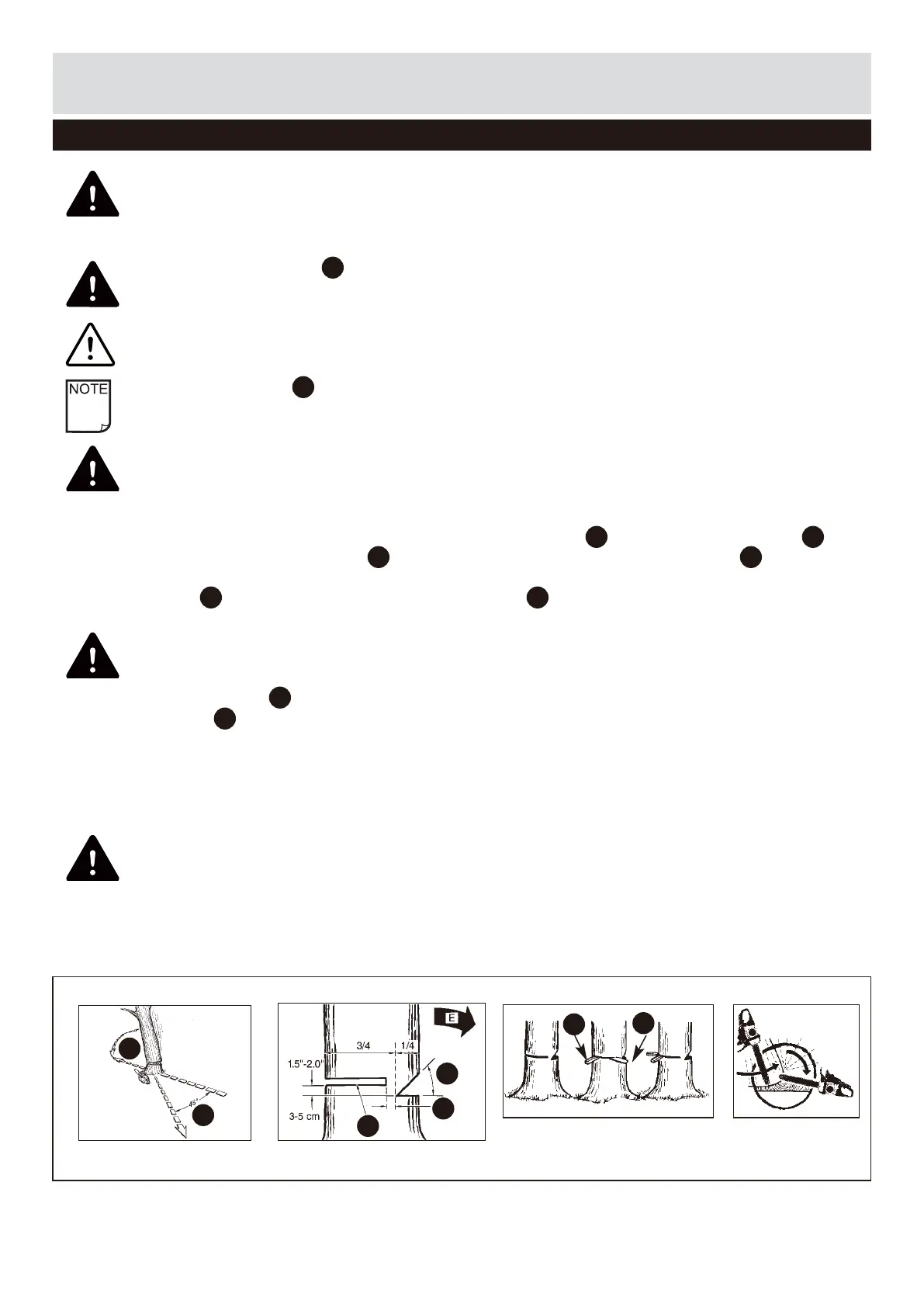
WARNING: A retreat path (A) should be planned and cleared as necessary before cuts are started.
The retreat path should extend back and diagonally to the rear of the expected line of fall, as illustrated
in Fig.11A.
WARNING: Do not cut down a tree during high or changing winds or if there is a danger to property.
Consult a tree professional. Do not cut down a tree if there is a danger of striking utility wires; notify
the utility company before making any cuts.
WARNING: Never walk in front of a tree that has been notched.
WARNING: Before making the nal cut, always recheck the area for bystanders, animals or
obstacles.
FELLING A TREE:
Normally felling consists of 2 main cutting operations, notching (C) and making the felling cut (D).
Start making the upper notch cut (C) on the side of the tree facing the felling direction (E). Be sure you
don t make the lower cut too deep into the trunk.
The notch (C) should be deep enough to create a hinge (F) of sufcient width and strength. The notch
should be wide enough to direct the fall of the tree for as long as possible.
Never saw completely through the trunk. Always leave a hinge. The hinge guides the tree. If the trunk
is completely cut through, control over the felling direction is lost.
Insert a wedge or felling lever in the cut well before the tree becomes unstable and starts to move. This
will prevent the guidebar from binding in the felling cut if you have misjudged the falling direction. Make
sure no bystanders have entered the range of the falling tree before you push it over.
Make the felling cut (D) from the other side of the tree and 1.5 - 2.0 inches (3-5 cm) above the edge
of the notch (C) (Fig.11B)
GENERAL GUIDELINES FOR FELLING TREES:
1. Use wooden or plastic wedges (A) to prevent binding the bar or chain (B) in the cut. Wedges also
control felling (Fig.11C).
2. When diameter of wood being cut is greater than the bar length, make 2 cuts as shown (Fig.11D).
FELLING CUT:
NOTE: Direction of fall (B) is controlled by the notching cut. Before any cuts are made, consider the
location of larger branches and natural lean of the tree to determine the way the tree will fall.
Fig. 11A
B
Fig. 11B
CAUTION: If felling a tree on sloping ground, the chainsaw operator should keep on the uphill side of
the terrain, as the tree is likely to roll or slide downhill after it is felled.
Fig. 11DFig. 11C
A
WARNING: To seek professional advice if in doubt about felling large trees.
A
B
C
F
EC
C
C
A
A
B
C
D
F
B
D
D



 To Next Page