11
y
CMD2120P
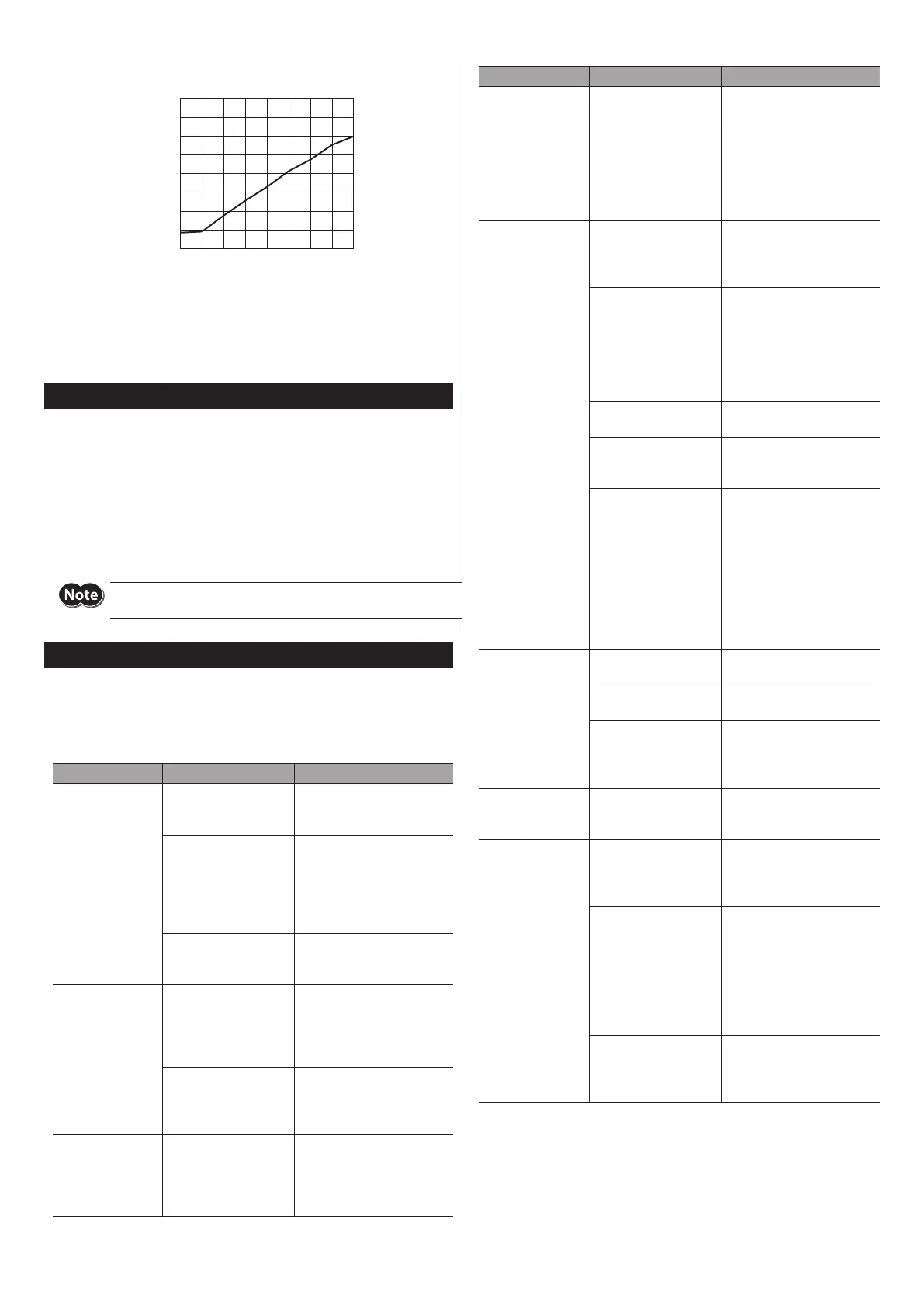
[Representative values]
0
10
20
30
40
50
60
70
80
12345678
STOP potentiometer
Current-cutback ratio (%)
4. When the setting is complete, turn o the power supply.
After about 0.1 second has passed since the pulse was stopped, the
motor’s operating current automatically decreases to the set value of
current at motor standstill.
Inspection
It is recommended that periodic inspections are conducted for the items
listed below after each operation of the motor. If an abnormal condition is
noted, discontinue any use and contact your nearest Oriental Motor sales
oce.
Inspection item
y
Are any of the mounting screws having installed the driver or connection
parts of the driver loose?
y
Is there attachment of dust, etc., on the driver?
y
Are there any strange smells or appearances within the driver?
The driver uses semiconductor elements, so be extremely careful when
handling them. Static electricity may damage the driver.
Troubleshooting and remedial actions
During motor operation, the motor or driver may fail to function properly due
to an improper speed setting or wiring. When the motor cannot be operated
correctly, refer to the contents provided in this section and take appropriate
action. If the problem persists, contact your nearest Oriental Motor sales
oce.
Phenomenon Possible cause Remedial action
y
The motor is not
excited.
y
The motor’s
output shaft can
be turned easily by
hand.
Connection error in the
motor or power supply.
Check that the connections
between the driver, motor and
power supply are correct.
Motor operating current
incorrectly set. If the
setting is too low, the
motor torque will also be
too low and operation
will be unstable.
Return the motor operating
current to its factory setting
and check.
The AWO input is set to
ON.
Switch the AWO input to OFF
and conrm that the motor is
excited.
The motor does not
run.
Pulse input line
connection error.
y
Check the controller and
driver connections.
y
Check the pulse input
specications (voltage and
width).
The CW input and the
CCW input came ON at
the same time.
Input either the CW input or
the CCW input, and always
switch the other terminal to
OFF.
The motor rotates
in the direction
opposite that which
is specied.
The CW input and the
CCW input are connected
in reverse.
Connect the CW pulses to the
CW input (pin Nos.1 and 2),
and connect the CCW pulses
to the CCW input (pin Nos.3
and 4).
Phenomenon Possible cause Remedial action
Motor operation is
unstable.
Motor connection error.
Check that the driver and
motor connections are correct.
Motor operating current
incorrectly set. If the
setting is too low, the
motor torque will also be
too low and operation
will be unstable.
Return the motor operating
current to its factory setting
and check.
Loss of
synchronization
during acceleration
or running.
The centers of the
motor’s output shaft
and load shaft are not
aligned.
Check the connection
condition of the motor output
shaft and load shaft.
The load or load
uctuation is too high.
Check for large load
uctuations during motor
operation. If adjusting the
motor’s operating speed to
low and high torque eliminates
the problem, it is necessary to
review the load conditions.
The speed of the starting
pulse is too high.
Lower the speed of the starting
pulse.
The acceleration
(deceleration) time is too
short.
Lengthen the acceleration
(deceleration) time.
Eect of electrical noise.
Check running with only the
motor, driver and required
controller. If the impact of
noise is recognized, take
countermeasures, such as
rewiring for greater distance
from the noise source,
changing the signal cables to
shielded wire, or mounting a
ferrite core.
Motor does not
move the set
amount.
Mistake in switching CS
input.
Check the CS input state.
Wrong step angle
settings.
Check the settings of the step
angle setting switches.
Pulse output count is too
low or too high.
Check whether or not the
number of pulses required for
operation at the set step angle
are being output.
Current does not
drop when the
motor stops.
The ACDOFF input is set
to ON.
Switch ACDOFF input to OFF.
Motor vibration is
too loud.
The centers of the
motor’s output shaft
and load shaft are not
aligned.
Check the connection
condition of the motor output
shaft and load shaft.
Motor is resonating.
If the vibration decreases
when the operating pulse
speed is changed, it means
the motor is resonating.
Change the operating pulse
speed setting or install a
clean damper (accessory) to
suppress vibration.
Load is too small.
Lower the motor operating
current. Vibration will increase
if the motor’s output torque is
too large for the load.



 To Next Page
 Loading...