
 Need help?
Do you have a question about the otometrics Bio-Logic NavPRO ONE and is the answer not in the manual?
Details the connection and setup for Auditory Steady State Response (ASSR) testing.
Explains how to adjust test parameters like stimulus bandwidth, masking noise, and test modes.
Describes the components and data displayed on the ASSR test screen during a test.
Guides on viewing and interpreting the results and audiograms from ASSR tests.
The Bio-logic® NavPRO ONE® ASSR is a portable device designed for Auditory Steady State Response (ASSR) testing, offering a comprehensive solution for audiological assessments. This quick start guide outlines the device's core functionalities, from basic operation to advanced testing and result interpretation.
The primary function of the Bio-logic® NavPRO ONE® ASSR is to perform Auditory Steady State Response (ASSR) tests. ASSR is an objective audiological test used to estimate hearing thresholds in individuals who cannot provide reliable behavioral responses, such as infants, young children, or individuals with developmental disabilities. The device generates auditory stimuli and records the brain's electrical activity in response to these stimuli, allowing for the estimation of hearing thresholds across different frequencies.
The device supports both monaural and binaural testing, providing flexibility for various clinical scenarios. It can be used with different transducers, including headphones, insert earphones, and ear probes, to accommodate diverse patient needs and testing environments. The system is designed to provide frequency-specific information, which is crucial for accurate diagnosis and management of hearing loss.
In addition to ASSR, the device's start menu indicates the potential for other audiological tests, such as QuickABR, ABR (Auditory Brainstem Response), Audio, and DPOAE Diag (Distortion Product Otoacoustic Emissions Diagnostics). While this quick start guide focuses on ASSR, the presence of these options suggests a multi-functional platform capable of a broader range of audiological evaluations, making it a versatile tool for hearing healthcare professionals.
The Bio-logic® NavPRO ONE® ASSR is designed for ease of use, featuring a clear and intuitive interface.
Powering On/Off and Charging: The device is turned on or off using a dedicated button located on the right side. It can be charged via a power supply connector, ensuring the device is ready for use when needed.
Start Menu Navigation: Upon powering on, the device presents a start menu with various test options, which may vary depending on the specific setup. Users can select the desired test, such as ASSR, from this menu. The screen also displays the current time and provides options to customize settings or turn off the device. An "Additional information" button offers context-sensitive help for the current screen's options.
Electrode and Transducer Connection: For ASSR testing, the device requires the connection of an electrode cable and a transducer. The electrode cable connects to a white connector, while the probe connects to a red connector. Transducers like headphones or insert earphones connect to a blue connector, and a second probe for binaural testing also connects to a blue connector. This color-coded system simplifies the setup process, reducing the chance of incorrect connections.
Patient Preparation and Electrode Placement: Proper patient preparation is crucial for accurate results. The guide emphasizes cleaning the patient's skin before placing electrode pads. Recommended electrode montage includes:
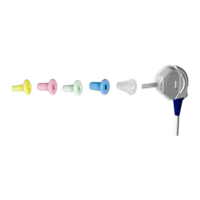
Transducer Placement: If using insert earphones, selecting the correct size ear tips and placing them properly in the ear canal is essential. For headphones, they should be placed over the ears.
Protocol Selection and Parameter Configuration: After selecting ASSR, users choose a protocol from a list of presets, such as "Fixed 40Hz," "Thres 40Hz," "Fast Thres," "Fine Thres," and "FastScreen." To modify parameters, users select a preset and then use the "tools" button at the bottom of the screen.
Configurable Test Parameters: The device offers extensive configurability for ASSR tests:
Test Ear Selection: Users select the test ear (Right, Left, or Right + Left for binaural testing) by pressing the corresponding button. Binaural testing is available when headphones, insert phones, or two ear probes are connected, especially when stimulating at low intensity levels.
Patient Comfort and Impedance Check: Ensuring the patient is sitting or lying down comfortably is important. Before measurement, an impedance check is performed. An impedance below 6 kOhm makes the start button available, with an impedance below 4 kOhm allowing for autostart if configured. If impedance is between 6 kOhm and 12 kOhm, a "skip" button becomes available. An impedance below 6 kOhm is recommended for best test results.
Calibration: If an ear probe is used, a calibration is performed alongside the impedance check. Users can choose between "simple calibration" or "expert calibration" modes in the device setup.
ASSR Test Screen: During the test, the screen displays:
ASSR Test Results: The device presents test results in various formats:
While the quick start guide does not explicitly detail maintenance features, several aspects imply the device's design for reliability and longevity:
In summary, the Bio-logic® NavPRO ONE® ASSR is a sophisticated yet user-friendly device for ASSR testing, offering comprehensive features for accurate hearing threshold estimation. Its intuitive interface, configurable parameters, and clear result presentation make it an effective tool for audiological professionals, while implied maintenance practices ensure its reliability and longevity.
 General
| Category | Medical Equipment |
|---|---|
| Manufacturer | Otometrics |
| Reporting | Customizable reports |
| Device Type | Diagnostic Audiometer |
| Stimulus Types | Click, Toneburst, Chirp |
| Filter Settings | Adjustable |
| Testing Capabilities | ABR, OAE |
| OAE Features | DPOAE, TEOAE |
| Connectivity | USB |
| Channels | 2 |
| Stimulus Rate | Adjustable |
| Stimulus Intensity | Adjustable |
| Power Supply | AC adapter, Battery |
| Weight | Lightweight |
| Modularity | Modular design for flexible configurations |
| Dimensions | Compact and portable design |



 To Next Page