
 Need help?
Do you have a question about the otometrics ICS Impulse USB and is the answer not in the manual?
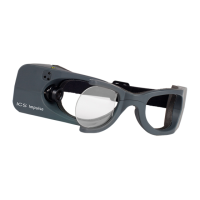
Describes the goggles and their intended application in vestibular testing.
Explains the use of warning, caution, and note statements.
Steps to start the application and log in.
Describes the navigation panel and presentation remote functions.
Covers entering patient data and logging out of the system.
Procedure for creating and managing patient records.
How to access patient lists and view collected tests.
How to select tests and add remarks for analysis.
Procedures for deleting selected tests and videos to save space.
Steps for managing videos related to Head Impulse tests.
How to add and edit test remarks using the Remarks window.
Recommendations for patient prep and goggles cleaning.
Instructions for replacing goggles strap and face cushion.
Instructions on how to properly place and fit the goggles on the patient's face.
Preparing the environment and patient for vision-denied tests.
Steps to attach the vision-denied eye cups and patches correctly.
Checking light seal and final goggles placement for vision-denied tests.
Test environment setup and video recording for Oculomotor tests.
Steps for detecting the pupil for Oculomotor tests.
Positioning ROI and selecting image display options for pupil detection.
Procedure for calibrating the system for Oculomotor tests.
Steps to check the accuracy of the calibration.
Features to ensure good data collection for Oculomotor tests.
Details on performing Gaze and Spontaneous nystagmus tests.
How to collect Gaze data and monitor head movement.
How to view and analyze Gaze test results.
Overview of the Analysis window components for Gaze data.
Lists test parameters and information for Gaze data analysis.
Options for reanalyzing trace data and playing back collected data.
Procedures for Visual VOR and VOR Suppression tests.
How to collect VOR data and monitor head/eye movement.
How to view and analyze VOR test results.
Overview of the Analysis window for VOR data.
How to collect data for the Skew Deviation test.
Manually indicating eye cover/uncover for accurate calculation.
How to view and analyze Skew Deviation test results.
Overview of the Analysis window for Skew Deviation data.
Test environment setup and pupil detection for Head Impulse tests.
Procedure for performing the Lateral Head Impulse test.
Positioning ROI and selecting image display for pupil detection.
Procedures for performing LARP or RALP Head Impulse tests.
Guidance on head movement feedback for LARP/RALP tests.
Procedure for calibrating the system for Head Impulse tests.
Steps to check the accuracy of the calibration.
How to start and control video recording for Head Impulse tests.
Tips for improving data collection for LARP/RALP Head Impulse tests.
How to set up and collect Head Impulse data.
Criteria for what is considered a valid head impulse.
Options for stopping the test early with or without saving data.
Using Real Time Traces and Impulse windows to monitor data quality.
Displays training curves and actual head/eye traces for analysis.
How to view and analyze results for a single Head Impulse test.
Overview of analysis details for Head Impulse tests.
Explains gain calculation and display.
Explains asymmetry calculation, normative data, and age-based data.
Discusses causes for high gain values and how to display gain data.
How to select and delete individual head impulses.
Defines saccades and refers to relevant analysis features.
Overview of the 2D Analysis window for Head Impulse data.
Overview of the Hex Plot window for analyzing Head Impulse data.
Overview of the 3D Analysis window for Head Impulse data.
How to analyze multiple Head Impulse test sessions.
Viewing multiple test sessions in 3D graphs.
Specifies requirements for the test environment for Positional tests.
Video recording and pupil detection steps for Positional tests.
Positioning ROI and selecting image display for pupil detection.
Procedure for calibrating the system for Positional tests.
Steps to check the accuracy of the calibration.
Features for optimizing data collection and treatment for Positional tests.
Details on performing Dix-Hallpike and Hallpike-Stenger dynamic tests.
Describes Side-Lying and Roll maneuvers for Positional assessment.
How to collect Dynamic data for Positional tests.
Monitoring real-time SPV to track nystagmus subsidence.
How to view and analyze Dynamic test results.
Overview of the Analysis window for Positional data.
Lists test parameters and information for Positional data analysis.
Options for reanalyzing trace data and playing back collected data.
Details on performing Repositioning tests.
Performing Canalith Repositioning Treatment (CRT).
Describes Liberatory and BBQ Roll maneuvers.
How to collect Repositioning data.
Monitoring real-time SPV to track nystagmus subsidence.
How to view and analyze Repositioning test results.
Overview of the Analysis window for Repositioning data.
Lists test parameters and information for Repositioning data analysis.
Options for reanalyzing trace data and playing back collected data.
Options for recording eye video: Full Image or Region of Interest.
Details on using the Region of Interest for video recording.
Controls for starting, stopping, and setting up video recording.
Managing connections and setting up video recording parameters.
Settings for synchronized room video and recording speed.
How to play back video files and view associated information.
Playback controls, speed options, and room video synchronization.
Opening the Reports window and its default content.
Adding information to reports from predefined lists or custom text.
How to select items from Symptoms, Impressions, and Macros lists.
Managing and previewing reports, creating new ones, and selecting data elements.
Details on report elements for Oculomotor and Head Impulse tests.
Details on report elements for Positional tests and toolbar functions.
Accessing the Administrator window and setting up new users.
Editing/deleting users and configuring additional system settings.
Specifies the minimum hardware and software requirements for installation.
Information on remotes and step-by-step software installation.
Options for installing the software: Standalone, Server, Client, Both.
Steps for installing server, client, or both components.
Final steps to complete the software installation.
Adjusting display settings and connecting the ICS Impulse goggles.
Guide for installing the synchronized room video software.
Importing lists, demo data, and customizing facility information.
Installing Adobe Reader and setting up file storage locations.
Setting up storage locations for various file types.
Steps for upgrading the OTOsuite Vestibular application.
Lists available accessories for the ICS Impulse system.
References to manual, video, website, and device standards.
Details on interface, power, performance, software, and laser specs.
Recommended conditions for device operation, storage, and handling.
Compliance with safety and EMC standards.
Manufacturer contact info and statement on responsibilities.
Compliance with WEEE, Medical Devices, and safety standards.
Refers to the Reference Manual for label locations.
Manufacturer's declaration regarding electromagnetic emissions and immunity.
 General
| Connection | USB |
|---|---|
| Compatibility | PC |
| Power Supply | USB-powered |
| Features | Lightweight goggles |
| Functionality | Assessment of vestibular function |
| Eye Tracking | High-speed camera |
| Calibration | Automated calibration procedure |



 To Next Page