9.4 Video recording eye movement during testing
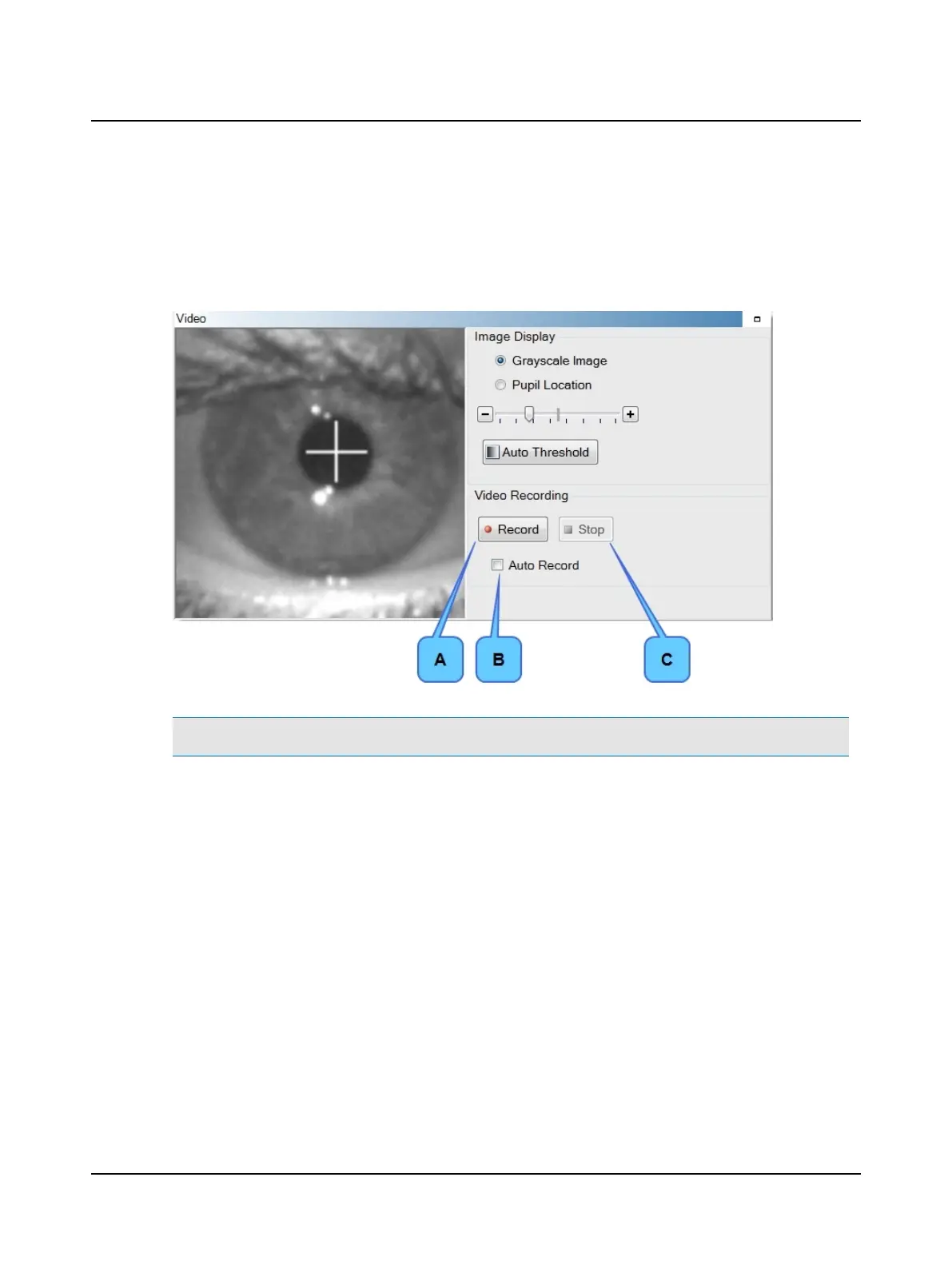
The Video window displays the image of the eye.
To start the video recording at the same time as data collection starts, select the check box Auto Record (B). To control
the recording manually, click Record (A) to start the recording and Stop (C) to stop the recording.
Note• Refer to Video Record/Playback ► 97 for information about playing back a video.
9.5 Optimizing collection
It is best to perfect doing the lateral head impulse test before collecting data using LARP/RALP. LARP/RALP impulse tests
are more difficult to perform and familiarity with the lateral head impulse test will increase success with data collection for
LARP/RALP impulse tests.
The basic head impulse test starts with the tester standing behind the patient who is wearing the goggles. While the
patient is asked to stare at the fixation dot placed on a surface in front of them, the tester rotates the patient’s head hori-
zontally for a lateral head impulse test through a small angle (about 10-20degrees) in a brief, abrupt and unpredictable
manner, varying the direction and the velocity.
For LARP, turn the patient’s head 35-45 degrees to the right. Have the patient stare at the fixation dot. The pupil of the
right eye will be close to the nose. The tester places one hand under the patient’s chin and one on the top of the patient’s
head and rotates the patient’s head vertically through a small angle in pitch (about 10-20 degrees) in a brief, abrupt and
unpredictable manner, varying the direction and the velocity. A head impulse downward stimulates the left anterior canal.
A head impulse upward stimulates the right posterior canal.
For RALP, turn the patient’s head 35-45 degrees to the left. Have the patient stare at the fixation dot. The pupil of the
right eye will be close to right side of their head. The tester places one hand under the patient’s chin and one on the top
52 Otometrics - ICS Impulse USB
9 Head Impulse




 To Next Page