9 Head Impulse
9.1 Test environment
The environment can vary but must allow you to position the patient at least one meter from the wall (or other solid sur-
face that can be used as a projection surface).
For Calibration and Test Purposes:
Note• The patient should be seated in a chair that is stationary and does not swivel.
1. Choose a wall that allows you to position the patient at least one meter in front of the fixation dot.
2. Apply one of the fixation dots supplied with the system to the wall in a location that allows you to position the patient
directly in front of the fixation dot.
9.2 Pupil detection
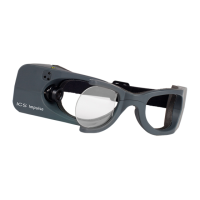
Refer to Goggles placement ► 18 for placement instructions.
9.2.1 Lateral test
Note• It is recommended to do the Lateral test prior to doing either the LARP or RALP test. Calibration must be with
Lateral test type selected.
1. Choose the Impulse Type: Lateral.
2. For patients with spontaneous nystagmus or gaze-evoked nystagmus (evoked by gaze position during head impulse),
select the check box Spontaneous Nystagmus. By selecting this check box for a patient who has spontaneous nys-
tagmus or gaze-evoked nystagmus, it prevents good impulses from being rejected inappropriately.
3. Position the patient at least one meter in front of the wall. (Refer to Test environment ► 44 for information.)
44 Otometrics - ICS Impulse USB
9 Head Impulse




 To Next Page