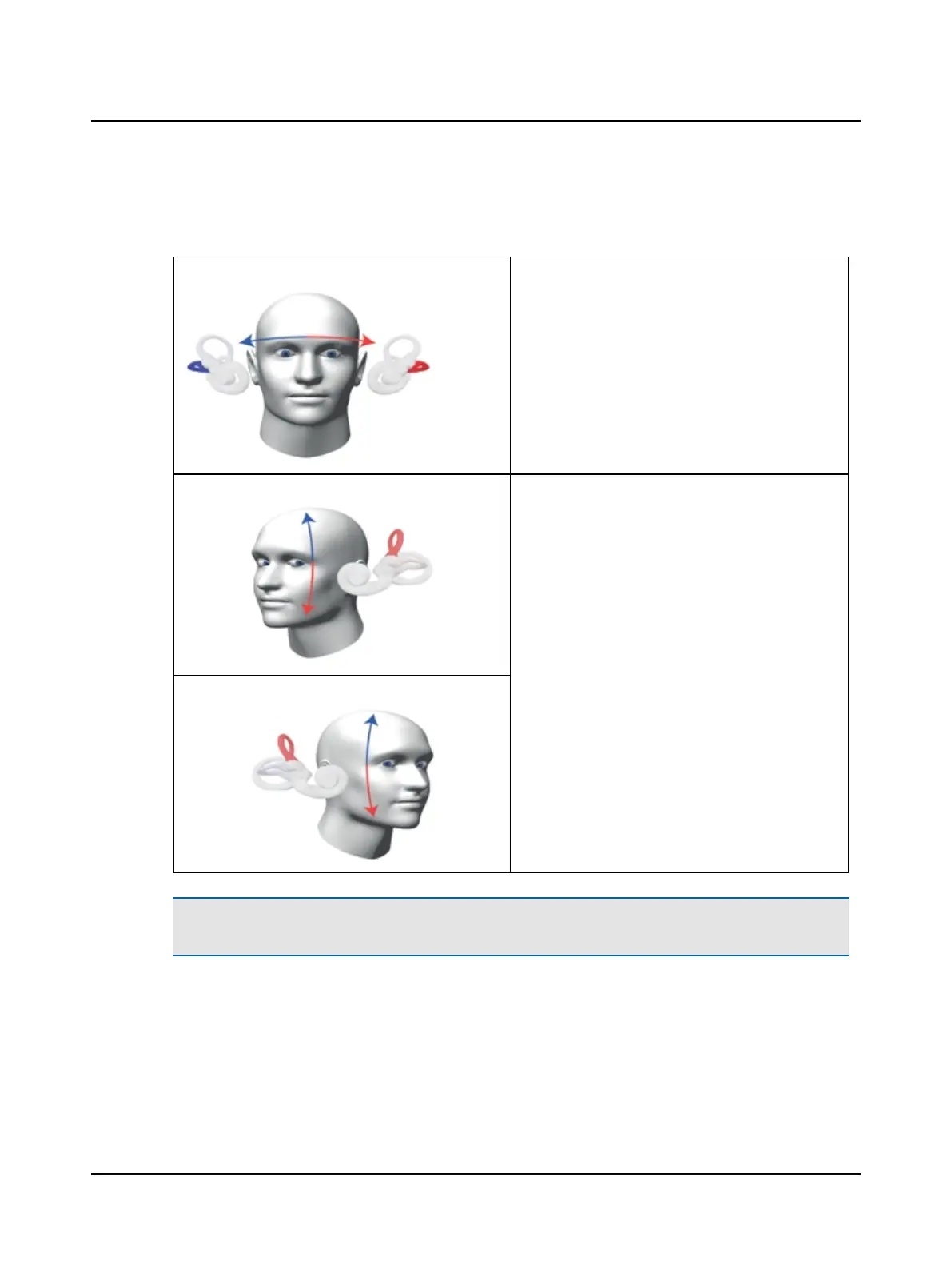
of the patient’s head and rotates the patient’s head vertically through a small angle in pitch (about 10-20 degrees) in a
brief, abrupt and unpredictable manner, varying the direction and the velocity. A head impulse downward stimulates the
right anterior canal. A head impulse upward stimulates the left posterior canal.
Lateral Head Impulse Stimulus
Displacement: 10-20°
Minimum Acceptable Peak Head Velocity: 120°/s – 250°/s
Peak Head Acceleration: 1200°/s
2
– 2500°/s
2
LARP Head Impulse Stimulus
Displacement: 10-20°
Minimum Acceptable Peak Head Velocity: 100°/s – 250°/s
Peak Head Acceleration: 1000°/s
2
– 2500°/s
2
RALP Head Impulse
Note• You can find more information in the ICS Impulse training video, at icsimpulse.com, or at www.-
headimpulse.com.
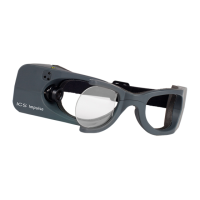
The goggles collect both head and eye data. The gyroscope measures the velocity of the head movement (the stimulus).
The high-speed camera captures the image of the eye. The OTOsuiteVestibular software processes the head velocity data
and velocity data for eye movement (the response).
Simultaneous displays of the data for head movement and for eye movement allow the clinician to determine if the
response is within normal limits or not.
Otometrics - ICS Impulse USB
53
9 Head Impulse




 To Next Page