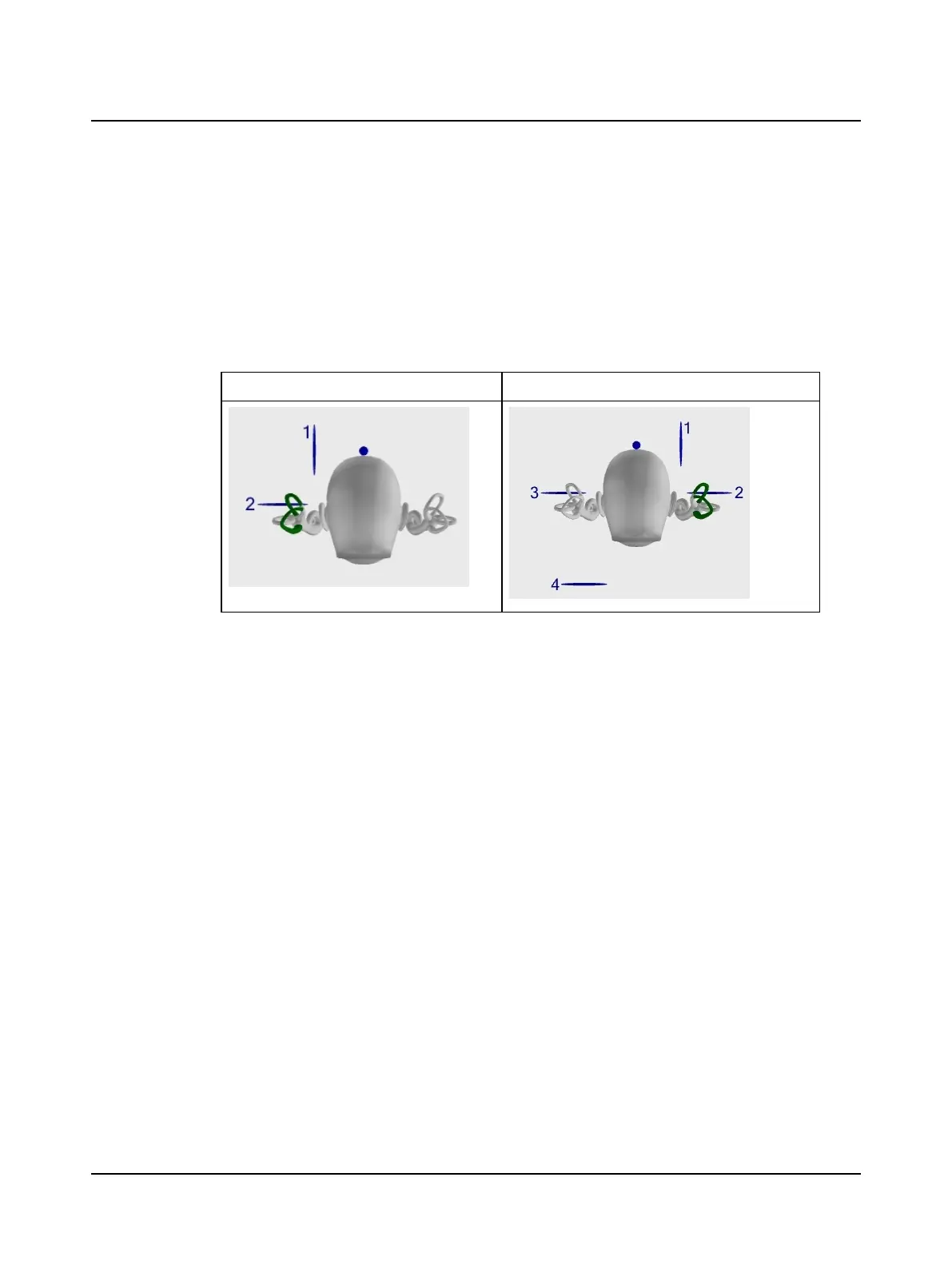
• Head Position Feedback
For SPV tests, the Head Position Feedback option is the default setting. When set to this option, a reference graphic
of the patient's head position in real time displays on the computer monitor. (For information about setting this
option, refer to the Reference Manual.)
– The semicircular canal(s) being tested or treated is highlighted in green.
– The blue dot is the reference point for the head.
– Numbered blue lines are the reference points specific for each test or maneuver.
– Movement of the patient's head, tracked by a sensor in the goggles, is reflected in the graphic.
Dix-Hallpike – Head Left Canalith Repositioning Treatment (CRT) - rightward
Move the patient's head aligning the blue dot with each successive numbered blue line according to the test or
treatment maneuver being performed.
10.6 Dynamic tests
In these tests, the goggles collect eye data. The high speed camera captures the image of the eye.The OTOsuiteVestibular
software processes the eye position data and calculates the slow-phase velocity (SPV).
The Dynamic tests provide the ability to assess nystagmus that occurs from dynamic changes in the patient’s body ori-
entation with respect to gravity. The patient typically begins in a sitting position and is moved into a position which will
align either the anterior/posterior or the lateral canals perpendicular to the floor and the canal(s) thus affected by gravity.
These tests are used to determine if a patient’s symptoms are caused by benign paroxysmal positional vertigo.
Dix-Hallpike or Hallpike-Stenger
This test assesses the anterior and posterior semicircular canals by recording the patient’s eye movement during the man-
euver. The ANSI standard recommends that this test be performed with vision denied. The patient is sitting. For both
tests, the head is turned 45° to the left or right depending on which side is being assessed.
Hallpike-Stenger
For this test an additional position is included with the head centered and facing straight. The patient is quickly laid back
with the head slightly hanging off the end of the exam table. The patient’s head is comfortably supported by the examiner
during the test. According to the ANSI standard, the eyes should be recorded for a minimum of 20 seconds in this position.
It is best to continue recording the eye movement until the nystagmus subsides. The patient is brought back up to the sit-
ting position and eye movement should again be recorded until nystagmus subsides.
82 Otometrics - ICS Impulse USB
10 Positional




 To Next Page