Video Playback buttons and selections
Stop
Stops the video
Play from Cursor
Select to start the playback at the position of the cursor. If not selected, play-
back starts at the beginning of the trace.
Speed
Note• Before setting the playback speed, check the recorded frame rate
(fps) stated below the eye video.
• Normal - eye video recorded at 30 frames per second can only be
played back at normal speed.
• Slow - eye video recorded at 60 frames per second can be played back
at normal or slow speed.
• Slower - eye video recorded at > 60 frames per second can be played
back at normal, slow, or slower speed.
8.9 VOR tests
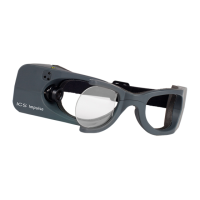
In these tests, the goggles collect both head and eye data. The gyroscope measures the velocity of the head movement
(the stimulus). The high speed camera captures the image of the eye. The OTOsuiteVestibular software processes the eye
and head velocity data (the response). Simultaneous displaysof the data for head movement and for eye movement allow
the clinician to determine if the response is within normal limits or not.
The VOR tests provide the ability to assess the vestibulo-ocular reflex (VOR) with visual enhancement and without visual
enhancement. The purpose of these two test types is to identify if catch-up saccades are present in either test condition.
The patient is in a sitting position 1 meter from the wall where the fixation target is fixed and the suppression target is pro-
jected.
VVOR (Visual VOR)
This test type assesses the patient’s vestibulo-ocular reflex with visual enhancement. The patient is asked to stare at the
fixed fixation dot on the wall. The person assessing the patient slowly moves the patient’s head at about 0.5 Hz and with an
amplitude of 10° in the horizontal plane or in the vertical plane. The patient should maintain fixation on the dot for the
duration of the test.
VORS (VOR Suppression)
This test type assesses the patient’s vestibulo-ocular reflex without visual enhancement. The patient is asked to stare at
the laser dot on the wall. This laser dot will move with the head. The person assessing the patient slowly moves the
patient’s head at about 0.5 Hz with amplitude of 10° in the horizontal plane or in the vertical plane. The patient should
continue to follow the laser dot for the duration of the test. This test may be performed in a darkened room.
Otometrics - ICS Impulse USB
35
8 Oculomotor




 To Next Page