Basic Instructions
2 − 67
Precautions during programming
When the label is written in an address before the LOOP instruction, be careful of the following points.
Be sure to have the instruction that sets the number of loop cycles before the area between the LBL and
LOOP instructions.
Set the instructions that will be repeated between LBL and LOOP so that they have the same trigger as the
LOOP instruction.
During repeating, it is possible that one scan can exceed the surveillance time for operation jams and cause a
operation bottleneck error.
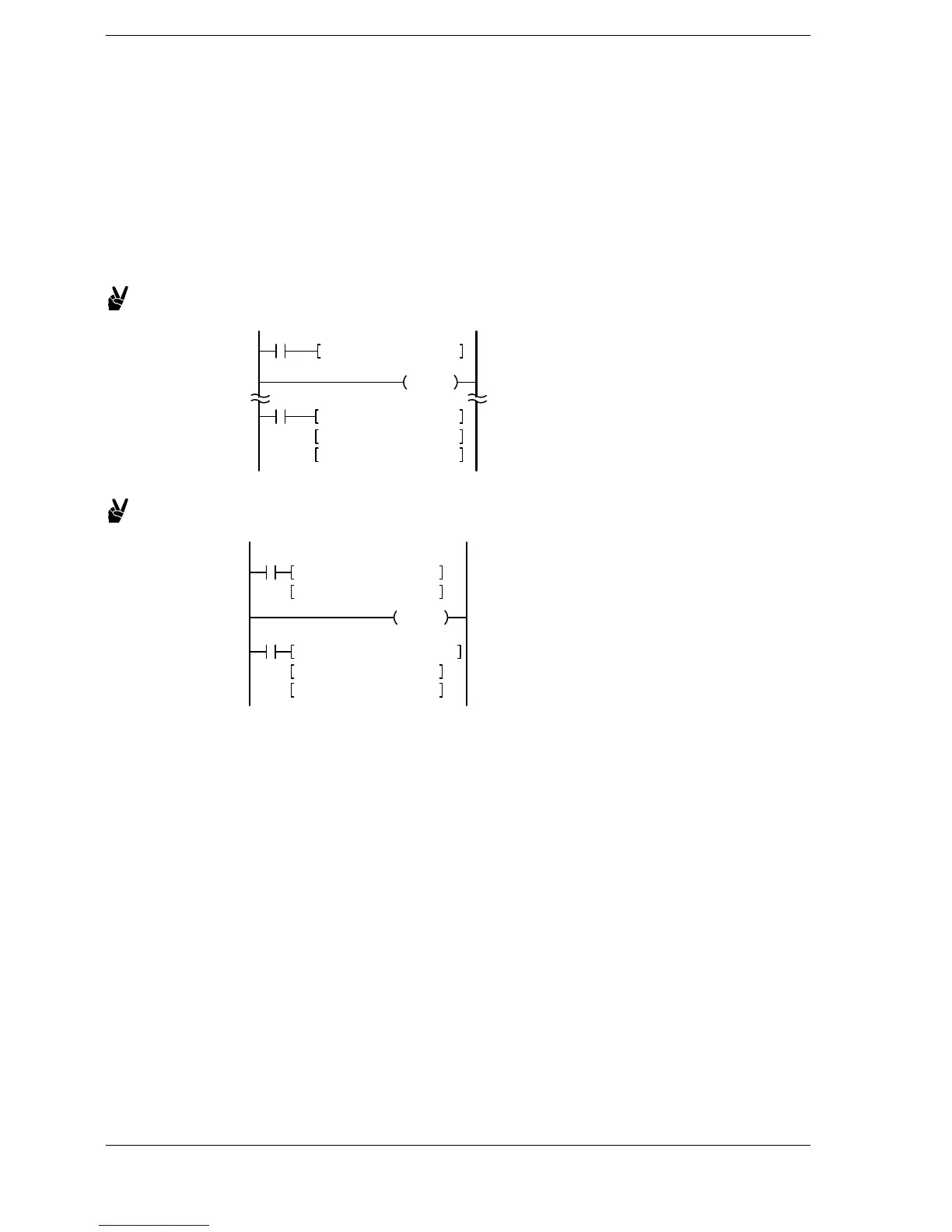
Example 1: Execute 5 times of both F0 (MV) instructions when X5 is on.
F0 MV, WR 0, DT 10
F0 MV, WR 1, DT 20
LOOP 10, DT 0
X5
LBL 10
X5
F0 MV, K 5, DT 0
Example 2: Send the value of DT100 to DT200 through DT219.
F0 MV, DT100, IXDT200
R0
LBL 10
R0
F0 MV, K 20, DT 0
F35 +1, IX
LOOP 10, DT 0
F0 MV, K 0, IX
The LOOP instruction and LBL instruction cannot be used in the step ladder area (the area between SSTP
and STPE).
You cannot perform a jump from a main program to a sub−program (a subroutine program or interrupt
program after the ED instruction), from a sub−program to a main program, or from a sub−program to another
sub−program.
You must be careful when using one of the instructions below, which are executed by detecting the leading
edge of execution condition (trigger) such as the differential instruction.
− DF (leading edge differential)
− Count input of CT (counter)
− Count input of F118 (up/down counter)
− Shift input of SR (shift register)
− Shift input of F119 (left/right shift register)
− NSTP (next step)
− Differential execution type high−level instruction (this instruction is specified by P and a number)





 To Next Page