High−level Instructions
3 − 539
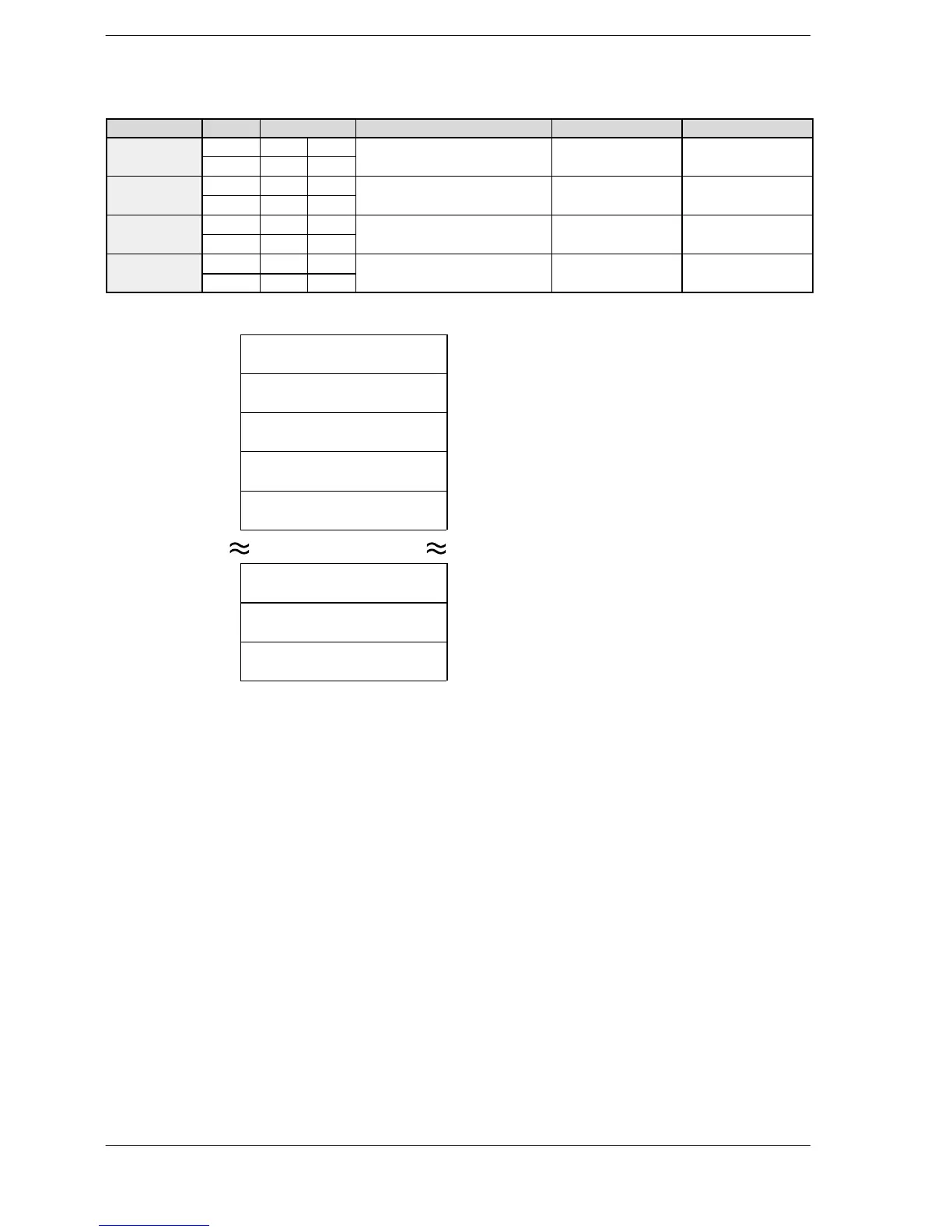
Pules output channels and areas used
Channel No. Output Output type Pulse output instruction flag Elapsed value area Target value area
DT90433
Setting the data table
S
S+1
Control code *1
S+2
S+3
Frequency 1 (Hz) *2
S+4
S+5
Target value 1 (No. of pulses) *3
S+2
S+3
Frequency 2 (Hz)
S+4
S+5
Target value 2 (No. of pulses)
S+2n
S+2n+1
Frequency n (Hz)
S+2(n+1)
S+2(n+1)+1
Targe value n (No. of pulses)
S+2(n+2)
S+2(n+2)+1
K0: fixed: Table end
Note: If the frequency “n” is set to a value larger than 50kHz, it will be corrected to 50kHz.
Note the following characteristics applied according to the value of frequency 1.
(1) When the frequency 1 is 1 or higher, and lower than 46Hz, the control up to the maximum frequency to the
degree of 10kHz can be performed.
If the frequency “n” is set to a value below 6Hz, it will be corrected to 6Hz.
(2) When the frequency 1 is 46 or higher, and lower than 184Hz, the control up to 50kHz can be performed.
If the frequency “n” is set to a value below 46Hz, it will be corrected to 46Hz.
(3) When the frequency 1 is 184 or higher, the control up to 50kHz can be performed.
If the frequency “n” is set to a value below 184Hz, it will be corrected to 184Hz.
FP0R





 To Next Page