EasyManua.ls Logo

Panasonic RX-C300 - Circuit Description

Panasonic RX-C300
20 pages
Print Icon
To Next Page IconTo Next Page
To Previous Page IconTo Previous Page
Loading...
5
DG
Ox
11)
0
teen
DG
Ox
10)
0)
CIRCUIT
DESCRIPTION
CP5-2(Rch)
CP4-2
Tape
Amp
O
IC
208
Power
IC
200
Q401—404,
e400
IC
209
its
BPF.
VR400—
404
;
4
Power
G.EQ
|
Ame
Circuit
|
Q600
Q6I7
Q50!—
504,
>
-
VR500
504
<|
G.EQ
Circuit
VR505
Total
Amp
_
VR405,505:
Volume,
VR6OI:
Balance
1C
205
e608
K
I2.5kHz
B.P.F.
1c
207
Sampling
Pulse
Generator
jouBIS
plsd
JaAlIQ
4019N
14
IC
206
IC204
|DUBIS
aAl4ig
juawbas
}OuUBIS
aAIUg
4aLaW
DC-AC
Converter
Q61l2
,613
T600
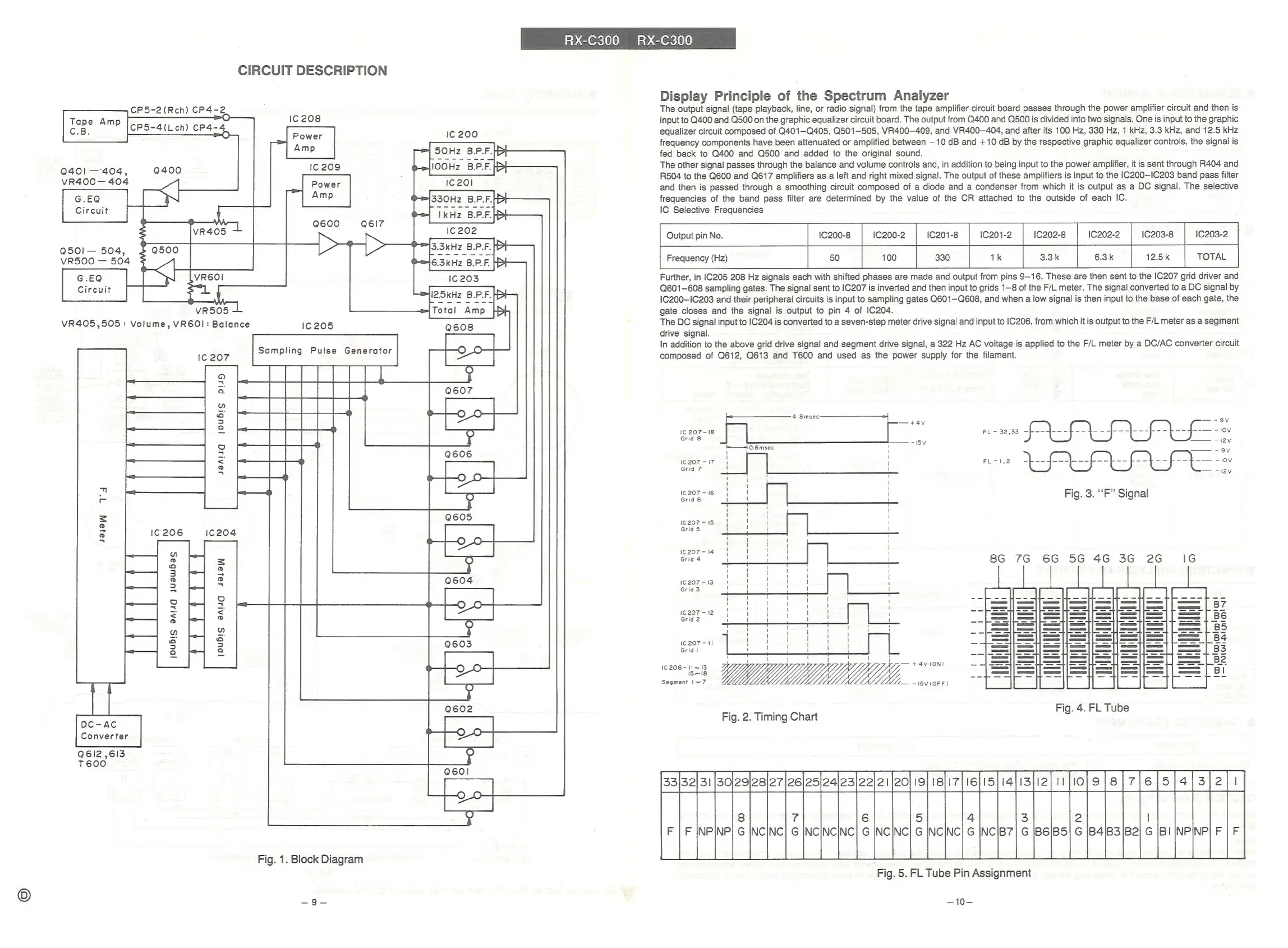
Fig.
1.
Block
Diagram
Display
Principle
of
the
Spectrum
Analyzer
The
output
signal
(tape
playback,
line,
or
radio
signal)
from
the
tape
amplifier
circuit
board
passes
through
the
power
amplifier
circuit
and
then
is
input
to
Q400
and
Q500
on
the
graphic
equalizer
circuit
board.
The
output
from
Q400
and
Q500
is
divided
into
two
signals.
One
is
input
to
the
graphic
equalizer
circuit
composed
of
Q401—Q405,
Q501—505,
VR400—409,
and
VR400—404,
and
after
its
100
Hz,
330
Hz,
1
kHz,
3.3
kHz,
and
12.5
kHz
frequency
components
have
been
attenuated
or
amplified
between
—10
dB
and
+10
dB
by
the
respective
graphic
equalizer
controls,
the
signal
is
fed
back
to
Q400
and
Q500
and
added
ito
the
original
sound.
The
other
signal
passes
through
the
balance
and
volume
controls
and,
in
addition
to
being
input
to
the
power
amplifier,
it
is
sent
through
R404
and
R504
to
the
Q600
and
Q617
amplifiers
as
a
left
and
right
mixed
signal.
The
output
of
these
amplifiers
is
input
to
the
|C200—-1C203
band
pass
filter
and
then
is
passed
through
a
smoothing
circuit
composed
of
a
diode
and
a
condenser
from
which
it
is
output
as
a
DC
signal.
The
selective
frequencies
of
the
band
pass
filter
are
determined
by
the
value
of
the
CR
attached
to
the
outside
of
each
IC.
IC
Selective
Frequencies
Output
pin
No.
1C200-8
1C200-2
1C201-8
1C201-2
IC202-8
1C202-2
1C203-8
1C203-2
Further,
in
1C205
208
Hz
signals
each
with
shifted
phases
are
made
and
output
from
pins
9-16.
These
are
then
sent
to
the
|C207
grid
driver
and
Q601—608
sampling
gates.
The
signal
sent
to
C207
is
inverted
and
then
input
to
grids
1—8
of
the
F/L
meter.
The
signal
converted
to
a
DC
signal
by
IC200-IC
203
and
their
peripheral
circuits
is
input
to
sampling
gates
Q601—Q608,
and
when
a
low
signal
is
then
input
to
the
base
of
each
gate,
the
gate
closes
and
the
signal
is
output
to
pin
4
of
IC204.
The
DC
signal
input
to
1C204
is
converted
to
a
seven-step
meter
drive
signal
and
input
to
1C206,
from
which
it
is
output
to
the
F/L
meter
as
a
segment
drive
signal.
In
addition
to
the
above
grid
drive
signal
and
segment
drive
signal,
a
322
Hz
AC
voltage
is
applied
to
the
F/L
meter
by
a
DC/AC
converter
circuit
composed
of
Q612,
Q613
and
T600
and
used
as
the
power
supply
for
the
filament.
4.8msec
IC
207-18
FL
-
32,33
--H--4---+--+---]---]---F--
Grid
8
1
:
|
|
ic207-17
1
'
FL-1,2
Grid
7
'
|
1
t
!
1
i
I
Ic207-16
|
'
Grid
6
| !
i
bresiini
cet
C207
152)
4
|
1 !
Grid
5
1
!
1
I
1
H
t
'
|
i
|
Ic207-
14
|
|
4
1
'
Grid
4
1
|
| I
1
|
!
eH
1 !
I
I
|
|
1
|
Ic207-13
|
\
\
\
Grid3
| |
i
'
1
H
1
|
Bes
\ !
\
ic2zo7-12
|
|
1
:
--
Grid
2
1
|
:
\
oe
7
1
:
\
,
\
|
I
H
|
Fig.
3.
‘‘F”
Signal
8G
7G
6G
5G
4G
3G 2G
IG
Ic207-11
Grid
|
t
WY
WM.
Fig.
2.
Timing
Chart
:
1@,olwolo!wio!
1—
NIGI
SII
OIA
Fig.
4.
FL
Tube
33)82|
31
|solecies|e7
|26|e5|2q[e3|29|21
|20]
19]
18|17/16|15]
14]
13|12|
1
[10]
9|8|7]6
[5
]4|
3]
2]
8
i
6
5
4
3 2
|
Foe
G
|NC|NC]
G
|NC|NC|NC}
G
|NC/NC]
G
|NC/NC}
G
|NC/B7|
G
B5|G
B3|B2|
G
F
Fig.
5.
FL
Tube
Pin
Assignment
ch
—~10—

Related product manuals