
 Need help?
Do you have a question about the Panasonic SB-HW750P and is the answer not in the manual?
Details speaker type, impedance, power, sensitivity, frequency, dimensions, and mass.
Contains notes on specification changes and measurement methods.
Lists speaker combinations for different main unit systems (K and S models).
Directs users to other manuals for packaging details.
Lists and introduces disassembly sections for net frame and woofer.
Provides a visual guide for the disassembly process.
Step-by-step instructions for removing the net frame assembly.
Step-by-step instructions for removing the woofer unit.
Instructions, diagrams, and notes for correct speaker cable connection to the main unit.
Recommendations for optimal positioning of subwoofer, front, center, and surround speakers.
Guidance for wireless system placement and avoiding interference with other devices.
Notes on using supplied speakers, volume levels, and avoiding damage.
Explains potential TV picture interference from speakers and how to resolve it.
A diagram illustrating the polarity and connection of wires to the woofer.
An exploded view showing the location of cabinet parts with reference numbers.
Lists replacement parts with part numbers and descriptions, including a safety notice.
The SB-HW750P is a subwoofer, part of a larger speaker system designed to enhance the audio experience of a home theater setup. This service manual provides comprehensive information for experienced repair technicians, covering system combination, assembly, disassembly, wiring, and replacement parts.
The SB-HW750P functions as a dedicated subwoofer within a Panasonic home theater system. Its primary role is to reproduce low-frequency sounds, commonly known as bass, which are crucial for a rich and immersive audio experience, especially in movies and music. By handling the lower end of the audio spectrum, the subwoofer offloads this task from the main speakers, allowing them to focus on mid-range and high-frequency sounds, resulting in clearer and more dynamic overall sound. The subwoofer is designed as a 1-way, 1-speaker bass reflex system, meaning it uses a single driver and a port to enhance bass output. It is available in two color variations: black (K) and silver (S), to match different aesthetic preferences and system configurations.
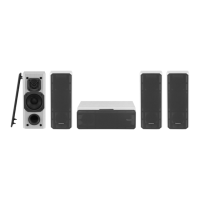
The SB-HW750P is typically integrated into larger speaker systems such as the SB-PT750P-K or SB-PT650P-S, which include front, surround, and center speakers, along with a music center and a digital transmitter/receiver system. This modular approach allows for flexible system configurations tailored to various room sizes and user preferences. The subwoofer connects to the main unit of the home theater system via speaker cables, ensuring proper signal transmission for optimal bass reproduction.
When setting up the SB-HW750P, proper positioning is key to achieving the best sound quality. The manual advises placing the subwoofer to the right or left of the television, on the floor or a sturdy shelf, to prevent vibration. It's also recommended to maintain a distance of about 30 cm (11 13/16") from the television. Placing speakers too close to floors, walls, and corners can lead to excessive bass, so experimentation with placement is encouraged. For optimal ventilation, the subwoofer should be positioned at least 10 mm (13/32") away from the system.
Connecting the subwoofer to the main unit involves specific steps to ensure correct polarity and prevent damage. Users are instructed to twist and pull off the vinyl tips of the speaker cords (if present) or connect bare wires directly to the terminals. It is crucial to connect positive (+) wires (white) to positive (+) terminals and negative (-) wires (blue) to negative (-) terminals. Reversing polarity or short-circuiting the speaker wires can damage the speakers and the amplifier. The manual emphasizes using only the supplied speakers to avoid damage to the unit and ensure optimal sound quality.
The system also highlights the importance of managing volume levels to prevent damage to the speakers. Users should reduce volume when playing distorted sound, when speakers are reverberating due to external sources (like record players or FM broadcasts), when adjusting sound quality, or when turning the unit on or off.
In cases where irregular coloring occurs on a television screen due to the proximity of the speakers, users are advised to turn off the television for about 30 minutes to allow its demagnetizing function to correct the problem. If the issue persists, moving the speakers further away from the television is recommended. The manual also provides warnings against attaching these speakers to walls using methods other than those described, and advises against touching the front netted area of the speakers, instead holding them by the sides.
The service manual is primarily intended for experienced repair technicians, detailing procedures for internal inspection and component replacement. For reassembly after checks or replacement, technicians are instructed to reverse the disassembly procedures. Special reassembly procedures are described only when necessary.
Disassembly of the SB-HW750P involves a systematic approach, starting with the net frame assembly and then proceeding to the woofer. To disassemble the net frame assembly, a flathead screwdriver is inserted above the cloth at the grooves, and light force is applied along the bosses to push up the assembly. For the woofer, four screws are removed, and then the blue (-) and white (+) wires are detached. The manual includes a disassembly flow chart to guide technicians through the process.
When replacing components, technicians are reminded to use only manufacturer-specified parts as listed in the replacement parts list. This ensures compatibility and maintains the performance and safety standards of the device. The parts list includes items such as the speaker box assembly, net frame assembly, EVA packing, leg cushions, specification labels, screws, and the woofer unit itself. Important safety notices are included, warning technicians about sharp edges on chassis components and the need for careful handling during servicing. The manual also reiterates that unauthorized copying and distribution of the service information is a violation of law, underscoring its professional and restricted use.
 General
| Bluetooth | Yes |
|---|---|
| HDMI Input | 1 |
| Optical Input | 1 |
| Wall Mountable | Yes |
| Remote Control | Yes |
| HDMI Output | 1 (ARC) |




 To Next Page