Brought to you by PCS Electronics, www.pcs-electronics.com
Appendix B: General tips for setting up transmitters
Typical FM transmitter setups
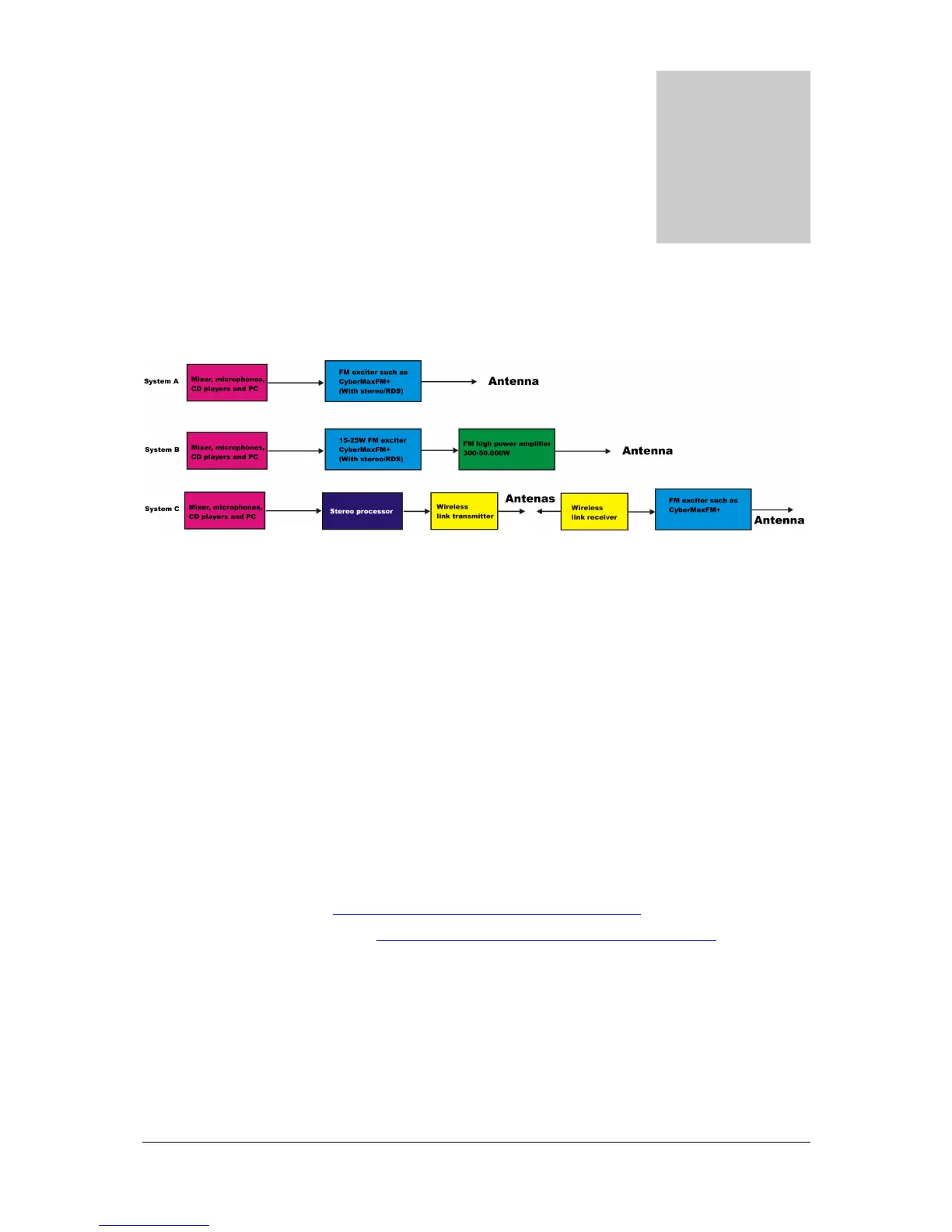
Below are several of the typical broadcasting systems that can be encountered worldwide.
Fig. 19: Typical broadcasting systems
Lets look at system A first. It consists of audio source (mixer, microphones, CD players and a PC), FM exciter with
integrated RDS and stereo encoder (such as our CyberMaxFM+ units from 15W-300W) and antenna. Note antenna in this
system is located in the same location as the transmitter and studio, typically it would be placed on a small tower or a pole at
the top of the building with studio. Disadvantage of this system is that you have to keep studio, transmitter and antenna
close. Now you usually can’t place studio on the top of a mountain for practical reasons so this limits your range. This is a
typical small community radio with output powers of up to 300-500W.
System B is very similar to system A, but operators have decided to add an additional amplifier to boost the range. Such
stations can go into kilowatts, but they are starting to hit another speed limit. Since the studio is typically located in a town,
high RF powers aren’t desirable due to interference with other services and safety regulations. So range is still limited
compared to system C stations.
System C is radically different in one respect. Antenna and transmitter are no longer located at the same place with the
studio. To accomplish this the two audio channels are first combined with stereo processor. Resulting MPX signal is than
passed to the STL wireless link transmitter (STL=Studio Transmitter Link). Up in the mountains is a STL wireless link
receiver that receives the signal from the studio and passes I to the exciter. In this case exciter does not need to be stereo
anymore since composite MPX signal is passed to its MPX input (all mono transmitters have this input). Such exciters can
than optionally drive big amplifiers with powers going into tens of KW with maximum range.
You can check our amplifiers here: http://www.pcs-electronics.com/fm-amplifiers-c-41.html
You can check our wireless STL links here: http://www.pcs-electronics.com/wireless-audio-links-c-42.html


 To Next Page