Coating Thickness Range
Applied coats should be cured, thickness tested, visually inspected and
accepted – before high voltage porosity testing is carried out. Coating
thickness should be above 150µm; coatings below this thickness
should be tested with a wet sponge unit.
2.0 OPERATION
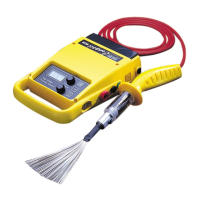
Connect the probe and earth leads to the unit. Connect the earth clamp
to the metallic substrate of the item to be tested – substrate should be
earthed to ground. Select the probe best suited for the test and attach
to the probe handle.
Fit the Fuse (if not already fitted).
Turn the unit on.
Check the batteries to ensure that they are charged.
Turn the voltage control clockwise to the required test voltage.
Note: If the neon is in place allow an additional 200v.
Place the probe near the metal substrate.
A spark should occur (if not re-check all leads and connections).
Place the probe on the surface to be tested.
Re-check the output – adjust if necessary. Turn alarm sensitivity until
the alarm is just off.
Place the probe on the coated surface and move at approximately one
metre per four seconds.
A fault is indicated by:
A spark at the probe – this can usually be seen and heard.
A light flashes on the front panel of the unit.
An audible sound – buzzer is mounted inside the unit.
Digital test voltage drops drastically.
The neon in the probe flashes.
Note: A definite flaw should be made in the coating and located with
the designated test voltage, therefore proving that the unit is locating
the type of fault you wish to find.
Probes must be kept in full contact with the surface, gaps in or between
the probe and the coating may result in flaws going undetected.
Wire brushes, rubber and coil spring probes should all be kept in good
condition. Probes other than fine wire brushes may require higher
voltages.
Wet and contaminated coatings should not be tested until dry and
clean (see also troubleshooting pages).
5


 To Next Page