5.0 VOLTAGE RECOMMENDATIONS
AS 3894.1 recommends minimum voltages for testing specified
thickness of film of various Coating Products
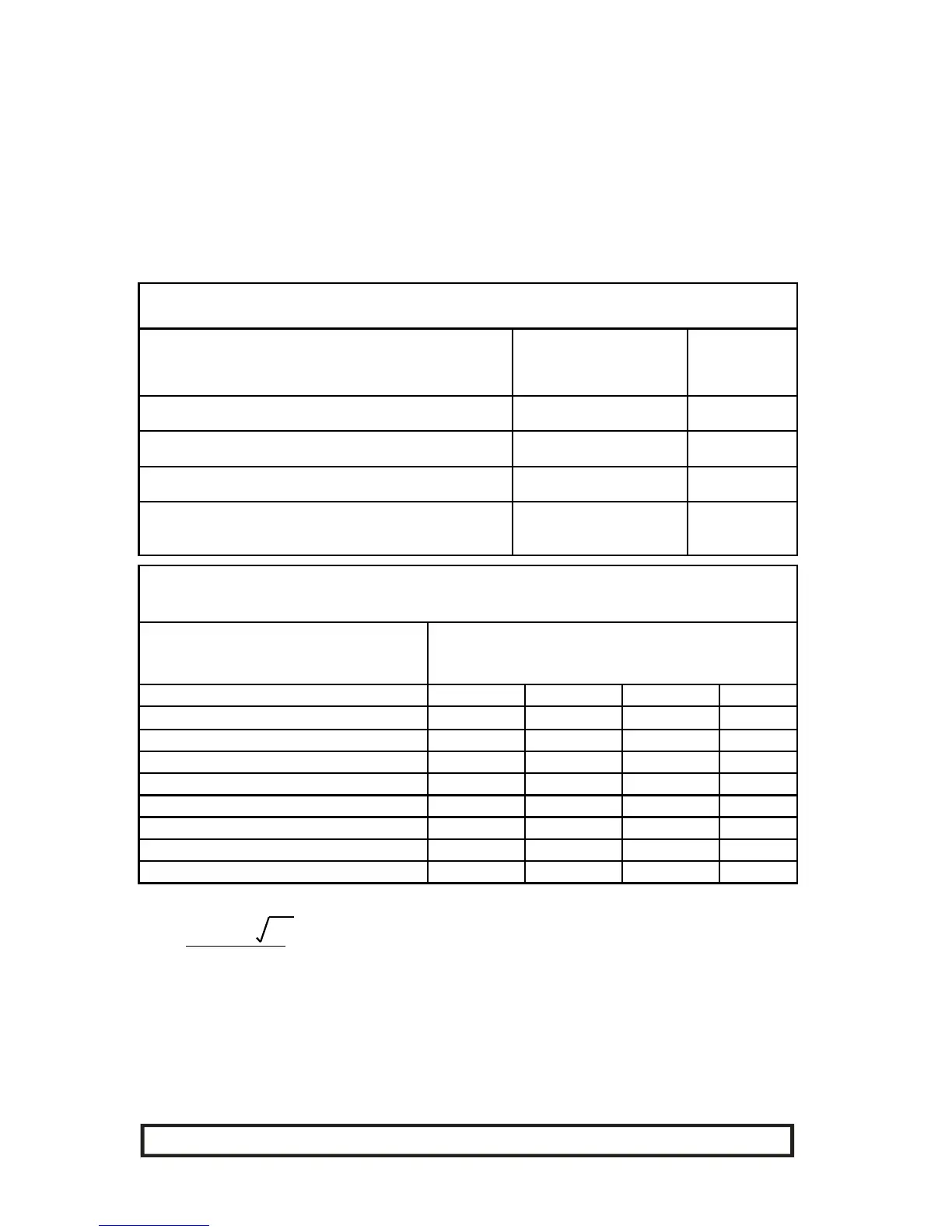
Tables 1 and 2 below provide guidance for determination of minimum
voltage for high voltage porosity testing of the indicated generic types of
coating products, at the indicated dry film thicknesses which may
contain residual solvents.
V = minimum test voltage applied in volts
T = dry film thickness of cured coating in microns
F = a whole number factor which rates a coating’s generic
type and residual solvent content (Table 1)
The above minimum test voltages have been derived from Australian
Standard AS3894.1; the whole of this Standard should be used. The
above voltages relate to the following: the detector should have a direct
earth connection to the substrate and a fine wire brush electrode must be
connected to the probe.
ALLOW AN ADDITIONAL 200 VOLTS IF THE NEON IN THE PROBE HANDLE IS IN USE.
Table 1. Determination of the coating film rating (F) from coating type and
volume solids content.
Generic Type of Coating
Volume Solids %(V/V)
Volume Solids
%(V/V)
Factor (F)
Factor
(F)
Chorinated Rubber, Vinyl
15 to 39 4
Low Build Epoxy, some Tar Epoxy
40 to 59 3
High Build Epoxy, some Tar Epoxy
60 to 79 2
Polyester/Vinyl esters, Solventless Epoxy,
Fusion-bonded Epoxy.
80 and greater 1
Table 2. Determination of the test voltage (V) from dry film
thickness (T) and coating material rating (F).
Nominal dry film thickness in
microns
Test Voltage (kV)
F=1 F=2 F=3 F=4
150 3.06 1.53 1.01 0.77
250 3.96 1.98 1.32 0.99
400 5.00 2.50 1.67 1.25
600 6.12 3.06 2.04 1.53
800 7.07 3.54 2.36 *
1500 9.69 4.84 * *
2500 12.50 * * *
4000 15.81 * * *
V = 250 x T
F
8


 To Next Page