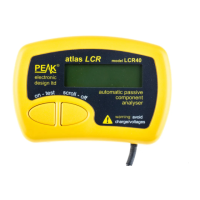
Atlas LCR User Guide April 2012 – Rev 5
Page 6
Probe Compensation
If you change the probes on your Atlas LCR, it is good practice to run through
the short compensation procedure. This ensures that the probes' own
inductance, capacitance and resistance is automatically taken into account for
subsequent measurements.
Before you start the compensation procedure, attach a
small length of tinned copper wire between the two test
probes. Now let the leads rest on a non-conductive
surface, try not to touch them during the compensation
procedure.
Now press and hold on-test until the
following is displayed:
After a short delay, the unit will prompt
you to short the probes together. As you
have already shorted the probes with the
piece of wire, the Atlas LCR will then
ask you to open the probes.
Now simultaneously unclip the both
probes from the small length of wire and let the leads rest without touching
them.
If this procedure has been successful, the unit will display “OK” and then
switch off.
At this point the parasitic and stray characteristics associated with the test
leads (and indeed the Atlas LCR itself) will be stored in non-volatile memory.
All further tests will have these values subtracted from the measured values,
therefore displaying the characteristics of the component alone.
Please note that probe compensation is particularly important when
analysing low value inductors, capacitors and resistors.
Please short
Please shortPlease short
Please short
the probes
the probesthe probes
the probes



 To Next Page