
 Need help?
Do you have a question about the Pentax IQZoom 135 M and is the answer not in the manual?
Explains visual symbols used in the manual for operation, attention, and status.
Highlights precautions to prevent serious injury to the operator if not followed.
Highlights precautions to prevent minor/medium injury or equipment damage if not followed.
Guidelines for protecting the camera from water, drops, vibrations, and condensation.
Advice on storing the camera in a cool, dry place, avoiding high humidity.
Instructions on cleaning the lens, viewfinder, and camera body using appropriate tools.
Covers operating temperature range, warranty limitations, and LCD behavior in temperature extremes.
Explains how the LCD panel may react to high or low temperatures.
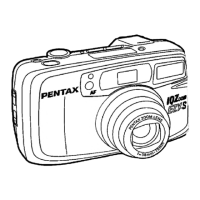
Diagram and list identifying key parts of the camera.
Details the various symbols and readouts on the camera's LCD panel, including data, exposure, and warnings.
Instructions on how to properly attach the camera strap.
Step-by-step guide for inserting and securing the camera battery.
Explains the battery symbol on the LCD and when to replace the battery.
Instructions on how to use the main switch to turn the camera on and off.
Explains frames like Spot AF, Multi-focus, and close distance compensation.
Details on AF frames and close distance compensation frames.
Explains the meaning of the green (focus) and red (flash) lamps.
Guide on how to adjust the diopter for clear viewfinder vision.
Step-by-step instructions for correctly loading a film cartridge.
How the camera automatically sets film speed for DX-coded films.
Instructions for rewinding the film roll and unloading the cartridge.
How to rewind the film before the roll is finished.
Advice on holding the camera steady for sharp photos, especially with flash.
Information on the camera's standard shooting range from infinity to 0.8m.
How to use the zoom buttons to adjust focal length.
How to compose shots and use the autofocus system.
Explains the red light used to assist autofocus in difficult conditions.
Lists subjects or conditions that may be difficult for autofocus.
How to use the mode for distant scenes or through windows.
Procedure to select Spot AF mode and focus on a particular area.
How to achieve and maintain focus on a specific subject.
Instructions on switching to and using panorama format.
How to choose between various flash modes like Auto, Daylight-Sync, etc.
How to use the dedicated button to reduce red-eye effects.
Table showing flash effective range based on ISO and focal length.
How to use flash for fill-in lighting in daylight situations.
Covers shooting modes like Single-Frame, Self-Timer, Remote Control, and focusing modes.
Using slow shutter speeds without flash for low light or ambient effects.
Balancing subject and background exposure with flash and slow shutter.
For long exposures like fireworks and night scenes.
Using flash with Bulb Mode for portraits against night scenes.
How to use the self-timer to include yourself in photos.
Methods to stop the self-timer after activation.
Details on using the remote control, including its parts and how to operate it.
How to compose and shoot using the remote control.
Information regarding FCC compliance and potential interference guidelines.
How to cycle through Year/Month/Day and other date formats.
Information on how data is imprinted on film and special indicators.
Step-by-step guide to set the camera's date and time accurately.
Remedies for when the shutter button does not function.
Solutions for blurry or unclear printed pictures.
Explains why the lens retracts and power turns off automatically.
Solutions for issues with the wireless remote control not operating.
Explains why the flash might discharge when not expected.
Comprehensive list of camera specifications, including type, film, format, lens, and viewfinder.
Details on returning the camera for service within the warranty period.
Information regarding FCC compliance and potential interference guidelines.
 General
| Brand | Pentax |
|---|---|
| Model | IQZoom 135 M |
| Category | Digital Camera |
| Language | English |



 To Next Page