Need help?
Do you have a question about the Phcbi MBR-305GR and is the answer not in the manual?
PHC Corporation's warranty conditions and liability limitations for product contents.
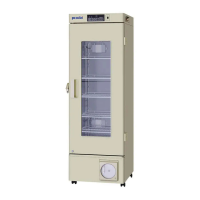
Details the equipment's design for blood storage and suggests a remote alarm system.
Explains the meaning of warning and prohibition symbols used in the manual for safe operation.
Covers warnings related to installation location, environmental conditions, and stability.
Details electrical safety, handling of power cords, and operational safety measures.
Covers precautions for moving, long-term storage, and child safety to prevent accidents.
Highlights specific cautions, dedicated circuits, and pre-operation checks for safe use.
Details hazard labels found on the unit, their types, locations, and descriptions of danger.
Explains the meaning of various symbols attached to the unit for user guidance.
Lists the required environmental conditions for safe and optimal operation of the equipment.
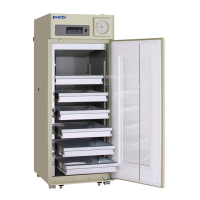
Illustrates the main parts of the refrigerator unit with numbered components for identification.
Provides detailed explanations for each numbered component of the refrigerator unit.
Details the layout, indicators, and function keys of the refrigerator's control panel for operation.
Specifies ideal locations for unit installation, considering sunlight, ventilation, heat, and humidity.
Covers unpacking, cleaning, levelling, securing the unit, and earthing for safe installation.
Step-by-step instructions on preparing monitor bottles with fluid for accurate temperature measurement.
Outlines the steps for the initial start-up of the refrigerator unit and post-operation checks.
Instructs on proper placement of items to ensure adequate airflow and prevent temperature issues.
Explains how to change the displayed temperature from upper, lower, to average readings.
Describes the two automatic defrosting methods: cycle defrost and forced defrost.
Details how to connect a remote alarm device for remote monitoring of alarms.
Identifies and explains the various parts and functions of the temperature recorder unit.
Step-by-step instructions for loading a new pen cartridge into the temperature recorder.
Guides on how to set the start time and replace the recording chart for the temperature recorder.
Lists the different alarms (high-temp, low-temp, power-failure, door) and their corresponding situations.
Explains self-diagnostic functions for sensor abnormalities, battery, and fan motor issues.
Details procedures for cleaning the unit and checking the alarm operation periodically.
Step-by-step instructions for replacing the fluorescent lamp in the refrigerator chamber.
Guides on replacing the glow starter and the battery for the power-failure alarm.
Advises performing temperature calibration annually and contacting the representative for service.
Lists common issues like no operation, alarms, noise, and temperature problems with their remedies.
Provides information on recycling the unit's battery and decontaminating the unit before disposal.
Explains disposal of electrical products and batteries in EU countries with recycling systems, referencing symbols.
Details the technical specifications of the Blood Bank Refrigerator MBR-305GR.
Provides performance data including storage temperature, ambient temperature range, and power consumption.
A safety check sheet to be filled out before servicing the unit for engineer and user safety.
 General
| Brand | Phcbi |
|---|---|
| Model | MBR-305GR |
| Category | Laboratory Equipment |
| Language | English |

 To Next Page